When my seven-year-old daughter, Ava, climbed into my bed that Tuesday night, I assumed she wanted another bedtime story.
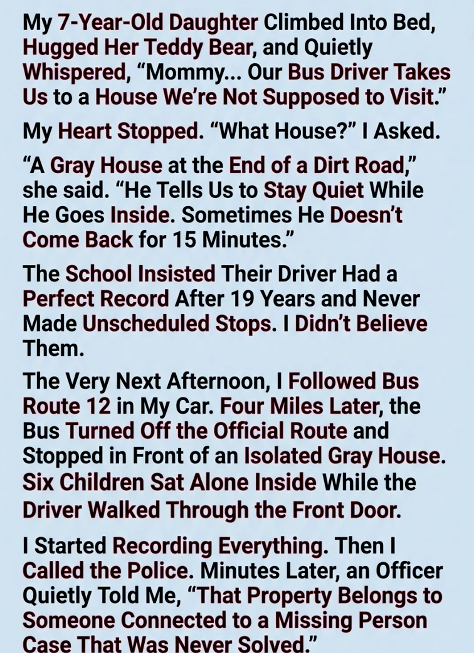
Instead, she hugged her teddy bear tightly and whispered,
“Mommy… our bus driver takes us to a house we’re not supposed to visit.”
I sat up immediately.
“What house?”
She looked toward the bedroom door before answering.
“A gray house at the end of a dirt road.”
“What happens there?”
“He tells us to stay quiet.”
“Then he goes inside.”
“For how long?”
“Sometimes fifteen minutes.”
My stomach tightened.
“Does anyone else go inside with him?”
She shook her head.
“No.”
“The little kids just wait.”
“Has this happened before?”
“A lot.”
“Missy says we’re not supposed to tell because Mr. Carter gets sad when people ask questions.”
I didn’t sleep much that night.
…
The next morning, I called the school transportation office.
The supervisor sounded surprised.
“Our GPS records show no unauthorized stops.”
“The driver has been with us for nineteen years.”
“He has an excellent safety record.”
“Are you certain your daughter isn’t imagining this?”
I thanked her politely.
But something didn’t sit right.
Children sometimes misunderstand what they see.
They also sometimes notice things adults overlook.
I decided to find out for myself.
…
The following afternoon, I parked several blocks away from the school.
When Bus Route 12 pulled out, I followed at a safe distance.
For nearly twenty minutes, everything looked normal.
Children got off at their regular stops.
Traffic moved slowly through town.
Then, instead of continuing along the published route, the bus signaled and turned onto an unpaved road.
I checked the route map on the school district’s website.
This road wasn’t on it.
Four miles later, the bus stopped in front of an aging gray farmhouse.
Exactly as Ava had described.
Through binoculars, I counted six children still seated inside.
The driver stepped off the bus.
Walked to the front porch.
Knocked once.
Then disappeared inside.
I immediately began recording video on my phone.
After several minutes, I called 911.
I explained exactly what I was seeing.
The dispatcher asked me to remain where I was and avoid approaching the bus.
Within minutes, two patrol cars arrived without lights or sirens.
One officer quietly joined me behind my vehicle.
He watched through binoculars.
Then his expression changed.
Very quietly, he said,
“That property belongs to the brother of someone connected to a missing-person investigation from years ago.”
My heart pounded.
“Do you think the children are in danger?”
He answered honestly.
“We don’t know.”
“But we’re going to find out.”
…
Additional officers arrived.
They positioned themselves where they could safely observe without alarming the children.
Then the front door opened.
An elderly woman stepped onto the porch using a walker.
Behind her came the bus driver.
He wasn’t carrying boxes.
He wasn’t hiding anything.
He was pushing a wheelchair.
In it sat an elderly man attached to portable oxygen.
The officer beside me lowered his binoculars.
“I know him.”
“You do?”
He nodded slowly.
“That’s Walter Evans.”
“He disappeared from public life after his wife vanished nearly twenty years ago.”
Another detective who had just arrived quietly corrected him.
“Not exactly.”
“He was questioned during the investigation because his wife disappeared.”
“He was never charged, and the case remained unsolved.”
The officer nodded.
“Right.”
“I remember now.”
…
The detectives approached calmly.
After identifying themselves, they spoke with the bus driver.
His explanation surprised everyone.
Years earlier, while driving the same route, he’d noticed the elderly couple struggling to carry groceries.
Over time, he began checking on them after completing the afternoon portion of his route.
When Walter’s health declined and his sister moved in to care for him, the driver occasionally stopped briefly to deliver medication, groceries, or meals donated by local volunteers.
He admitted he should never have deviated from the approved route or left children unattended on the bus.
“I thought I was helping,” he said quietly.
“I never imagined how it looked.”
School policy clearly prohibited leaving students unsupervised during the route.
The district later acknowledged that its GPS monitoring process had failed to flag the repeated deviations and announced an internal review of transportation procedures.
The officers confirmed the children were safe, and another qualified driver was sent to complete the route.
…
As for the old missing-person case, detectives explained that the brief stop gave them a legitimate opportunity to speak again with Walter and review old information.
They also made it clear that the investigation remained unresolved and that nothing about that afternoon established anyone’s guilt.
Sometimes old cases are reopened because of new information.
Sometimes they simply remind investigators to look again.
In this instance, no evidence linked the children or the bus stop to the disappearance.
The two situations had only crossed paths by coincidence.
…
The following week, the school superintendent called a meeting with parents.
New transportation rules were announced.
No unscheduled stops.
Real-time route monitoring.
Immediate notification if a bus deviated from its assigned path.
The superintendent also thanked the parent who had reported the concern.
“I’d rather investigate one hundred reports that turn out to be harmless than ignore the one that isn’t.”
I appreciated that answer.
…
That evening, I tucked Ava into bed.
She looked worried.
“Is Mr. Carter in trouble?”
I chose my words carefully.
“He made a decision that wasn’t safe.”
“Adults have rules too.”
“Did I do something bad by telling you?”
I kissed her forehead.
“No.”
“You did exactly the right thing.”
“If something feels strange or makes you uncomfortable, you should always tell a grown-up you trust.”
She smiled.
“I thought maybe nobody would believe me.”
“I’ll always listen.”
Looking back, the biggest surprise wasn’t the gray house.
It wasn’t the old investigation.
It wasn’t even the bus driver’s explanation.
It was realizing how important it is to take children’s concerns seriously without rushing to conclusions.
A little girl’s quiet bedtime story uncovered an unsafe practice that needed to stop.
And while it didn’t solve a decades-old mystery, it reminded everyone involved of something even more important:
Protecting children begins by listening when they find the courage to speak.