The day my son was born should have been the happiest day of my life.
Instead…
It became the beginning of the greatest mistake I would ever make.
When the nurse placed him in my wife’s arms, everyone cried.
Everyone except me.
The doubt had been growing for months.
People told me I was imagining things.
My friends said I was overthinking.
But once suspicion finds a place to live, it doesn’t leave quietly.
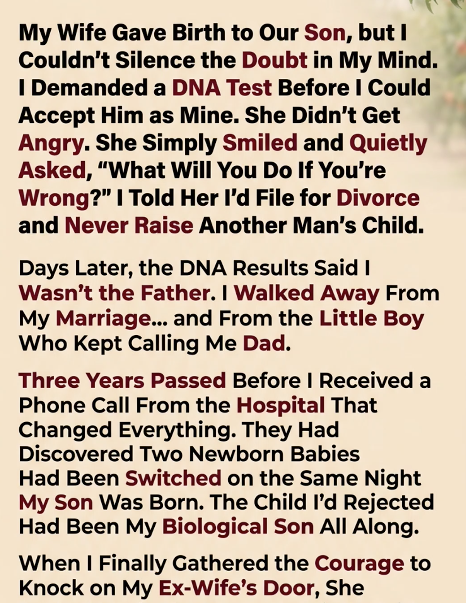
On the second day after the birth, I looked at my wife, Emily, and said the words that destroyed our family.
“I want a DNA test.”
The room fell silent.
My mother looked horrified.
Emily didn’t cry.
She didn’t yell.
She simply looked at me with heartbreaking calmness.
“Okay,” she said softly.
Then she asked one question.
“What will you do if you’re wrong?”
“I won’t be wrong.”
“And if you are?”
I crossed my arms.
“If that child isn’t mine, I’ll file for divorce.”
“I’m not raising another man’s son.”
She stared at me for several seconds.
Then nodded.
“So be it.”
The DNA report arrived two weeks later.
I opened it with shaking hands.
Probability of paternity: 0%.
I felt sick.
Emily asked to see the report.
She read it once.
Then looked back at me.
“I have never been unfaithful.”
“The test says otherwise.”
She shook her head.
“Then something is wrong.”
“I trust science.”
“I trust the truth.”
“So do I,” she whispered.
“I just don’t think you’ve found it.”
Within six months, our marriage was over.
The divorce wasn’t loud.
There were no screaming matches.
Only silence.
The worst part wasn’t signing the papers.
It was my little boy.
Every time I came to collect my remaining belongings, he’d toddle toward me.
“Dada!”
He’d lift his little arms, asking to be picked up.
The first time, I froze.
The second time, I stepped back.
The third time…
I walked away.
Emily never begged me to stay.
She simply held him close while he cried because he couldn’t understand why his father no longer wanted him.
I told myself I was doing the right thing.
I built a new life.
A new apartment.
A new routine.
I convinced myself the past belonged where I’d left it.
Three years later, my phone rang during lunch.
The caller identified herself as the patient safety coordinator from the hospital where my son had been born.
“There has been a significant review of historical maternity records,” she said.
“We need to speak with you immediately.”
I frowned.
“Why?”
“There was a serious identification error involving two newborns born the same night.”
My stomach tightened.
“What kind of error?”
A long pause.
Then the words that shattered everything I’d believed.
“We have reason to believe two infants were inadvertently switched shortly after birth. We are contacting all affected families and recommending confirmatory DNA testing.”
I couldn’t breathe.
The next forty-eight hours felt unreal.
New DNA samples were collected.
The hospital apologized repeatedly but explained that they would not speculate until all testing was complete.
Then the results arrived.
The little boy I’d rejected…
Was my biological son.
The original DNA test had been performed on a sample associated with the other infant involved in the mix-up.
The records had been wrong.
My certainty had been wrong.
My choices had been wrong.
I sat alone in my apartment for hours.
Every memory returned.
His tiny hands reaching toward me.
His first word.
“Dada.”
The child I thought belonged to someone else had been mine all along.
The hospital accepted responsibility for the identification error and began working with both families, offering counseling and support as everyone faced an unimaginable situation.
But no apology could erase the years that had already passed.
Three days later, I drove to Emily’s house.
My hands shook as I knocked.
She opened the door.
She looked older.
Stronger.
More peaceful.
For a long moment, neither of us spoke.
Finally I whispered,
“I know.”
She nodded.
“I figured you’d come.”
Tears filled my eyes.
“I’m so sorry.”
She didn’t answer immediately.
Instead, she called softly,
“Ethan?”
Little footsteps echoed down the hallway.
A six-year-old boy appeared.
He had my eyes.
My smile.
My father’s ears.
He looked at me politely.
“Hi.”
Not…
“Dad.”
Just…
“Hi.”
My heart broke.
Emily gently placed a hand on his shoulder.
“Sweetheart, why don’t you go finish your puzzle?”
He nodded and disappeared into the living room.
Only then did she look back at me.
“He already has someone he calls Dad.”
The words hit harder than anything I’d ever experienced.
“What?”
“Michael.”
She smiled sadly.
“You remember my college friend?”
I nodded.
“He and his wife couldn’t have children.”
“After the divorce, we reconnected.”
“We took things slowly.”
“He never tried to replace anyone.”
“But Ethan chose the name himself.”
“Dad.”
I lowered my head.
“I deserve that.”
She didn’t argue.
Over the following months, we met with counselors, attorneys, and specialists recommended by the hospital.
The other family faced their own heartbreaking journey as they got to know the child who was biologically theirs while continuing to love the son they had raised from birth.
There were no easy answers.
Only careful decisions centered on the children’s well-being.
Experts reminded all of us that biology matters—but so do love, stability, and the bonds children have already formed.
No one tried to erase those relationships.
Instead, we worked to build new ones without destroying the old.
I never asked Ethan to call me Dad.
I hadn’t earned that.
Instead, I showed up.
Soccer games.
School plays.
Science fairs.
Birthdays.
Always respecting the boundaries Emily and Michael set.
Years passed.
Trust returned slowly.
One afternoon, when Ethan was ten, we were fishing together.
He quietly asked,
“Can I ask you something?”
“Anything.”
“Were you scared?”
I looked out across the lake.
“Yes.”
“Is that why you left?”
I nodded.
“I let fear become more important than the people I loved.”
He was silent for a long time.
Finally he skipped a stone across the water.
“I’m glad you came back.”
“So am I.”
On the day Ethan graduated from high school, he hugged Michael first.
Then he walked over to me.
He smiled.
“I’ve been thinking.”
“About what?”
“I don’t think love has limited seats.”
Before I could answer, he wrapped his arms around me.
“I was lucky enough to have two fathers.”
I couldn’t hold back the tears.
One had raised him every day.
The other had spent years trying to become worthy of the second chance he never deserved.
Looking back, the biggest mistake of my life wasn’t asking for a DNA test.
Questions can be asked with honesty and respect.
My greatest mistake was deciding that one test result defined a child before every possibility had been explored—and abandoning the people I loved before the truth had fully come to light.
Some mistakes can never be erased.
But if we are willing to accept responsibility, seek forgiveness without demanding it, and patiently rebuild trust, they do not have to be the final chapter of our lives.