The first time my daughter called me “Mom” after she got married, she sounded different.
Not unhappy.
Just… careful.
She laughed less.
She always said she was “fine.”
When I asked why she hadn’t visited in months, there was always a reason.
“We’re busy.”
“We’re traveling.”
“Maybe next week.”
I told myself she was adjusting to married life.
I wanted to believe that.
Then my phone rang at 2:14 a.m.
A nurse from a private hospital asked if I was Captain Sarah Mitchell.
“Yes.”
“Your daughter has requested that only you be notified.”
My heart stopped.
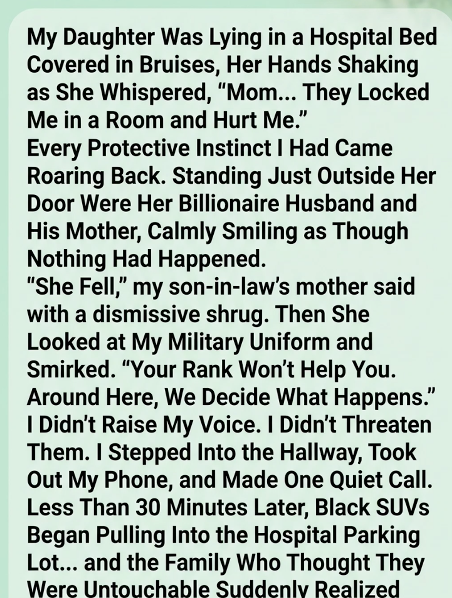
When I arrived, Emily was lying in a hospital bed.
Purple bruises covered her arms.
A bandage wrapped around her forehead.
One wrist was swollen.
The moment she saw me, tears filled her eyes.
She reached for my hand.
“Mom…”
I leaned close.
“What happened?”
She looked toward the door to make sure no one else could hear.
Then whispered,
“They locked me in a room.”
“They kept taking my phone.”
“They hurt me.”
Every instinct I had as both a mother and an Army officer screamed that something was terribly wrong.
Outside the room stood her husband, Daniel, and his mother.
Both were impeccably dressed.
Both looked strangely relaxed.
Daniel’s mother folded her arms.
“She fell down the stairs.”
The nurse quietly avoided eye contact.
I looked at Emily’s injuries.
Then back at them.
“I’d like to speak with my daughter alone.”
Daniel’s mother smiled thinly.
“There’s nothing to discuss.”
“She’s emotional.”
I didn’t argue.
Instead, I waited until they stepped a few feet away.
Then I quietly asked the attending physician whether Emily was able to speak privately.
He nodded.
Hospital staff escorted everyone else from the room.
Emily told me everything she could remember.
She said arguments had become more frequent.
She described controlling behavior, being isolated from friends, and occasions when she said she had been prevented from leaving the house.
She also described the incident that had brought her to the hospital.
I listened without interrupting.
When she finished, I squeezed her hand.
“You did the right thing by telling me.”
I stepped into the hallway.
Daniel’s mother looked at my military uniform and gave a dismissive smile.
“Your rank won’t help you.”
“Around here, we decide what happens.”
I simply nodded.
Then I walked away and made a phone call.
Not to threaten anyone.
Not to demand favors.
I called the military legal assistance office to let them know I would be unavailable because of a family emergency.
Then I called local law enforcement to report what Emily had disclosed and asked to speak with officers trained in handling domestic violence cases.
Finally, I contacted the hospital social worker and requested a domestic violence advocate.
Within half an hour, several unmarked law enforcement vehicles arrived.
Detectives, uniformed officers, and victim advocates entered the hospital.
No one was arrested on the spot.
No dramatic speeches were made.
Instead, everyone followed procedure.
Emily was interviewed privately.
The medical team documented her injuries.
Investigators collected evidence with her consent.
The advocate explained her options, including emergency protective orders, safe housing, and counseling resources.
Watching the process unfold, Daniel’s confidence began to fade.
For the first time that night, he realized this wasn’t going to be decided by family influence or money.
It would be decided by evidence.
Over the next several weeks, investigators gathered medical records, phone data, witness statements, and other evidence.
The case moved through the courts.
I stayed out of the legal arguments.
My role wasn’t to prosecute anyone.
It was to stand beside my daughter while trained professionals did their jobs.
Emily moved into a secure apartment arranged through a local support program.
She started counseling.
Some days she barely spoke.
Other days she laughed for the first time in months.
Healing wasn’t quick.
But it was real.
One afternoon, she apologized.
“I’m sorry you had to come rescue me.”
I looked at her in disbelief.
“Emily…”
“You don’t owe me an apology.”
“You asked for help.”
“That’s one of the bravest things a person can do.”
She cried.
Then smiled.
“I thought no one would believe me.”
“I believed you.”
“So did the doctors.”
“So did the investigators.”
“And most importantly…”
“You finally believed yourself.”
A year later, Emily spoke at a community event supporting survivors of domestic abuse.
She didn’t mention names.
She didn’t seek revenge.
She simply ended her speech with one sentence.
“I used to think asking for help meant I was weak.”
“It turned out to be the strongest decision I ever made.”
I sat in the audience wearing civilian clothes this time.
Not because my military service didn’t matter.
But because, in that room, I wasn’t being recognized as an officer.
I was simply a mother.
And that had always been the title I was proudest to earn.
Looking back, the black SUVs arriving at the hospital didn’t change my daughter’s life.
The real turning point came the moment she whispered the truth—and a team of medical professionals, advocates, and investigators listened, took it seriously, and acted through the proper legal process.
Sometimes courage begins with a single quiet sentence:
“I need help.”