For thirty-five years, Diane wasn’t just my best friend.
She was family.
She stood beside me at my wedding.
I held her hand when her father died.
She watched my children while I recovered from surgery.
We celebrated birthdays, anniversaries, promotions, and grandchildren together.
If someone had asked me who knew me better than anyone else…
I would have said Diane.
Without hesitation.
Every Tuesday evening, we’d text each other.
“Have fun at Pilates!” I’d write.
“See you Thursday for coffee!” she’d answer.
It became part of our routine.
One ordinary Tuesday morning, she called.
“Can I come over?”
“Of course.”
When she arrived, she looked pale.
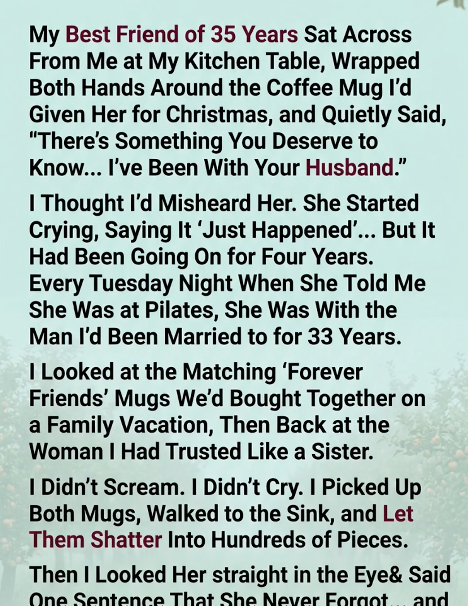
I poured coffee into the matching mugs we’d bought years earlier during a family trip.
They read:
Forever Friends.
She wrapped both hands around hers.
Then whispered,
“There’s something you deserve to know.”
“I’ve been with your husband.”
I stared at her.
“I’m sorry… what?”
She burst into tears.
“It just happened.”
“When?”
She covered her face.
“It didn’t just happen once.”
“How long?”
“So long that I don’t even know how to tell you.”
“How long, Diane?”
She looked up.
“Four years.”
The room became impossibly quiet.
Every Tuesday night.
Every Pilates class.
Every excuse.
For four years.
I looked at the mug in my hand.
Then at the one in hers.
I stood.
Walked to the sink.
Placed both mugs inside.
And let them fall.
They shattered into hundreds of tiny pieces.
The sound echoed through the kitchen.
Only then did I look back at her.
She waited for me to scream.
To insult her.
To throw her out.
Instead, I quietly said,
“You didn’t break my marriage today.”
“You showed me how long I’d been the only person trying to protect it.”
She started sobbing.
“I never meant to hurt you.”
I answered honestly.
“Intentions stopped mattering years ago.”
She left without another word.
I sat alone in the kitchen until evening.
When my husband, David, came home, I asked him one question.
“Is what Diane told me true?”
He looked at me for a long time.
Then nodded.
No denial.
No confusion.
Just one quiet word.
“Yes.”
The conversation that followed lasted hours.
I didn’t yell.
He didn’t offer excuses.
He admitted the relationship had begun during a difficult period in both of their lives.
He claimed they kept trying to end it.
Then starting again.
I listened.
When he finished, I said,
“You both made thousands of separate choices.”
“Not one mistake.”
The next morning, I met with an attorney.
Not because I wanted revenge.
Because I needed to understand my options.
We reviewed finances.
Property.
Retirement accounts.
The attorney reminded me not to make decisions out of anger.
“Make them out of clarity.”
That advice stayed with me.
Over the following weeks, David moved into a rented apartment.
We began the legal process of ending our marriage.
It wasn’t dramatic.
It was heartbreaking.
Our adult children deserved the truth, but not every painful detail.
So we told them simply that trust had been broken and that we had decided to separate.
They were hurt.
They were angry.
But they didn’t need to become participants in our conflict.
Three days after Diane’s confession, she called.
I didn’t answer.
She left one voicemail.
“I’ve lost everything.”
I believed she meant our friendship.
Perhaps more.
I never called back.
Not because I hated her.
Because there was nothing left to repair.
Some relationships end long before the conversation that finally reveals it.
Months later, I packed away old photographs.
In one picture, Diane and I stood on a beach, holding those matching mugs and laughing so hard we could barely stand.
For a moment, I almost threw the photograph away.
Then I stopped.
That memory had been real.
The betrayal that came later didn’t erase the joy we once shared.
Both things could be true at the same time.
So I placed the photo in a box labeled “A Life That Happened.”
Not “A Life I Wanted Back.”
A year later, I bought myself a new coffee mug.
It wasn’t expensive.
It had no matching pair.
Across the front, it simply said:
“Peace begins where pretending ends.”
Every morning, I drink from it while watching the sunrise from my kitchen window.
The sink where those old mugs shattered is still there.
Sometimes I think about that sound.
Not as the moment my life fell apart.
But as the moment I finally stopped holding together something that had already been broken for years.
Looking back, the sentence I spoke that afternoon wasn’t meant to punish my friend.
It was the first honest thing I’d said after living inside someone else’s secret for far too long.
And from that day forward, I chose something neither of them could give me.
The chance to rebuild my life on truth instead of appearances.