There are moments that seem ordinary while you’re living them.
Only years later do you realize they quietly changed the direction of your life.
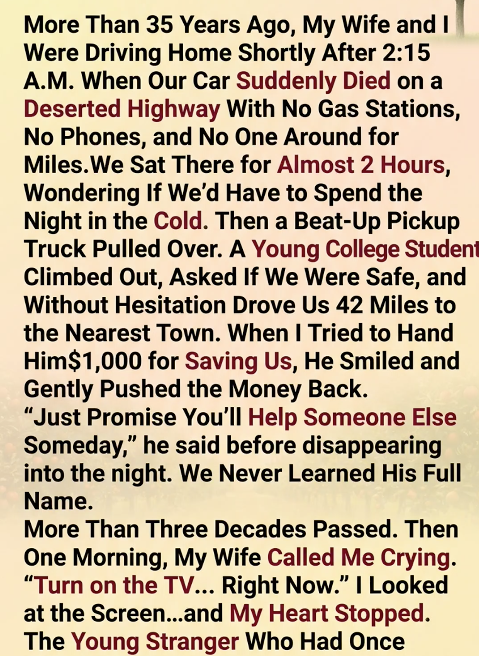
For my wife, Linda, and me, that moment came just after 2:15 a.m. on a freezing November night in 1988.
We were driving home from visiting her parents.
The highway cut through miles of open farmland.
There were no gas stations.
No convenience stores.
No houses with porch lights glowing in the distance.
This was long before smartphones, GPS, or roadside assistance apps.
Just darkness.
And silence.
Then our engine died.
Without warning.
The headlights stayed on.
The engine didn’t.
I tried the ignition again.
Nothing.
Again.
Nothing.
Linda looked through the windshield into the darkness.
“What do we do?”
I honestly didn’t know.
The nearest town was more than forty miles away.
Walking wasn’t an option.
The temperature had already dropped below freezing.
So we waited.
Minutes turned into an hour.
An hour became almost two.
Every time we saw distant headlights, they disappeared down another road.
Linda wrapped herself in an old wool blanket we kept in the back seat.
“I hope somebody comes.”
“So do I.”
I had never felt so helpless.
Then…
Faint headlights appeared behind us.
An old pickup truck slowed.
Its muffler rattled.
One headlight was dimmer than the other.
The truck stopped.
A young man climbed out.
He looked about twenty.
He wore faded jeans, worn work boots, and a college sweatshirt with grease stains across the sleeves.
He approached carefully.
“You folks okay?”
I smiled with relief.
“We’re stranded.”
He looked under the hood for less than a minute.
“I can’t fix this tonight.”
Then he asked,
“Can I take you somewhere warm?”
There were no questions about money.
No hesitation.
He simply opened the truck door.
“I know a twenty-four-hour diner in the next town.”
“It’s about forty-two miles.”
“Hop in.”
The heater barely worked.
The radio crackled with country music.
He told us he was studying mechanical engineering during the day and working nights at a machine shop to pay tuition.
“What year are you?”
“Second.”
“You must be exhausted.”
He laughed.
“I’ll sleep after finals.”
When we reached town, I pulled out an envelope of cash.
One thousand dollars.
Almost everything we’d brought for the trip.
I held it toward him.
“Please.”
“You’ve done more for us than you’ll ever know.”
He smiled.
Then gently pushed my hand away.
“I can’t.”
“You absolutely can.”
He shook his head.
“My grandfather taught me something.”
“If you’re lucky enough to help someone…”
“…don’t turn kindness into a business transaction.”
He started his truck.
Then rolled down the window one last time.
“If you really want to repay me…”
“Promise me that someday…”
“…when someone else needs help…”
“…you’ll stop.”
Then he drove away.
We never learned his last name.
Life moved on.
We raised three children.
Started a small heating and air-conditioning business.
Paid off our mortgage.
Welcomed grandchildren.
Yet every winter, whenever we passed that stretch of highway, one of us would say,
“I wonder what happened to that young man.”
We never found out.
Or so we thought.
Thirty-five years later, Linda called me one Tuesday morning.
She was crying so hard I could barely understand her.
“Turn on the television.”
“Right now.”
I picked up the remote.
Every news channel carried the same live broadcast.
A familiar face filled the screen.
Older now.
Gray at the temples.
Confident.
Kind eyes that somehow hadn’t changed.
My heart nearly stopped.
“It can’t be.”
Linda whispered,
“It’s him.”
The reporter announced the story.
Dr. Daniel Brooks.
Founder of one of the nation’s largest nonprofit engineering organizations.
Creator of affordable clean-water systems now used in dozens of countries.
Recipient of countless humanitarian awards.
That wasn’t why he was making headlines.
The nation had just learned he had quietly donated nearly all of his personal fortune to establish scholarships for students from low-income families.
The total commitment exceeded $4.2 billion.
Reporters asked why he had given away so much.
He smiled.
“My grandfather always believed success only matters if someone else’s life becomes better because of it.”
One reporter asked,
“Was there a particular moment that shaped your philosophy?”
Dr. Brooks laughed softly.
“I still remember driving an old pickup through the middle of nowhere.”
“I found a frightened couple stranded on a highway.”
“They tried to hand me every dollar they had.”
“I told them the only payment I wanted…”
“…was for them to help someone else someday.”
Linda grabbed my hand.
“He remembers us.”
At the bottom of the screen, the network displayed an address where viewers could send letters.
We wrote one that afternoon.
Not to congratulate him.
To thank him.
Again.
We reminded him about the freezing night.
The broken-down sedan.
The thousand dollars he refused.
The promise he asked us to make.
Three weeks later, a handwritten envelope arrived.
Inside was a short letter.
“Dear Mr. and Mrs. Harrison,”
“Of course I remember you.”
“You shared your homemade apple bread with me because you thought I looked hungry.”
“It got me through two days of studying for engineering finals.”
I laughed out loud.
“We remembered the rescue.”
“He remembered the bread.”
Near the bottom of the letter, he wrote:
“One question…”
“Did you keep your promise?”
I smiled.
Because we had.
Not perfectly.
But faithfully.
Over the years we’d stopped for stranded drivers.
Helped elderly neighbors with repairs.
Started a free winter furnace-repair program for families who couldn’t afford emergency service.
Sometimes we accepted payment.
Sometimes we quietly refused.
Whenever someone asked why, I’d simply say,
“Someone once helped me.”
Several months later, we received an invitation to attend the opening of a new engineering education center funded by Dr. Brooks.
After the ceremony, he walked straight toward us.
He hugged Linda first.
Then me.
“I’ve wanted to thank you for years.”
I looked surprised.
“For what?”
“For proving my grandfather was right.”
“I asked you to pass kindness forward.”
“You did.”
I shook my head.
“No.”
“You started it.”
He smiled.
“No.”
“My grandfather started it.”
“And someone before him probably inspired him.”
“That’s how kindness survives.”
On the drive home, Linda looked out the window.
“You know what amazes me?”
“What?”
“We spent decades believing that young man changed our lives.”
“He did.”
She smiled.
“So did everyone we helped because of him.”
I hadn’t thought about it that way.
One cold night.
One old pickup.
One stranger who refused a thousand dollars.
One promise.
Thirty-five years later, the country celebrated Dr. Daniel Brooks for changing millions of lives.
But to us, he would always be the tired college student who stopped on an empty highway simply because two strangers needed help.
Looking back, I’ve realized something important.
Most people think history changes because of famous speeches, billion-dollar donations, or headlines on the evening news.
Sometimes it does.
But just as often…
History changes because one person pulls over on a dark road, opens the passenger door, and decides that a stranger’s safety matters more than getting home on time.
Kindness rarely knows how far it will travel.
That’s what makes it extraordinary.