The day I told my parents I was marrying a welder, my mother cried.
Not happy tears.
The kind that come from disappointment.
My father didn’t even try to hide his anger.
“You graduated at the top of your class,” he said.
“You could have had any future you wanted.”
“I do have the future I want.”
He shook his head.
“No.”
“You’re throwing it away.”
Across the dining room, my older sister, Victoria, sat silently beside her fiancé—a polished businessman from one of the wealthiest families in the city.
Mom smiled proudly at them.
Then looked back at me.
“You could have had this life.”
Instead…
“You chose a man who works with his hands.”
I reached across the table and took Daniel’s hand.
His palms were rough.
Scarred from years of welding.
Strong.
Steady.
Exactly like the man himself.
“I didn’t choose a job.”
“I chose a person.”
No one answered.
Two months later, Daniel and I were married in a small church.
Forty-three guests attended.
My parents didn’t.
Neither did Victoria.
As we loaded two suitcases into Daniel’s old pickup truck after the ceremony, he looked at me.
“You can still change your mind.”
I laughed.
“About what?”
“Marrying a welder.”
I kissed him.
“I married the kindest man I’ve ever known.”
“I’ve never regretted that for a single second.”
The early years weren’t easy.
Daniel worked long shifts at a fabrication shop.
I taught high school mathematics.
Some months we counted every dollar.
We postponed vacations.
Bought secondhand furniture.
Painted our own walls.
Repaired our own roof.
When friends asked whether we wished we’d waited until we were more financially secure to marry, Daniel always smiled.
“We already had everything we needed.”
What very few people knew was that Daniel spent every spare evening designing improvements for industrial welding systems.
He filled notebooks with ideas.
Sometimes he’d wake at two in the morning to sketch another design.
“I think this could make steel fabrication safer,” he’d say.
I didn’t understand every drawing.
But I understood his passion.
So I encouraged him.
Five years later, he left his job.
Everyone thought he was crazy.
He rented a tiny workshop.
For months he paid himself almost nothing.
We survived on my teacher’s salary.
There were evenings when we shared one inexpensive meal and laughed about it.
“If this fails,” he once told me, “I’ll go back to welding tomorrow.”
“It won’t change who I am.”
I smiled.
“That’s exactly why I believe in you.”
Slowly, the business grew.
One client became five.
Five became fifty.
Then came international contracts.
Investors approached.
Daniel accepted only those who shared his long-term vision.
He insisted on one principle.
“No decision is worth sacrificing the people who build this company.”
By the time fifteen years had passed, our little workshop had become one of the country’s most respected specialty steel manufacturers.
Yet Daniel never stopped introducing himself the same way.
“I’m Daniel.”
“I’m a welder.”
He still visited factory floors.
Still wore protective gear.
Still knew employees by name.
If someone complimented his success, he’d smile.
“I just never stopped loving the work.”
Almost eighteen years after our wedding, we received an invitation to a charity business gala.
I almost declined.
Then I saw the guest list.
Victoria.
Her husband, Charles.
I hadn’t spoken to either of them in years.
Daniel looked at me.
“We don’t have to go.”
I smiled.
“No.”
“We’re going.”
The ballroom glittered with crystal chandeliers.
Executives.
Investors.
Government officials.
Servers moved quietly through the crowd carrying silver trays.
I had almost convinced myself the evening would pass peacefully.
Then I heard Victoria’s voice behind me.
She looked exactly as I remembered.
Elegant.
Confident.
She glanced at Daniel’s hands.
Even in a tuxedo, faint welding scars remained.
She smiled just loudly enough for nearby guests to hear.
“So…”
She laughed softly.
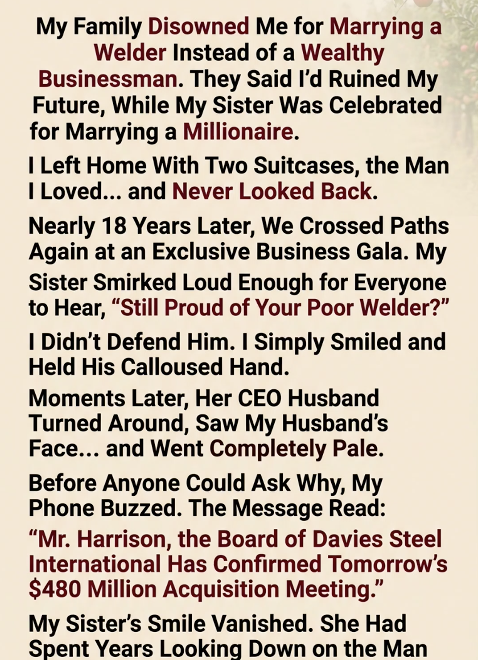
“Still proud of your poor welder?”
The conversation around us became noticeably quieter.
Everyone waited.
I didn’t defend him.
I simply reached for Daniel’s hand.
Those same scarred fingers gently intertwined with mine.
“I’m proud of the man I married.”
Victoria rolled her eyes.
“Some people never learn.”
At that moment, Charles turned around.
He looked directly at Daniel.
His expression changed instantly.
The color drained from his face.
He whispered,
“…Mr. Harrison?”
Daniel smiled politely.
“Good evening.”
Charles straightened his jacket nervously.
“I didn’t realize…”
Daniel nodded.
“Clearly.”
Before anyone could ask another question, my phone vibrated.
It was a message from Daniel’s assistant.
“Mr. Harrison, the board has confirmed tomorrow’s acquisition meeting. The directors have approved moving forward with the proposed purchase, pending final signatures.”
I quietly locked the screen.
Victoria frowned.
“What acquisition?”
Charles looked as though he wanted the floor to open beneath him.
He answered before Daniel could.
“The company I’ve spent the last year trying to partner with.”
Victoria blinked.
“What company?”
Charles swallowed.
“Harrison Industrial Systems.”
Silence spread through the nearby crowd.
She looked from Daniel…
…to me…
…then back again.
“No.”
“That’s impossible.”
“He’s a welder.”
Daniel smiled gently.
“I still am.”
For the rest of the evening, Victoria barely spoke.
Several executives approached Daniel.
Not because he was wealthy.
But because they respected him.
They asked about new manufacturing technologies.
Employee apprenticeship programs.
Safety innovations.
He answered every question with the same humility he’d always carried.
Watching him, I realized something.
Success hadn’t changed him.
It had simply given more people the chance to see who he’d always been.
As the gala ended, Victoria finally approached us.
“I owe you an apology.”
I looked at her quietly.
“You don’t owe me one.”
“I judged him.”
“You judged both of us.”
She lowered her eyes.
“I thought money proved someone’s worth.”
Daniel smiled kindly.
“It doesn’t.”
“It only makes your character easier to see.”
Several weeks later, my parents asked if we would visit.
We did.
Not to celebrate.
Not to settle old scores.
Just to share dinner.
My father looked at Daniel for a long time before speaking.
“I spent years believing I knew what success looked like.”
Daniel answered softly.
“So did I.”
“What changed?”
“I realized success isn’t measured by what people own.”
“It’s measured by how many people are better off because you showed up.”
On our drive home, I reached over and took Daniel’s hand.
The scars were still there.
So were the callouses.
The same hands my family once dismissed had built machines, created jobs, supported families, and transformed an entire company.
I smiled.
“What?”
he asked.
“I was just thinking…”
“They said I ruined my future.”
He laughed.
“Do you feel ruined?”
I looked out the window as the sun disappeared beyond the horizon.
“Not even a little.”
Looking back, people often think this story is about wealth.
It isn’t.
It’s about respect.
The greatest mistake my family made wasn’t underestimating my husband’s future.
It was confusing a person’s occupation with their value.
A title can impress strangers.
A fortune can attract attention.
But character is built quietly—in ordinary days, honest work, and promises kept long before anyone is watching.
And that’s the kind of success no one can ever take away.