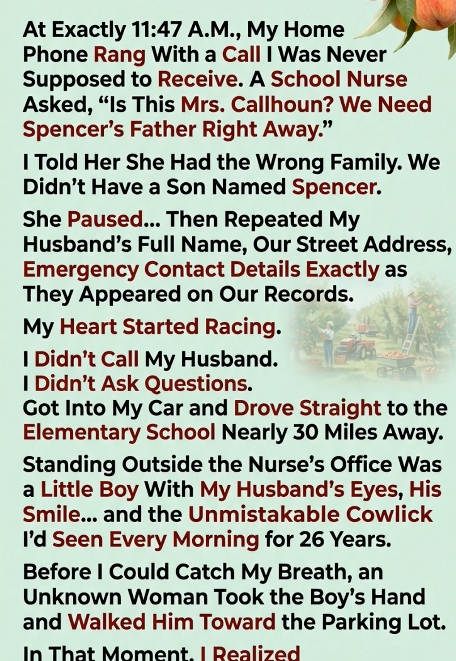
At exactly 11:47 a.m., my home phone rang.
I almost ignored it.
I was in the middle of folding laundry, and the caller ID showed an unfamiliar number.
I answered anyway.
“Hello?”
A calm woman spoke.
“Good morning. Is this Mrs. Calhoun?”
“Yes.”
“This is the nurse at Willow Creek Elementary. Spencer had a fall during recess. He’s awake and stable, but we’d like his father to come pick him up.”
I frowned.
“I’m sorry…”
“I think you’ve called the wrong family.”
“We don’t have a son named Spencer.”
The nurse paused.
Then she read from the emergency contact form.
“Father: Michael Calhoun.”
She spoke my husband’s full name.
Then our home address.
Then our landline number.
Every detail was correct.
Every single one.
Only the child was a stranger.
My heart began pounding.
The nurse sounded confused.
“Ma’am… isn’t this the emergency contact listed on Spencer’s file?”
I could barely answer.
“I’ll… I’ll come.”
I didn’t call my husband.
I didn’t know what I would even say.
Instead, I grabbed my keys and drove nearly thirty miles to the school.
The entire drive, I tried to convince myself there had to be some simple explanation.
Maybe another Michael Calhoun.
Maybe a clerical error.
Maybe an old form someone forgot to update.
I repeated those possibilities over and over.
None of them felt convincing.
The nurse met me at the front office.
“You made good time.”
She smiled politely.
“Spencer is feeling much better.”
I couldn’t speak.
She led me toward the health office.
Then I saw him.
A little boy sat quietly on the examination bed.
Maybe eight years old.
He looked up.
My breath caught.
He had Michael’s dark eyes.
The same crooked smile.
The exact cowlick that refused to stay flat every morning no matter how much water or gel my husband used.
It wasn’t one feature.
It was all of them together.
The resemblance was startling.
The little boy smiled shyly.
“Hi.”
I managed a smile.
“Hi.”
Before I could ask a single question, another woman hurried down the hallway.
She looked to be in her mid-thirties.
“I’m so sorry,” she said to the nurse.
“Traffic was awful.”
She took Spencer’s hand.
As they turned to leave, she noticed me watching.
For a brief moment, our eyes met.
Recognition flashed across her face.
Not confusion.
Recognition.
Then she quickly looked away.
My stomach dropped.
The nurse glanced between us.
“Oh…”
“I assumed you knew each other.”
Neither of us answered.
The woman quietly led Spencer toward the parking lot.
I stood frozen.
That evening, I placed one question on the dinner table between my husband and me.
“Who is Spencer?”
The fork slipped from his hand.
He didn’t ask what I meant.
He didn’t pretend not to know.
He simply closed his eyes.
After a long silence, he whispered,
“You got the phone call.”
It wasn’t a question.
It was resignation.
“What aren’t you telling me?”
He buried his face in his hands.
Then, very quietly, he said,
“He’s my son.”
Every sound in the room disappeared.
I couldn’t feel the chair beneath me.
“You have another child?”
He nodded.
“But not the way you’re thinking.”
Over the next two hours, he told me a story I’d never heard.
More than nine years earlier, before Spencer was born, Michael had donated sperm while he was in graduate school.
He’d done it anonymously through a licensed fertility clinic.
The compensation helped him pay tuition.
He’d signed paperwork stating he would have no parental rights or responsibilities and that his identity would remain confidential under the laws and agreements in place at the time.
“I never imagined…”
“…that anyone would connect us.”
“So how did your name end up on the school records?”
“I don’t know.”
He looked genuinely shaken.
“I’ve never met Spencer.”
“I’ve never spoken to his mother.”
“I didn’t even know a child had been born.”
The next morning, we contacted the fertility clinic.
After an internal review, the clinic acknowledged a serious administrative error.
Years earlier, during a software migration, portions of an anonymous donor identification file had been incorrectly linked with emergency contact information from unrelated records.
When Spencer enrolled in school, outdated data imported from a medical file had mistakenly populated my husband’s name, address, and phone number as an emergency contact.
The clinic accepted responsibility for the error and immediately worked with the family to correct the records.
Several days later, Spencer’s mother asked if she could meet us.
Not because she wanted money.
Not because she expected Michael to become a father.
She wanted to apologize for the distress caused by something neither of us had created.
She explained that she had conceived Spencer through a legal fertility program after years of infertility.
She believed the donor would remain anonymous.
The phone call had shocked her just as much as it had shocked us.
“I never intended to disrupt your family,” she said quietly.
“I know,” I answered.
Spencer spent most of the meeting drawing dinosaurs while the adults talked.
At one point, he looked at Michael.
“My mom says you’re not my dad.”
Michael smiled gently.
“She’s right.”
“But we do have something in common.”
“What?”
“We both have impossible hair.”
Spencer laughed and reached up to flatten his cowlick.
It immediately sprang back up.
Everyone laughed.
The tension in the room eased for the first time.
Driving home, I looked out the window for a long time.
“I was so sure…”
“So sure what?”
“That my marriage had been built on a lie.”
Michael reached for my hand.
“I’m sorry I never told you I had donated.”
“You should have.”
“I know.”
“I honestly forgot about it until yesterday.”
I believed him.
Not because it erased the surprise.
But because the facts fit what we had learned.
That experience changed the way I think about certainty.
When I answered the phone, my mind immediately filled in the missing pieces.
I believed I had uncovered a secret family.
An affair.
Years of deception.
The truth turned out to be something entirely different: an old decision, a modern clerical mistake, and a series of assumptions made by everyone involved.
Sometimes the story we fear most isn’t the one that’s actually happening.
Sometimes the hardest part isn’t discovering the truth.
It’s waiting long enough to let the truth reveal itself before we decide what it must be.