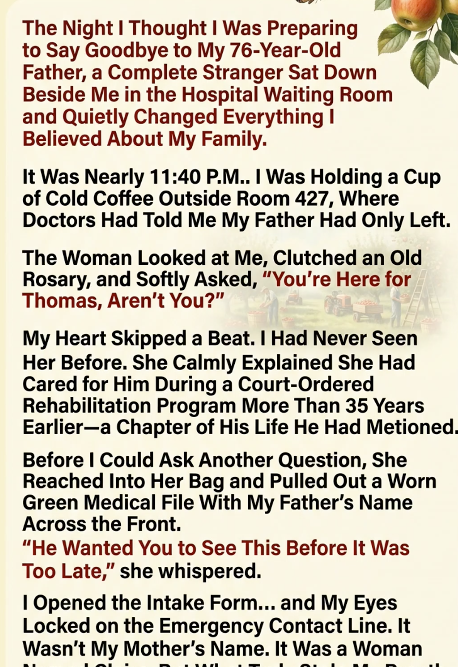
At 11:38 p.m., I was sitting outside Room 427 with a paper cup of coffee that had long since gone cold.
The cardiologist had been honest.
My father, Thomas Ellis, had suffered massive heart failure.
At seventy-six, after years of declining health, there wasn’t much left medicine could do.
“If there’s anyone who wants to see him,” the doctor had said gently, “now is the time.”
The waiting room was almost empty.
A television played muted news in the corner.
A janitor slowly polished the hallway floor.
I stared at the closed hospital door, wondering how two people could love each other deeply for a lifetime and still leave so many conversations unfinished.
My father and I had always been close.
Or so I believed.
A quiet voice interrupted my thoughts.
“You’re here for Thomas, aren’t you?”
I looked up.
An elderly woman stood beside me.
She wore a gray cardigan despite the summer heat.
A worn wooden rosary rested between her fingers.
I had never seen her before.
“Yes.”
“How do you know my father?”
She smiled sadly.
“I knew him a very long time ago.”
She introduced herself as Margaret.
More than thirty-five years earlier, she had worked as a nurse and counselor at a court-ordered rehabilitation center.
My father had spent several months there after a serious alcohol-related driving offense before I was born.
I stared at her.
“My father never drank.”
“He didn’t.”
“Not after he left.”
“He spent the rest of his life making sure of that.”
I couldn’t remember ever seeing alcohol in our house.
Not once.
“I wasn’t sure I’d ever see him again,” Margaret continued.
“But about six months ago…”
“…he came to visit me.”
She reached into her handbag.
Carefully removed a worn green medical folder.
Across the front, faded black letters read:
THOMAS ELLIS
She held it toward me.
“He asked me to keep this.”
“And if I ever learned he was dying before he had the courage to tell you himself…”
“…he wanted you to have it.”
My hands shook as I accepted it.
Inside were intake forms.
Counseling notes.
Attendance records.
Thirty-six-year-old documents that smelled faintly of old paper.
Then I reached the first page.
Emergency Contact
My eyes stopped.
The name wasn’t my mother’s.
It wasn’t anyone I recognized.
It read:
Claire Bennett
Beneath that…
Relationship: Sponsor
I blinked.
Sponsor?
Margaret saw my confusion.
“In recovery programs,” she explained softly, “a sponsor isn’t someone who gives you money.”
“It’s someone who helps keep you alive.”
I looked back at the file.
Everything suddenly made sense.
The daily walks.
The strict routines.
The way my father always left family dinners early if people began drinking heavily.
The quiet phone call he made every October.
The framed coin in his dresser I had never understood.
Thirty-five years sober.
It had been there all along.
I had simply never asked.
“Who was Claire?”
I whispered.
Margaret smiled.
“The woman who refused to let your father give up.”
She told me about the frightened thirty-nine-year-old man who had arrived at the rehabilitation center ashamed and convinced his life was over.
He had lost his driver’s license.
Nearly lost his job.
Nearly lost himself.
Claire, a volunteer who had been sober for several years, became his sponsor.
She wasn’t family.
She wasn’t a therapist.
She was simply someone who answered the phone every time he thought about drinking.
Sometimes at two in the morning.
Sometimes three times a day.
She reminded him that one mistake didn’t have to become the rest of his life.
“He talked about your mother constantly,” Margaret said.
“They weren’t married yet.”
“But he kept saying…”
“If I don’t become the man she deserves now…”
“I’ll never deserve the life we’re dreaming about.”
I felt tears filling my eyes.
My parents had always seemed so ordinary.
I never imagined how hard my father had fought simply to become the husband and father I remembered.
“There was one condition,” Margaret added.
“He never wanted you to know while he was alive.”
“Why?”
“He was afraid.”
“Afraid of what?”
“That you’d spend your life seeing him as the man he had been…”
“…instead of the man he worked every day to become.”
A nurse appeared.
“Your father is awake.”
“You can come in.”
I carried the green folder into Room 427.
Dad opened his eyes.
The oxygen mask hid most of his face.
But I could still recognize the expression.
He saw the file.
Then closed his eyes.
“I suppose…”
“…Margaret found you.”
I nodded.
“Why didn’t you tell me?”
His voice was barely audible.
“Because…”
“I wanted you to admire the life I built.”
“Not the wreckage I climbed out of.”
I pulled a chair beside the bed.
“Dad…”
“I don’t admire you less.”
“I admire you more.”
He looked surprised.
“You do?”
“You spent thirty-five years becoming someone different.”
“That isn’t weakness.”
“That’s courage.”
For the first time that night…
He cried.
We talked until sunrise.
Not about shame.
About gratitude.
He told me how Claire had attended my parents’ wedding.
How she quietly sat in the back pew and left before the reception because she wanted the day to belong to them.
Every anniversary, he mailed her a handwritten thank-you card.
Not because she expected it.
Because he never wanted to forget that none of what followed would have existed without the chance she helped him protect.
Claire had passed away several years before.
My father still kept every letter she ever wrote him.
Inside one was a sentence highlighted in yellow.
“Recovery isn’t pretending the past never happened.”
“It’s making sure the future doesn’t have to repeat it.”
My father died peacefully two days later.
At the memorial service, I spoke about the man everyone knew.
A devoted husband.
A loving grandfather.
An honest mechanic.
Then I told them about the man very few had known.
The frightened father-to-be who once believed his worst mistake would define the rest of his life.
It didn’t.
Because he chose, one day at a time, to become someone else.
People sometimes think family secrets are always about betrayal.
Sometimes they are.
Sometimes they’re about hidden children, stolen inheritances, or lies that destroy trust.
But sometimes…
A secret is simply the quiet story of someone’s hardest battle.
Not hidden because they were ashamed forever.
Hidden because they hoped the people they loved would only remember the life they managed to build after surviving it.
That night in the hospital, I thought I was saying goodbye to the father I had always known.
Instead, I met the man he had once been.
And somehow…
It made me love him even more.