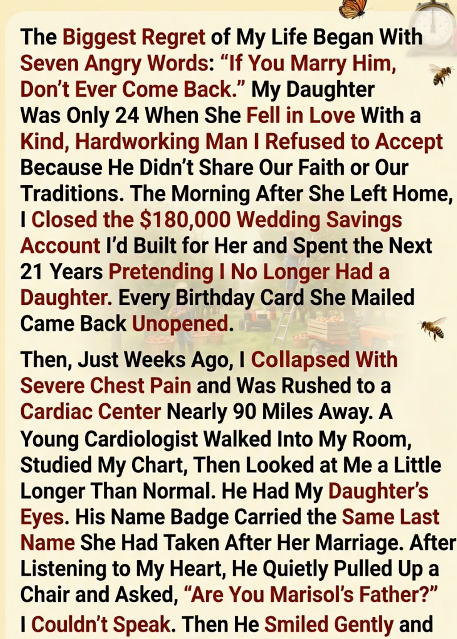
The biggest regret of my life began with seven words.
“If you marry him, don’t ever come back.”
I wish I could tell you I didn’t mean them.
I did.
That’s what hurts the most.
My daughter, Marisol, was twenty-four years old.
She had fallen in love with a man named Daniel.
He was honest.
Hardworking.
Respectful.
He treated her with kindness.
None of that mattered to me.
All I could see was what he wasn’t.
He didn’t share our faith.
He came from a different culture.
He celebrated different holidays.
I convinced myself I was protecting our family’s traditions.
In reality…
I was choosing my pride over my child.
The morning after our argument, Marisol packed two suitcases.
She stood at the front door crying.
“Dad…”
“I love him.”
“I know.”
“Can’t you try to know him?”
“No.”
She waited.
Hoping I’d change my mind.
Instead, I repeated the same seven words.
“If you marry him, don’t ever come back.”
She nodded slowly.
“I hope someday…”
“…you’ll regret saying that.”
Then she walked away.
I watched from the window.
She looked back exactly once.
I didn’t wave.
That moment haunted me for the next twenty-one years.
The following week, I closed the savings account I’d built for her wedding.
Nearly $180,000.
Money I’d been setting aside since the day she was born.
I donated part of it.
Invested the rest.
Anything to avoid thinking about why I’d opened it in the first place.
Every birthday, a card arrived.
Always the same handwriting.
Always addressed simply:
Dad.
I never opened them.
I wrote RETURN TO SENDER across each envelope.
The mail carrier eventually stopped asking questions.
Friends occasionally mentioned seeing Marisol.
“She looks happy.”
“Her husband seems wonderful.”
“They have children now.”
I pretended not to hear.
The lie became easier every year.
“I don’t have a daughter.”
I said those words often enough that I almost believed them.
Almost.
Then, six weeks ago, I collapsed while mowing the lawn.
The pain in my chest was unlike anything I’d ever felt.
An ambulance rushed me to a regional cardiac center nearly ninety miles away.
After several tests, I lay quietly in a hospital room wondering whether I’d ever leave.
The door opened.
A young cardiologist walked in.
Early thirties.
Calm.
Professional.
He studied my chart.
Then looked at me a little longer than most doctors do.
There was something familiar about him.
I couldn’t place it.
Then I noticed his name badge.
Dr. Gabriel Alvarez.
Alvarez.
Marisol had taken her husband’s last name.
My heart skipped.
He listened to my heartbeat.
Checked the monitor.
Then quietly pulled up a chair.
“Mr. Reyes…”
He paused.
“May I ask you something personal?”
I nodded.
“Are you Marisol’s father?”
Every sound in the room disappeared.
“Yes.”
The word barely escaped my lips.
He smiled gently.
“I’m her oldest son.”
I stared at him.
My grandson.
Standing less than three feet away.
A physician.
A man I’d never met.
He reached into the pocket of his white coat and unfolded a small photograph.
It showed three children standing beside a smiling couple.
The youngest held a birthday cake.
“Mom carries this picture everywhere.”
I looked at the family I’d refused to know.
My chest hurt for reasons that had nothing to do with my heart.
“She’s here,” Gabriel said softly.
“Outside your room.”
I looked toward the closed door.
“I don’t think she’ll want to see me.”
He smiled.
“You don’t know my mother.”
Then his expression became more serious.
“Before she comes in…”
“She asked me to ask you one question.”
I couldn’t breathe.
“What is it?”
He looked directly into my eyes.
“If she walks through that door…”
“…are you ready to meet your daughter?”
“…or are you still trying to win an argument that ended twenty-one years ago?”
I broke.
Completely.
Not because of the question.
Because I finally realized I’d spent more than two decades waiting for my daughter to apologize…
…for loving someone who treated her well.
“I’m ready.”
I whispered.
“If she’ll let me.”
Gabriel nodded once.
Then walked to the door.
A few seconds later…
Marisol entered.
Twenty-one years disappeared.
She looked older.
So did I.
But she still smiled exactly the way she had when she was little.
Neither of us spoke.
Finally I stood.
“I was wrong.”
The words felt impossibly small compared to the years we’d lost.
“I know.”
She answered quietly.
“I’ve known that for a long time.”
I shook my head.
“I chose my fear.”
“Over you.”
“I’m so sorry.”
She walked toward me.
Stopped just inches away.
Then hugged me.
“I’ve missed my dad.”
We cried longer than we talked.
There was too much history for one afternoon.
Too many birthdays.
Too many empty chairs.
Too many unopened letters.
The next morning, Gabriel returned carrying a small box.
“Mom wanted you to have these.”
Inside were every birthday card she’d ever mailed.
Still sealed.
She had mailed a new one each year after the old one came back.
She had kept copies of every letter.
The first one read:
“Happy Birthday, Dad.”
“I hope you’re healthy.”
“I love you.”
The tenth read:
“Your grandson learned to ride a bike today.”
“I wish you could have seen him.”
The twentieth simply said:
“Whenever you’re ready…”
“We’ll be here.”
I opened every one.
I cried through every page.
A month after leaving the hospital, I visited their home.
My younger grandchildren didn’t know me.
Not yet.
The smallest one looked at Marisol.
“Who is he?”
She smiled.
“This is my dad.”
The little girl walked over.
Placed her tiny hand in mine.
“Hi, Grandpa.”
One word.
Twenty-one years late.
Still the most beautiful word I’d ever heard.
Several months later, I finally asked Marisol something I’d wondered since the hospital.
“Why did you come?”
She looked surprised.
“Because you were my father.”
“Even when you forgot how to be one.”
Looking back, people often ask what my greatest regret is.
It isn’t missing the wedding.
It isn’t losing the wedding savings.
It isn’t even the twenty-one years apart.
My greatest regret is believing that being right mattered more than staying connected to my child.
Traditions can be passed down.
Faith can be shared.
Cultures can be celebrated together.
But time…
Time only moves in one direction.
If I could speak to the younger version of myself standing in that doorway twenty-one years ago, I wouldn’t argue with him.
I’d simply place a hand on his shoulder and say:
“Don’t make your daughter choose between the man she loves and the father who loves her.”
“Because if you do…”
“The person who loses the most won’t be her.”
“It will be you.”