When my daughter Emma started first grade, I expected tears about homework.
Complaints about vegetables in the cafeteria.
Stories about new friends.
Instead, eight days into the school year, she asked me a question I couldn’t answer.
“Mom…”
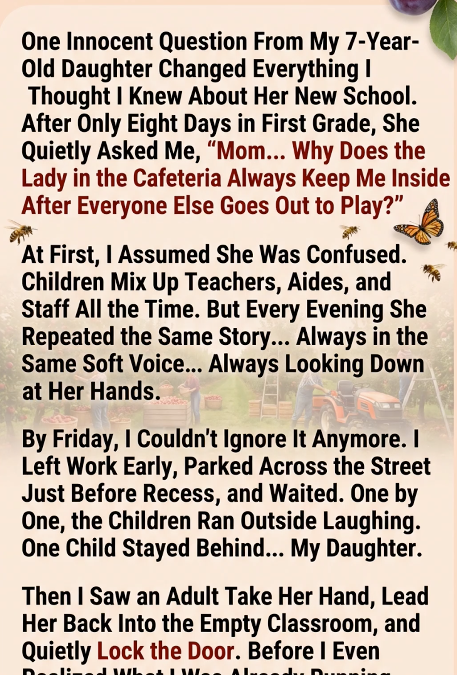
“Why does the cafeteria lady always keep me inside after everyone else goes out to play?”
I looked up from washing dishes.
“What do you mean?”
She shrugged.
“When lunch is over.”
“Everyone goes outside.”
“But she tells me to stay.”
I smiled gently.
“Honey, maybe you’re thinking of someone else.”
Children confuse adults all the time.
Teachers.
Aides.
Lunch supervisors.
Emma nodded.
“Maybe.”
But she didn’t sound convinced.
The next evening, she mentioned it again.
“Did you stay inside today?”
“Uh-huh.”
“Why?”
“I don’t know.”
“What did you do?”
“We colored.”
“Just you?”
She nodded.
“And the lady.”
By Thursday, I decided to email her teacher.
The reply came quickly.
“Emma is doing wonderfully in class. I haven’t noticed any problems during recess, but I’ll ask the lunch staff whether there’s been a misunderstanding.”
That seemed reassuring.
Until Friday.
When Emma quietly asked,
“Mom…”
“Did I do something bad?”
My heart sank.
“Why would you think that?”
“Because everybody else gets to play.”
I left work early that afternoon.
I didn’t tell the school I was coming.
I parked across the street where I could see the playground.
The lunch bell rang.
Children poured through the doors.
Laughing.
Running.
Chasing one another toward the swings.
I searched every face.
Then I saw Emma.
She stepped into the hallway.
A woman in a cafeteria apron gently touched her shoulder.
They turned.
Walked back inside.
The classroom door closed.
A moment later…
The door locked.
My pulse exploded.
Without thinking, I sprinted across the street.
By the time I reached the office, I was out of breath.
“My daughter.”
“Emma Collins.”
“Someone just took her back into a classroom.”
The receptionist looked startled.
“One moment.”
The principal immediately came out.
Within seconds, we were walking quickly down the hallway.
He unlocked the classroom.
Inside…
Emma sat smiling at a table covered with crayons.
The cafeteria worker looked up in surprise.
“Oh!”
“I didn’t know her mother was here.”
I pulled Emma into a hug.
“Are you okay?”
She nodded happily.
“I’m making butterflies.”
The principal turned toward the cafeteria worker.
“Mrs. Alvarez…”
“Can we speak in the hallway?”
A few minutes later, the principal invited me into his office.
Mrs. Alvarez was already there.
She looked deeply embarrassed.
“I’m so sorry.”
“I should have explained.”
I folded my arms.
“I’d appreciate that.”
Mrs. Alvarez took a slow breath.
“During the first week of school, I noticed Emma eating alone.”
“She hardly spoke.”
“She seemed overwhelmed by the noise in the cafeteria.”
I nodded.
Emma had always been shy in new places.
“I asked whether she’d rather help me organize art supplies after lunch until she felt comfortable joining recess.”
“And she said yes.”
I frowned.
“She wanted to stay inside?”
Mrs. Alvarez nodded.
“Every day I asked.”
“Every day she chose the quiet room.”
I looked at the principal.
“Then why didn’t anyone tell me?”
His expression fell.
“They should have.”
“Our staff should never create a recurring arrangement like that without informing a parent.”
He turned toward Mrs. Alvarez.
“Even with good intentions.”
She quietly nodded.
“You’re absolutely right.”
That evening, I sat beside Emma on her bed.
“Honey…”
“Did you want to stay inside?”
She thought for a moment.
“There were too many kids.”
“They yelled.”
“The playground scared me.”
“So I colored.”
I gently brushed her hair away from her face.
“Why didn’t you tell me?”
“I thought you’d make me go outside.”
The following Monday, the school counselor met with us.
Together, we came up with a better plan.
Emma would spend the first ten minutes of recess in a quieter activity with a small group of children, then gradually join outdoor play when she felt ready.
Most importantly…
Everyone would communicate.
No more secrets.
No more assumptions.
Several months later, I stopped by the school unexpectedly.
This time I stood near the playground.
I watched Emma laughing with three other girls while chasing bubbles across the grass.
Mrs. Alvarez noticed me watching.
She smiled.
“She doesn’t need the butterfly room anymore.”
“The butterfly room?”
She laughed softly.
“That’s what Emma called our little art table.”
“She said butterflies don’t fly the first day they leave the cocoon either.”
I smiled through tears.
“That sounds like her.”
At the end of the school year, Emma handed Mrs. Alvarez a handmade card.
On the front she’d drawn two butterflies.
Inside she’d written:
“Thank you for helping me feel brave.”
Mrs. Alvarez hugged her.
“You were brave all along.”
Driving home, I thought about how close I had come to assuming the worst.
Seeing an adult lead my daughter into an empty classroom and lock the door had terrified me.
Any parent would have rushed inside.
And I don’t regret doing that.
When something about your child’s safety doesn’t feel right, asking questions is the right thing to do.
But I’m also grateful that I kept asking questions after I walked through the door.
Because sometimes what looks frightening from a distance has a very different explanation.
The experience taught me two lessons I’ll never forget.
Parents should trust their instincts enough to investigate when something concerns them.
And schools should never leave families guessing about anything that affects a child’s daily experience.
A simple conversation on the first day could have prevented a week of fear.
Instead, it became a reminder that children need both attentive parents… and adults who communicate clearly enough to earn their trust.