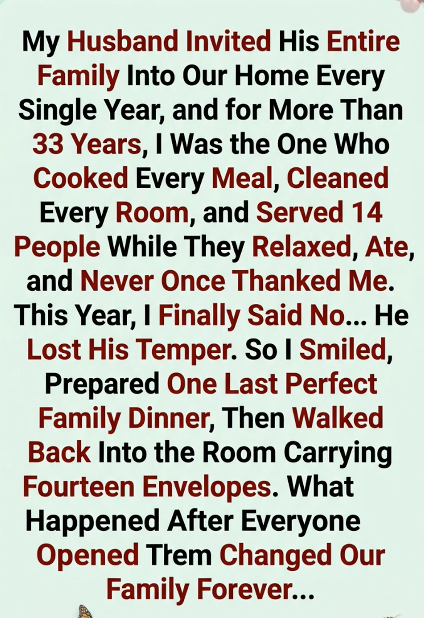
For thirty-three years, my husband’s family came to our house for every major holiday.
Thanksgiving.
Christmas.
Easter.
Birthdays.
Anniversaries.
If there was a reason to gather, somehow our home became the destination.
At first, I didn’t mind.
I loved cooking.
I loved seeing the cousins play together.
I loved the noise, the laughter, the traditions.
But somewhere along the way…
The tradition quietly became an expectation.
Every year, the routine was exactly the same.
I’d wake before dawn.
Put the turkey in the oven.
Peel ten pounds of potatoes.
Bake pies.
Set the table for fourteen people.
Vacuum every room.
Polish every glass.
Wash every bathroom.
By the time the first guest arrived, I’d already been working for six or seven hours.
Meanwhile, my husband, Frank, would say,
“Relax.”
“I’ve got the easy part.”
His “easy part” usually meant carrying one folding table from the garage.
His brothers arrived carrying nothing.
His sisters brought empty serving dishes they expected me to fill.
The grandchildren scattered toys across the living room.
Everyone complimented the food.
Nobody noticed the work.
When dinner ended, the men drifted toward football.
The women chatted over coffee.
The teenagers disappeared upstairs.
I washed mountains of dishes.
Alone.
Every year.
One Christmas, I quietly asked,
“Could everyone help clean up tonight?”
Frank looked genuinely surprised.
“But you’re so much better at organizing.”
Everyone laughed.
I smiled.
Then spent another three hours washing dishes after they all went home.
Last spring, while recovering from minor knee surgery, I finally realized something.
If I kept saying yes to everything…
No one else would ever learn to say yes to helping.
So when Frank announced,
“Everyone’s coming here again this year.”
I answered calmly.
“No.”
He looked up from his newspaper.
“What do you mean, no?”
“I mean…”
“I’m not hosting fourteen people by myself anymore.”
The conversation escalated quickly.
“It’s one day.”
“You always make too much of it.”
“My family expects it.”
I quietly replied,
“Exactly.”
“They expect it.”
“They don’t appreciate it.”
There’s a difference.
For three days, the house stayed unusually quiet.
Finally, Frank walked into the kitchen.
“So…”
“You’re really going to embarrass me?”
I smiled.
“No.”
“I’m going to give everyone exactly one more family dinner.”
He relaxed immediately.
“I knew you’d come around.”
I didn’t answer.
The day arrived.
Everything looked perfect.
Roast turkey.
Honey-glazed ham.
Fresh bread.
Homemade pies.
The dining table looked like something from a magazine.
Everyone praised the meal.
Frank’s oldest brother leaned back in his chair.
“Nobody cooks like Sarah.”
His wife nodded.
“You’re amazing.”
I smiled politely.
Then stood.
“I have one more thing before dessert.”
I walked into the study.
Returned carrying fourteen envelopes.
One for every guest.
Including Frank.
Curious laughter filled the room.
“What are these?”
“Christmas cards?”
I shook my head.
“Please open them.”
Inside every envelope was a neatly typed sheet of paper.
At the top:
Holiday Schedule—Beginning Next Year
Below it was a calendar.
Each family had been assigned responsibility for hosting one gathering over the next several years.
Beside every holiday was a checklist.
Planning.
Shopping.
Cooking.
Setting the table.
Cleaning afterward.
Every task I’d quietly handled alone for more than three decades.
At the bottom was one final note.
“If we all enjoy these family gatherings…”
“…then we can all help create them.”
Silence.
Complete silence.
Frank looked at me.
Then back at the paper.
His younger sister finally spoke.
“I… honestly never realized you did all of this yourself.”
I smiled gently.
“That’s exactly the problem.”
One nephew quietly asked,
“Who washes everything afterward?”
I laughed.
“I usually finish around midnight.”
His eyes widened.
“Seriously?”
“Seriously.”
Frank folded his paper.
“I guess…”
“I never really noticed.”
His older brother looked at him.
“That’s because you sat in front of the television every year.”
Several people laughed nervously.
Frank didn’t.
He looked embarrassed.
Then something unexpected happened.
My mother-in-law, who was ninety-one and had remained mostly quiet all evening, slowly stood.
She rested both hands on the table.
“When I was young…”
“I hosted every holiday too.”
She smiled sadly.
“I remember wishing someone would ask how I was holding up.”
She turned toward the family.
“None of us asked Sarah.”
Then she looked directly at me.
“I’m sorry.”
It was the first apology I’d ever received for thirty-three years of invisible work.
I cried immediately.
The following Easter, dinner was held at Frank’s younger brother’s house.
Two days before the holiday, my phone rang.
“Sarah?”
“Yes?”
“How do you keep mashed potatoes warm without drying them out?”
I laughed.
“I’ll tell you.”
Then another call.
“How many dinner rolls should I buy for fourteen people?”
Then another.
“What time do you usually start cooking?”
I answered every question happily.
Because for the first time…
Someone finally understood what the job actually involved.
After dinner that year, everyone stood up together.
Without anyone asking.
Plates disappeared.
Children carried napkins.
Teenagers loaded the dishwasher.
The men wrapped leftovers.
Frank stood beside me drying dishes.
Quietly.
Without being told.
Halfway through, he looked at me.
“I’m ashamed it took me thirty-three years.”
I squeezed his hand.
“It matters that you noticed now.”
Today, our family still gathers for every holiday.
The traditions survived.
Actually…
They became stronger.
Not because one person worked harder.
Because everyone participated.
Looking back, I don’t think the envelopes changed our family.
They simply revealed something we’d all been overlooking.
Love isn’t measured only by showing up to the table.
Sometimes it’s measured by who set it.
Who cooked the meal.
Who stayed behind long after everyone else had gone home.
And who finally felt loved enough to stop carrying the entire celebration alone.
The best family traditions aren’t built on one person’s sacrifice.
They’re built on everyone’s willingness to share it.