Walter wore the same brown corduroy jacket every November.
Without fail.
The first cold morning of autumn would arrive, and out came the jacket.
Elbows worn shiny.
One button slightly loose.
A faint scent of cedar from the closet.
I used to tease him about it.
He’d just grin and say,
“It still works.”
That was Walter.
If something still worked, he saw no reason to replace it.
After he died, I finally cleaned out his closet.
Not immediately.
I couldn’t.
For months, I left everything exactly where it was.
His slippers beside the bed.
His reading glasses on the nightstand.
His jackets hanging in a neat row.
Waiting.
As if he’d be back any minute.
Eventually, grief forced practicality.
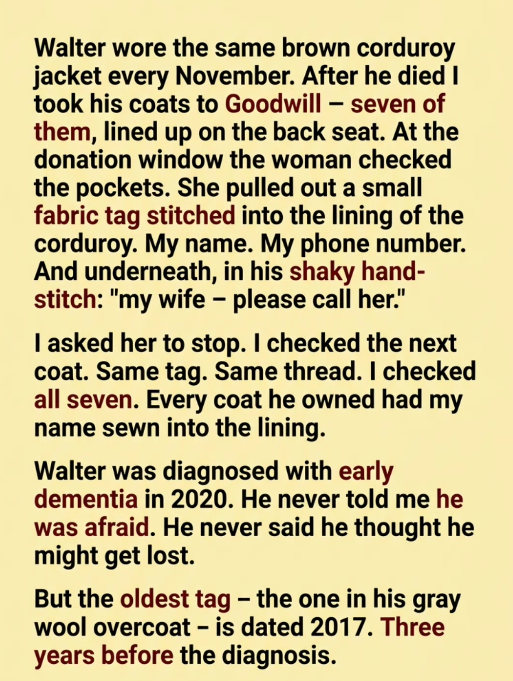
I gathered seven coats.
Folded them carefully.
Placed them in the back seat of my car.
And drove to Goodwill.
At the donation window, a volunteer began checking pockets.
Standard procedure.
Then she paused.
“Huh.”
I looked up.
She held a small fabric tag.
Hand-stitched into the lining of Walter’s brown corduroy jacket.
My name.
My phone number.
And beneath it, stitched in uneven thread:
“My wife. Please call her.”
For a moment I couldn’t understand what I was seeing.
The volunteer looked concerned.
“Did you know this was here?”
I shook my head.
“No.”
My voice barely worked.
I took the coat back.
Then checked another.
Same thing.
Another tag.
Same stitching.
Same message.
Then another.
And another.
Every coat.
All seven.
Each one carried my name.
My number.
And instructions to call me.
The parking lot seemed to tilt.
Walter had never mentioned any of this.
Not once.
I loaded the coats back into my car and drove home.
Then spread them across the living room floor.
One by one, I examined each tag.
The stitching varied.
Some newer.
Some older.
Then I found the oldest.
Inside his gray wool overcoat.
The coat he’d worn on our anniversary trips.
The coat he’d worn to our daughter’s wedding.
The coat he’d worn to his retirement party.
Unlike the others, this tag included a date.
Three years before his dementia diagnosis.
My hands started shaking.
Because Walter wasn’t diagnosed until 2020.
According to every doctor.
According to every test.
According to everything we knew.
Yet here was proof he had been worried years earlier.
I carefully unfolded the tag.
The message was longer than the others.
It read:
“If found, please call my wife, Margaret.
I sometimes lose things.
I’m hoping I never lose my way home.
But if I do, she knows how to find me.”
I burst into tears.
Not because of the words.
Because of the date.
Three years before anyone suspected anything.
Three years before the forgotten appointments.
Three years before the misplaced keys.
Three years before he looked at our daughter and briefly forgot her name.
He knew.
Somehow, he knew.
That night I opened the old wooden desk he’d used for decades.
The one I’d avoided since his death.
For three hours I searched.
Letters.
Receipts.
Manuals.
Tax returns.
Nothing.
Then, hidden inside a folder marked “Insurance,” I found a notebook.
A plain spiral notebook.
Walter’s handwriting filled every page.
The first entry was dated 2016.
A year earlier.
I sat down and started reading.
At first the notes seemed ordinary.
Forgot where I parked today.
Couldn’t remember neighbor’s name for ten minutes.
Burned toast because I forgot it was in the toaster.
Small things.
The kind of things everyone experiences.
Then the entries became more frequent.
More detailed.
More worried.
One sentence appeared repeatedly.
“I think something is changing.”
Another.
“Don’t tell Margaret yet.”
And another.
“Maybe I’m imagining it.”
Page after page.
Year after year.
Walter had been documenting his fears alone.
Trying to understand what was happening.
Trying to protect me from it.
Then I reached an entry dated November 2017.
The same month he stitched the first tag.
The words nearly broke me.
“Today I couldn’t remember the route home from the hardware store.”
I covered my mouth.
The hardware store was four blocks away.
A trip he’d made hundreds of times.
The next line shattered me.
“I sat in the parking lot for twenty minutes pretending to check receipts until the directions came back.”
I cried harder than I had at his funeral.
Because suddenly I understood.
The tags weren’t preparation.
They were fear.
Quiet.
Lonely fear.
A man recognizing pieces of himself slipping away.
The notebook continued for years.
As symptoms worsened, the entries became shorter.
Then one page changed everything.
Written in shaky handwriting.
Dated 2020.
The day after his official diagnosis.
It read:
“Margaret cried today.
I pretended not to notice.
She’s losing her future.
I’m only losing my memory.”
That sentence destroyed me.
Because even then.
Even facing his own decline.
He worried more about me.
The final entry appeared six months before he stopped writing entirely.
The handwriting was barely recognizable.
Words drifted across the page.
Sentences unfinished.
But one paragraph remained clear.
Perfectly clear.
As if he’d gathered every remaining piece of himself for one final message.
“If you’re reading this, then I’ve probably forgotten things I promised never to forget.
Maybe birthdays.
Maybe names.
Maybe where I left my glasses.
But there is one thing I want you to know.
Loving you was never something I had to remember.
It was the first thing I knew every morning.”
I couldn’t finish reading.
I simply sat there holding the notebook against my chest.
Crying.
Missing him.
Loving him.
A few weeks later, I took the coats out of storage.
Not to donate.
Not anymore.
Instead, I hung them back in the closet.
Every one.
The tags still sewn inside.
The little messages still hidden in the lining.
Sometimes I take out the brown corduroy jacket and run my fingers across the stitching.
The thread isn’t perfect.
Neither was Walter.
But every stitch tells the same story.
Long before doctors gave his condition a name.
Long before anyone else noticed.
He was preparing.
Not for getting lost.
For finding his way back to me.
And somehow, through seven old coats and a handful of hidden tags, he still does.