When my father introduced me to the woman he planned to marry, my first thought was that he was joking.
“This is Isabella.”
She smiled and extended her hand.
“It’s wonderful to finally meet you.”
I stared at her.
She looked familiar.
Not because we’d met before.
Because she looked exactly like women I worked with.
Women my age.
Actually…
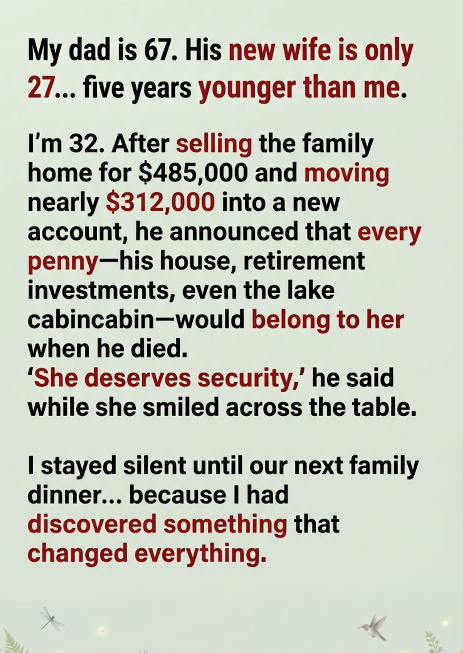
She was younger than me.
“I’m twenty-seven,” she said.
I was thirty-two.
My father was sixty-seven.
There were forty years between them.
Dad had been alone since my mother died four years earlier.
Their marriage had lasted thirty-six years.
Watching him after Mom’s death had been painful.
For months, he barely left the house.
He stopped fishing.
Stopped meeting friends for breakfast.
Sometimes I’d visit and find him sitting at the kitchen table staring at Mom’s empty chair.
So when he started smiling again, part of me was genuinely happy.
Even when I learned the reason was Isabella.
I tried not to judge.
Then everything started changing.
Fast.
They married after eight months.
There were twenty-two guests.
Dad looked happier than I’d seen him in years.
I hugged him afterward.
“If you’re happy, Dad…”
“…I’m happy.”
He squeezed my shoulder.
“That’s all I wanted to hear.”
I meant it.
At least then.
Six months later, Dad sold our family home.
The house where Mom and Dad had raised me.
The house they’d purchased when I was three.
The backyard where Mom taught me to ride a bicycle.
The kitchen doorway still had pencil marks showing my height from ages five through seventeen.
It sold for $485,000.
Dad didn’t tell me until after closing.
“It’s just a house.”
I swallowed my disappointment.
“You’re right.”
It belonged to him.
Not me.
Then he moved approximately $312,000 of the proceeds into a new account.
An account shared with Isabella.
Again, I said nothing.
His money.
His decision.
But then came Sunday dinner.
Dad poured himself another glass of iced tea and casually announced:
“I’ve changed my will.”
I looked up.
Isabella smiled.
“Everything goes to Isabella.”
I thought I’d misunderstood.
“Everything?”
“The house.”
“Retirement accounts.”
“Investments.”
“The lake cabin.”
“Everything.”
I stared at him.
“And me?”
Dad shrugged.
“You’re thirty-two.”
“You have a career.”
“Isabella deserves security.”
Across the table, she smiled.
Not cruelly.
Almost triumphantly.
I felt something inside me crack.
Still…
I didn’t argue.
I simply nodded.
“Okay.”
Dad seemed surprised.
“You’re not upset?”
“It’s your money.”
And that was true.
I went home.
Then I started going through boxes I’d taken from the family house before it sold.
That’s when I found something.
An old accordion folder belonging to my mother.
Inside were insurance policies.
Property records.
Tax statements.
And one document that made me sit down.
The lake cabin.
Dad had told everyone it belonged to him.
It didn’t.
Not entirely.
My grandparents had purchased the cabin almost sixty years earlier.
When Grandpa died, ownership passed equally to my mother and her sister, Aunt Rebecca.
Years later, Rebecca transferred her half to Mom.
Dad had never been added to the original deed.
After Mom died, her estate documents provided that her interest would pass according to her estate plan.
I couldn’t determine the current legal ownership from the old papers alone.
But there was enough there to make one thing clear:
Before Dad promised the cabin to anyone, the title needed to be checked.
So I called an attorney.
She ordered the current property records and reviewed Mom’s estate documents.
A week later, she called.
“You should come to my office.”
The answer was more complicated than I’d expected.
Dad had rights relating to some assets.
Others passed outside his estate.
Some beneficiary designations had never been updated.
And the lake property had restrictions created years earlier that Dad apparently hadn’t remembered.
Most importantly, Isabella could inherit only what Dad actually owned and what legally passed through the mechanisms he’d changed.
Simply saying “she gets everything” didn’t make it so.
But that wasn’t the discovery that truly frightened me.
That came three days later.
Aunt Rebecca called.
“I heard your father changed his will.”
“Yes.”
She went silent.
Then asked,
“Have you looked into Isabella?”
I frowned.
“Why would I?”
“Because I’ve seen her before.”
My stomach tightened.
“Where?”
“At your father’s grief-support group.”
“Months before he says they met.”
That night, I searched through Dad’s old photographs.
One picture had been taken at a charity luncheon roughly eighteen months earlier.
Dad stood with several members of his grief group.
In the background…
There she was.
Isabella.
According to Dad, he hadn’t met her until almost a year later.
Why was she there?
I didn’t accuse her.
Instead, I asked Dad at our next family dinner.
“How did you two meet again?”
He smiled.
“Coffee shop.”
“Last October.”
Isabella nodded.
“October nineteenth.”
I placed the photograph on the table.
Her smile disappeared.
“This was taken the previous February.”
Dad picked it up.
His forehead wrinkled.
There was Isabella.
Standing fifteen feet behind him.
She recovered quickly.
“I attended that fundraiser.”
“That doesn’t mean I knew him.”
“Fair enough.”
I placed down a second document.
“What about this?”
It was an email Aunt Rebecca had found.
Months before the coffee-shop meeting, Isabella had contacted the grief-support organization’s volunteer coordinator asking about upcoming events.
Nothing about that was inherently wrong.
But one line stood out.
She specifically asked whether widowed homeowners over sixty were among the people the program served because she was interested in “financial wellness outreach.”
Dad read it twice.
“What is this?”
Isabella pushed her chair backward.
“You’re twisting this.”
“Maybe.”
I looked at Dad.
“That’s why I’m not asking you to believe me.”
“I’m asking you to slow down.”
Then Dad surprised both of us.
He turned toward his wife.
“Why didn’t you tell me you’d seen me before?”
Isabella didn’t answer.
“Why did you pretend the coffee shop was the first time?”
Still nothing.
Finally, she whispered,
“Because I knew how it would sound.”
Dad’s expression changed.
“Then tell me how it sounds.”
What followed wasn’t the dramatic confession I’d expected.
The truth was messier.
Isabella had volunteered briefly with a financial education nonprofit.
She had seen Dad at several events.
She knew he was widowed.
She knew he owned property.
She admitted she’d been curious about him before their supposedly accidental meeting.
Eventually, she arranged to visit the coffee shop she knew he frequented.
Their meeting hadn’t been accidental at all.
“I wanted to meet him.”
She started crying.
“Yes.”
“But then I fell in love with him.”
I didn’t know whether to believe her.
Neither did Dad.
That night, Dad asked Isabella to stay with her sister for a while.
Then he came home with me.
At two in the morning, I found him sitting alone in my kitchen.
“Do you think she ever loved me?”
I sat beside him.
“I don’t know.”
He stared at his hands.
“I feel like an idiot.”
“You’re not.”
“You were lonely.”
“Someone made you feel wanted.”
“That doesn’t make you stupid.”
Then he asked the question I had been waiting for.
“Are you angry about the inheritance?”
I thought carefully before answering.
“No.”
“I’m angry that you made enormous decisions while believing things that might not have been true.”
Dad didn’t immediately divorce Isabella.
And I didn’t demand that he did.
Instead, he did something much smarter.
He slowed everything down.
He hired his own attorney.
Reviewed his estate plan independently.
Changed financial passwords.
Separated accounts where appropriate.
Updated beneficiary designations according to what he actually wanted.
Confirmed ownership of every property.
He also began seeing a counselor.
Not because there was something wrong with loving someone younger.
Because major financial decisions deserve independent thought regardless of whom you marry.
Isabella eventually returned.
She and Dad spent months in counseling.
Some truths were painful.
Others surprised me.
She admitted that financial security had attracted her initially.
Dad admitted that being desired by someone so much younger had made him ignore questions he normally would have asked.
Neither pretended their relationship had begun perfectly.
Whether their marriage would survive was ultimately their decision.
Almost a year later, Dad invited me to the lake cabin.
We sat on the dock together.
He handed me an envelope.
“I rewrote everything.”
“Dad…”
“I don’t want to know what’s in your will.”
He smiled.
“Good.”
“Because I’m not telling you.”
I laughed.
Then his expression became serious.
“I spent my whole life thinking inheritance was about deciding who gets your things after you die.”
He looked across the lake.
“I finally realized estate planning is also about making sure nobody controls you while you’re alive.”
He reached into his pocket and handed me something else.
Mom’s old house key.
The house itself belonged to strangers now.
The key opened nothing.
“Why are you giving me this?”
“Because I shouldn’t have sold the house without giving you a chance to say goodbye.”
That was when I cried.
Not over $485,000.
Not over the cabin.
Not over an inheritance.
Over a useless brass key.
Because Dad finally understood what I’d been trying to tell him.
I never wanted his money.
I wanted to know that thirty-two years of being his daughter hadn’t suddenly become less important because someone new entered his life.
I still have that key.
It sits inside a little wooden box beside a photograph of Mom and Dad taken on their twenty-fifth anniversary.
And the older I get, the more I understand something:
Parents don’t owe their adult children an inheritance.
Love cannot be measured by the percentage written beside someone’s name in a will.
But enormous financial decisions made under secrecy, pressure, or false assumptions deserve scrutiny.
Because sometimes protecting someone you love doesn’t mean fighting to get their money.
It means making sure the decision to give it away was truly theirs.
That was all I ever wanted for my father.
Not his house.
Not his retirement account.
Not his $485,000.
Not even the lake cabin.
I wanted him to remain the author of his own life.
And sometimes loving a parent means having the courage to ask whether someone else has quietly started holding the pen.