My name is Margaret Ellis.
I’m seventy-one years old.
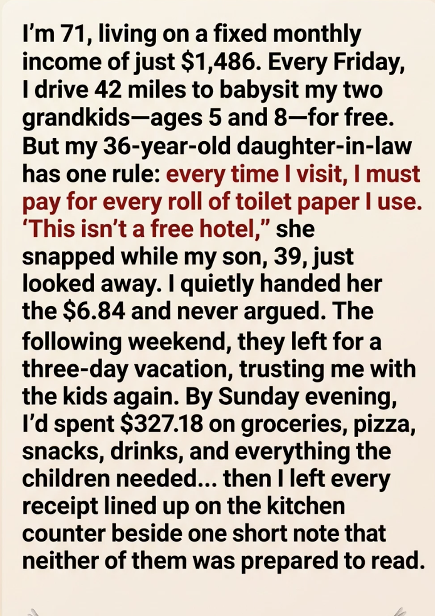
Every month, after Medicare premiums and supplemental insurance, my retirement check leaves me with exactly $1,486 to live on.
It isn’t much.
I budget everything.
I know which grocery store sells eggs for thirty cents less.
I wait for pharmacy discounts.
I haven’t bought myself a new winter coat in six years because the old one still keeps me warm.
I don’t feel sorry for myself.
Millions of people live carefully.
So do I.
Every Friday morning, I wake up before sunrise.
At 6:15, I climb into my twelve-year-old sedan and drive forty-two miles to my son Michael’s house.
My grandson, Owen, is eight.
My granddaughter, Lily, is five.
Their daycare closes early on Fridays, and hiring a sitter for the weekend costs far more than Michael and his wife, Ashley, want to spend.
So I help.
Not because anyone pays me.
Because I love those children.
We bake cookies.
Build blanket forts.
Read books.
Catch lightning bugs in the backyard.
Those weekends are the brightest part of my life.
Ashley likes organization.
Everything has rules.
Shoes stay by the door.
Only one towel per shower.
The dishwasher must be loaded a certain way.
I respected every rule.
Then one Friday afternoon, she stopped me as I came out of the downstairs bathroom.
She held out a package of toilet paper.
“I’m going to need you to replace what you use.”
I thought she was joking.
She wasn’t.
“This stuff is expensive.”
“We’re trying to keep a budget.”
I looked at Michael.
He stared at the floor.
Ashley pulled out her phone.
“I figured it up.”
“$6.84.”
I quietly reached into my purse.
Counted the bills.
Handed her the money.
She smiled.
“Thanks for understanding.”
I didn’t answer.
Not because I was angry.
Because I suddenly understood exactly where I stood in that house.
The following week, Michael called.
“Dad’s old fishing buddies surprised us with a three-day trip.”
“Could you stay with the kids all weekend?”
“Of course.”
He sounded relieved.
“We really appreciate it.”
I smiled.
“I know.”
Friday evening, Ashley rushed through instructions.
Emergency numbers.
Bedtime routines.
Soccer practice.
Then they drove away.
The children waved until the car disappeared.
As soon as the front door closed, Owen looked at me.
“Grandma…”
“Can we have pizza tonight?”
I laughed.
“Absolutely.”
Over the next three days, we had a wonderful weekend.
Pizza Friday.
Pancakes Saturday.
We visited the library.
Made popcorn for movie night.
Bought sidewalk chalk.
Replaced the milk that had run out.
Picked up fresh fruit because Lily loved strawberries.
Filled the car with gas after driving everyone to soccer.
When Owen accidentally tore his backpack, I bought a new zipper pouch so his school supplies wouldn’t fall out.
Every purchase came from my own pocket.
I never thought twice about it.
They’re my grandchildren.
By Sunday evening, I totaled everything.
Groceries.
Pizza.
Juice boxes.
Medicine for Lily’s mild fever.
Craft supplies.
Gas.
The grand total came to $327.18.
I carefully placed every receipt in a neat row across the kitchen counter.
Then I wrote one short note.
“Dear Michael and Ashley,”
“These receipts total $327.18.”
“Please don’t reimburse me.”
“Grandparents don’t keep score while caring for children they love.”
“Neither should parents.”
“The $6.84 you charged me last week wasn’t about toilet paper.”
“It showed me the difference between treating someone like family and treating them like an expense.”
“I love Owen and Lily more than words can say, and I will always be here for them.”
“But beginning next month, I won’t be your regular childcare.”
“I hope you’ll use the money you save on toilet paper toward a babysitter who better fits your budget.”
“Love,”
“Mom.”
I kissed the children goodbye.
Locked the door.
Drove home.
I cried most of the way.
Not because of the money.
Because setting boundaries with people you love is sometimes the hardest thing you’ll ever do.
Michael called before I even reached my driveway.
“Mom…”
“I’m so sorry.”
I could hear Ashley crying in the background.
“I never should’ve let that happen.”
“No,” I answered softly.
“You shouldn’t have.”
There was a long silence.
Then he whispered,
“I was embarrassed.”
“I know.”
“I should’ve defended you.”
“Yes.”
“I failed.”
Again…
“Yes.”
A week later, both of them came to my apartment.
Ashley carried a small paper bag.
Inside was a package of toilet paper.
On top sat a birthday card I’d somehow forgotten was coming.
Inside the card was another note.
“We forgot that our children were watching how we treated you.”
“We’re ashamed of what we taught them.”
“We’re sorry.”
Ashley quietly handed me an envelope.
Inside was a check for $327.18.
I handed it back.
“I told you.”
“I’m not charging you.”
She nodded through tears.
“I know.”
“It’s not payment.”
“It’s an apology.”
I accepted the apology.
Not the check.
Instead, I suggested something else.
“If you really want to make this right…”
“Open savings accounts for the kids.”
“Put the money there.”
“Teach them generosity instead of keeping score.”
They agreed.
Several months later, Owen asked me a question while we baked chocolate chip cookies.
“Grandma…”
“Why do you always help people?”
I smiled.
“Because one day, you’ll remember how people made you feel.”
He stirred the batter for a minute.
Then looked up.
“I want people to remember that I was kind.”
I hugged him tightly.
“So do I.”
I’m seventy-one now.
My income hasn’t changed.
I still count pennies.
I still shop sales.
But every Friday, I drive those forty-two miles with a lighter heart.
Sometimes I babysit.
Sometimes Michael and Ashley hire someone else.
Sometimes we all have dinner together.
The difference is that no one hands me a bill when I leave the bathroom anymore.
Respect, I learned, isn’t measured by dollars.
It’s measured by whether the people who love you remember that your generosity was never something they were entitled to.
And thankfully, my family finally remembered.