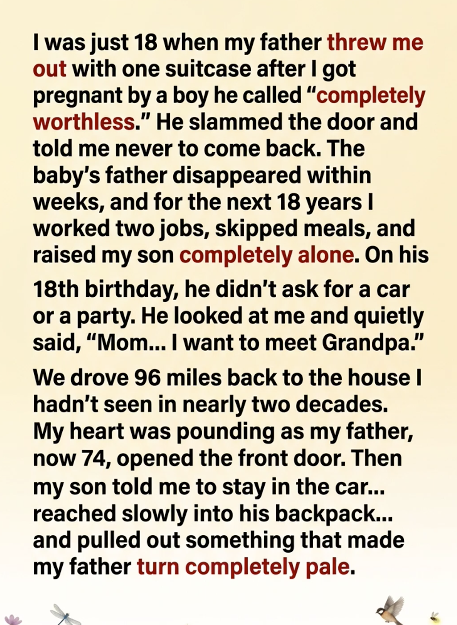
I was eighteen years old when my father threw me out of the house.
One suitcase.
A hundred and twelve dollars in cash.
And seven words I never forgot.
“If you leave now, don’t come back.”
I wasn’t leaving.
He was making sure I had no choice.
I was three months pregnant.
The baby’s father, Tyler, was nineteen.
My father called him “completely worthless.”
To be fair, he wasn’t entirely wrong.
Tyler promised we’d raise the baby together.
He promised he’d get a job.
He promised we’d be a family.
Three weeks after I moved into a tiny apartment with peeling wallpaper and broken blinds…
He disappeared.
No goodbye.
No child support.
No forwarding address.
Just gone.
For the next eighteen years, my life became a routine.
Waitressing before sunrise.
Cleaning offices at night.
Studying community-college classes whenever I could stay awake.
There were months I skipped dinner so my son could have seconds.
Birthdays with homemade cakes.
Christmas presents from thrift stores.
Secondhand clothes.
Old cars that barely started.
It wasn’t easy.
But my son, Noah, never complained.
Not once.
People often asked whether I hated my father.
The truth was more complicated.
For years, I was furious.
Then I became busy.
Then tired.
Eventually…
The anger settled into something quieter.
A sadness that never completely disappeared.
Noah grew into the kind of young man every parent hopes to raise.
Respectful.
Hardworking.
Gentle.
The exact opposite of the future everyone had predicted for him.
He graduated near the top of his class.
Earned a scholarship.
Worked weekends anyway.
He always thanked me for everything.
Even when I felt I hadn’t given him enough.
On his eighteenth birthday, I expected the usual requests.
A car.
A graduation trip.
Maybe a new laptop.
Instead, after blowing out the candles, he looked at me and quietly said,
“Mom…”
“I want to meet Grandpa.”
The room became completely silent.
I hadn’t spoken my father’s name in years.
“I don’t think that’s a good idea.”
“I do.”
“Why?”
He smiled gently.
“Because I think both of you have carried this long enough.”
The following Saturday, we drove ninety-six miles to the town where I’d grown up.
Every mile brought back memories I thought I’d buried.
The grocery store where Mom used to buy cinnamon rolls.
The little church.
The gas station where Dad always stopped for coffee.
Everything looked smaller.
Except my fear.
That felt exactly the same.
The old farmhouse hadn’t changed much.
The white paint had faded.
The porch swing was gone.
But the maple tree I’d climbed as a little girl still stood beside the driveway.
I almost turned the car around.
“I can’t do this.”
Noah placed his hand over mine.
“You don’t have to.”
“I’ll go first.”
He stepped out carrying a faded backpack.
I stayed in the driver’s seat.
My heart pounded so hard I thought I might faint.
He knocked.
A minute later, the front door slowly opened.
My father looked older.
Much older.
His shoulders stooped.
His hair completely white.
For several seconds, neither of them spoke.
Then Noah quietly said,
“My name is Noah.”
“I’m your grandson.”
Dad gripped the doorframe to steady himself.
I watched through the windshield as they talked.
Then Noah slowly reached into his backpack.
He pulled out a thick blue binder.
My father’s face lost every trace of color.
He looked as though he might collapse.
I couldn’t stand it anymore.
I hurried toward the porch.
“What is it?”
Noah looked at me.
“I found Grandma’s letters.”
I froze.
“My mother’s letters?”
He nodded.
“The ones she wrote before she passed away.”
After my grandmother died, several boxes had been stored in the attic of a cousin’s house.
While helping clean it out months earlier, Noah discovered a bundle of unopened envelopes.
Every one was addressed to my father.
None had ever been mailed.
Inside those letters, my grandmother pleaded with him to forgive me.
One passage read:
“If you lose your daughter because of your pride, you’ll lose far more than you realize.”
Another simply said:
“Please don’t let my granddaughter or grandson grow up believing our family stopped loving them.”
She had written those words while dying of cancer.
My father had never seen them.
His hands trembled as he read.
One page.
Then another.
Then another.
Tears rolled down his face.
The kind of tears that come only after years of refusing to cry.
Finally, he looked at me.
“I’m sorry.”
I had imagined that moment a thousand times.
I thought hearing those words would erase eighteen years of hurt.
It didn’t.
But it mattered.
He invited us inside.
For the first time since I was eighteen, I crossed the threshold of the house where I’d grown up.
Everything smelled exactly the same.
Coffee.
Old books.
Pine wood.
Dad quietly admitted something I’d never expected.
“I looked for you.”
I stared at him.
“What?”
“I drove to your old apartment.”
“You’d already moved.”
“I asked people.”
“No one knew where you went.”
He lowered his eyes.
“I convinced myself you didn’t want to be found.”
I whispered,
“I thought you never wanted me back.”
We spent the entire afternoon talking.
Not arguing.
Talking.
Dad admitted he’d let pride make decisions that love should have made.
I admitted I’d been too hurt to reach out again.
Neither of us could change the past.
But for the first time, we stopped pretending it hadn’t happened.
Before we left, Dad disappeared into the garage.
He returned carrying an old wooden rocking horse.
“I built this when I found out you were pregnant.”
I stared at him.
“You threw me out.”
“I know.”
“I built it anyway.”
He looked at Noah.
“I hoped…”
“…that someday…”
“…I’d meet the little boy.”
The rocking horse had never been finished.
It had waited eighteen years.
Just like we had.
Dad lived another six years.
They weren’t enough to make up for everything we lost.
Nothing could.
But they were enough for Noah to know his grandfather.
Enough for Sunday dinners.
Fishing trips.
Birthday cakes.
Stories about the family he’d almost never met.
The last time I saw my father alive, he hugged me at the front door.
Just before I left, he whispered,
“I spent eighteen years believing I was punishing you.”
He shook his head slowly.
“The whole time…”
“I was only punishing myself.”
People sometimes ask whether I forgave him.
The answer is yes.
Not because what he did wasn’t painful.
It was.
Not because he deserved forgiveness.
Perhaps he did.
Perhaps he didn’t.
I forgave him because carrying eighteen years of anger was heavier than carrying one honest apology.
And because my son—the little boy everyone expected to become another mistake—grew into the man who had enough courage to heal a family that two stubborn adults couldn’t.
In the end, the most valuable thing he carried in that backpack wasn’t a binder of old letters.
It was the willingness to open a door that pride had kept closed for nearly two decades.