The worst sentence I have ever spoken lasted only seven words.
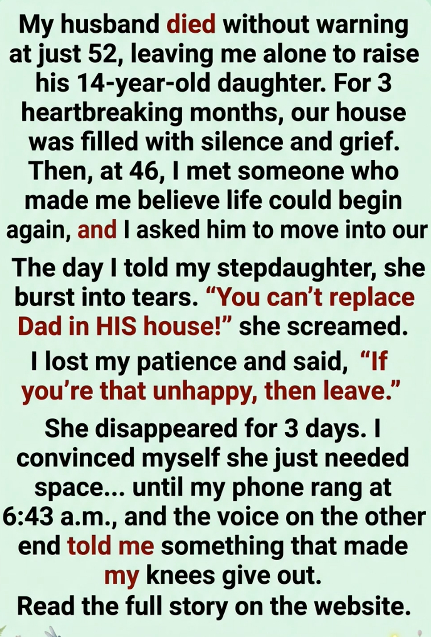
“If you’re that unhappy, then leave.”
I said it in anger.
I never imagined she would.
Or that those words would haunt me for the rest of my life.
My husband, Daniel, died suddenly from a massive heart attack at fifty-two.
One ordinary Tuesday morning he kissed us goodbye before work.
By lunchtime, a police officer was standing at my front door.
He never came home.
I was forty-six.
His daughter, Chloe, was fourteen.
Although I wasn’t her biological mother, I had helped raise her since she was six.
When her own mother moved overseas and gradually drifted out of contact, Daniel and I became the only parents she truly knew.
After his death, it was just the two of us.
Two people drowning in the same grief.
Trying to save each other.
Without realizing we were both sinking.
The house became painfully quiet.
Dinner happened in silence.
The television stayed off.
Daniel’s slippers remained beside the bed exactly where he’d left them.
Every room reminded us of him.
Neither of us knew how to move forward.
Three months later, I met Michael.
Not through a dating app.
Not because I was looking for someone.
We met in a grief support group.
He had lost his wife to cancer two years earlier.
He understood silence.
He understood loneliness.
Most importantly, he never tried to replace Daniel.
He simply reminded me that surviving wasn’t the same as living.
Over several months, we became close.
Eventually, I asked him to move into the house.
Looking back…
I should have talked to Chloe first.
That evening, I sat her down in the kitchen.
“I need to tell you something.”
She looked up from her homework.
“Michael is going to live with us.”
For several seconds, she said nothing.
Then tears filled her eyes.
“You can’t replace Dad.”
“I’m not trying to.”
“You are!”
She stood so quickly her chair fell backward.
“You can’t put another man in Dad’s house!”
I tried to explain.
She wouldn’t listen.
The argument grew louder.
Finally, exhausted and overwhelmed, I snapped.
“If you’re that unhappy…”
“…then leave.”
The moment the words left my mouth…
I wished I could take them back.
The next morning, Chloe was gone.
Her backpack.
A few clothes.
Nothing else.
A note lay on the kitchen table.
“I need time.”
I called every friend I knew.
Nobody had seen her.
Michael wanted to contact the police immediately.
I hesitated.
“She’s fourteen.”
“Maybe she’s staying with someone.”
Looking back, I wish I hadn’t waited even an hour.
Three days later.
6:43 a.m.
My phone rang.
Unknown number.
A calm voice answered when I picked up.
“Is this Mrs. Reynolds?”
“Yes.”
“This is Officer Martinez.”
My knees nearly gave out.
“We’ve located Chloe.”
She was alive.
Safe.
Cold.
Hungry.
She had been staying at a youth shelter nearly forty miles away after a bus driver noticed she seemed frightened and alone.
The shelter staff contacted authorities once they realized she was a missing minor.
I burst into tears before the officer finished speaking.
When I arrived, Chloe sat quietly wrapped in a gray blanket.
The moment she saw me, she looked down at the floor.
I didn’t lecture her.
I didn’t ask questions.
I simply hugged her.
For a long time…
Neither of us let go.
The drive home was almost silent.
Finally, Chloe whispered,
“I thought you meant it.”
I gripped the steering wheel tighter.
“I didn’t.”
“You told me to leave.”
“I know.”
“I’m so sorry.”
She stared out the window.
“I wasn’t angry because of Michael.”
I frowned.
“You weren’t?”
She shook her head.
“I was scared.”
She finally explained what she’d been unable to say during our argument.
Every major change after Daniel’s death had happened quickly.
His clothes disappeared.
His office became a guest room.
Family photographs were moved.
Now another man was moving into the house.
To Chloe…
It felt as though everyone expected life to continue while she was still trying to understand why her father was gone.
She wasn’t protecting a building.
She was protecting the last place where she still felt close to him.
That evening, Michael packed his overnight bag.
“I’m going back to my apartment.”
“You don’t have to.”
“I do.”
He smiled kindly.
“She needs her home to feel safe again.”
He wasn’t leaving because he felt rejected.
He was giving us room to heal.
Over the next year, Chloe and I attended family counseling together.
Not because either of us was broken.
Because grief changes how people hear each other.
I learned not to mistake silence for rejection.
She learned that loving someone new doesn’t erase the people we’ve lost.
Michael remained part of our lives.
Slowly.
Patiently.
Never forcing his place.
Never asking Chloe to call him anything except his name.
Two years later, on Daniel’s birthday, all three of us visited his favorite hiking trail.
After we placed flowers beneath the old oak tree he loved, Chloe quietly slipped her hand into mine.
Then she reached for Michael’s.
We walked back together.
Not because anyone had replaced Daniel.
No one ever could.
But because love had expanded without asking us to forget.
People sometimes ask me what the biggest mistake I made was after losing my husband.
It wasn’t meeting someone new.
It wasn’t falling in love again.
It was assuming that because I was ready to take one small step forward…
The child grieving beside me was ready too.
Grief doesn’t follow the same calendar for everyone.
And the people we love most often need understanding before they need solutions.
I still think about those seven words I spoke in anger.
But today, I remember something stronger than my mistake.
The moment Chloe finally believed my next words instead.
“You will always have a home with me.”