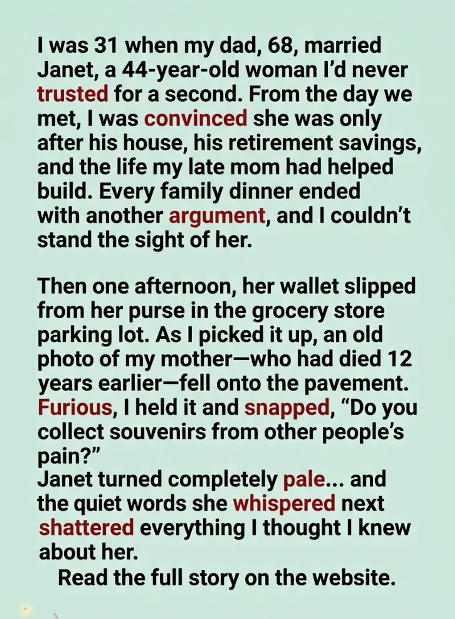
I was thirty-one when my father remarried.
He was sixty-eight.
Her name was Janet.
She was forty-four.
My mother had been gone for twelve years.
To me, that still wasn’t long enough.
Dad insisted loneliness had nothing to do with his decision.
“I’ve loved your mother every day since we met,” he told me.
“But loving someone who has died doesn’t mean you’re supposed to stop living.”
I nodded politely.
I didn’t believe him.
Or maybe I simply didn’t want to.
From the beginning, I distrusted Janet.
She never asked for expensive jewelry.
Never pushed Dad to sell the house.
Never talked about his retirement.
But I convinced myself she was simply patient.
Every kindness felt calculated.
Every smile seemed rehearsed.
Every family dinner ended the same way.
I’d make a sarcastic comment.
She’d stay quiet.
Dad would change the subject.
We all went home exhausted.
The hardest part wasn’t that Dad had married someone else.
It was seeing another woman sit in my mother’s chair during Sunday dinners.
Watching someone else water the roses Mom had planted.
Hearing laughter in a house that still smelled like my childhood.
Grief has a way of disguising itself as anger.
I didn’t understand that then.
One Saturday afternoon, I stopped at the grocery store after work.
As I pushed my cart toward my car, I noticed Janet several spaces away loading bags into Dad’s SUV.
She smiled politely.
I gave a stiff nod.
As she reached for another bag, her wallet slipped from her purse and landed on the pavement.
Cards scattered everywhere.
Along with one faded photograph.
I picked it up automatically.
Then I froze.
It was my mother.
Not a copy.
The original photograph I’d remembered sitting on our piano for years.
Mom was laughing at something outside the frame.
She wore the blue sweater Dad had always said was her favorite.
My chest tightened.
I held the picture up.
“What is this?”
Janet looked down.
The color drained from her face.
I couldn’t stop myself.
“Do you collect souvenirs from other people’s pain?”
Several shoppers turned toward us.
Janet didn’t answer immediately.
She simply stared at the photograph.
Then, in a voice barely above a whisper, she said,
“Your mother gave that to me.”
I laughed bitterly.
“My mother died twelve years ago.”
“I know.”
“So don’t lie to me.”
She swallowed hard.
“I met your mother fourteen years ago.”
My anger paused just long enough for confusion to slip in.
“What are you talking about?”
She glanced around the parking lot.
“Would you have coffee with me?”
“I don’t think so.”
“It’s about your mom.”
For reasons I still can’t explain, I agreed.
We sat in a quiet café across the street.
Janet carefully placed the photograph on the table.
“I was twenty-nine.”
“My husband had just died.”
“I was raising my six-year-old daughter alone.”
“I joined a grief support group.”
My heart skipped.
“So did your mother.”
I frowned.
“My mother wasn’t widowed.”
“No.”
“She had breast cancer.”
“She came to support meetings for families facing terminal illness.”
I’d never known that.
Mom had kept much of her illness hidden from me.
I was only nineteen.
She always insisted she was “doing fine.”
Janet reached into her wallet again.
This time she removed a folded letter.
The paper was worn soft from years of being opened.
“It’s addressed to me.”
The handwriting stopped me cold.
It was my mother’s.
“Dear Janet,”
“If you’re reading this, I probably wasn’t lucky enough to beat this disease.”
“Please don’t waste your life feeling guilty for surviving your husband.”
“Raise your little girl with joy.”
“And if you ever meet someone kind enough to love you again…”
“Don’t let anyone convince you that loving twice means loving the first person less.”
At the bottom, Mom had added one final sentence.
“Keep this photo so you’ll remember the day we promised each other we’d choose hope.”
My eyes filled with tears.
“I never knew about any of this.”
Janet smiled sadly.
“Your mother didn’t want you carrying her fear.”
For nearly two hours, Janet told me stories I’d never heard.
How Mom encouraged other patients even during chemotherapy.
How she baked muffins for the nurses.
How she convinced Janet to apply for a bookkeeping course because “one day you’ll need to believe in tomorrow.”
Then Janet quietly admitted something else.
“When I met your father years later…”
“I almost walked away.”
“Why?”
“Because I recognized your last name.”
“I knew exactly who he was.”
She looked down at the table.
“I thought falling in love with him would feel like betraying your mother.”
Instead, she’d found someone who still spoke about Mom with gratitude instead of trying to erase her memory.
That evening, I drove to Dad’s house.
He opened the door looking nervous.
“I’m guessing Janet told you.”
“You knew?”
He nodded.
“They stayed friends until your mother died.”
“Why didn’t either of you tell me?”
Dad smiled sadly.
“Because every time I mentioned your mother…”
“…you looked like your heart was breaking.”
“I thought knowing she’d helped Janet heal might make things harder.”
I walked into the living room.
On the bookshelf stood a photograph I’d never noticed before.
It showed my parents and Janet together at a charity fundraiser years before Mom died.
All three of them were laughing.
There had never been a secret affair.
No hidden betrayal.
Just a friendship I’d never known existed.
Weeks later, I apologized to Janet.
“I judged you before I knew you.”
She reached across the table and squeezed my hand.
“You weren’t really judging me.”
“You were protecting your mother.”
There was no anger in her voice.
Only understanding.
A few months later, Janet handed me the photograph.
“I think it belongs with you now.”
I shook my head.
“No.”
“My mother gave it to you.”
“And she meant for you to keep it.”
I smiled.
“But would you make me a copy?”
She laughed.
“I already did.”
Today, that copied photograph sits on my bookshelf.
The original is still inside Janet’s wallet.
Exactly where my mother wanted it to be.
For years, I believed Janet represented everything I’d lost.
I was wrong.
She was carrying one of the last gifts my mother ever gave another human being—a reminder that grief and love are not enemies.
They can exist together.
And sometimes the greatest way to honor someone we’ve lost isn’t by guarding their memory from others.
It’s by recognizing the kindness they left behind in the people whose lives they touched.