After twenty-seven years of marriage, I believed there wasn’t much left to surprise us.
My husband, Steven, was fifty-two.
I was forty-nine.
We had built a comfortable life together.
A paid-off home.
Retirement savings.
Weekend trips.
Shared routines that felt as permanent as the walls around us.
If someone had asked me whether I trusted him, I wouldn’t have hesitated.
Completely.
That certainty lasted until one ordinary Saturday in August 2023.
Steven tossed his sport coat onto the kitchen chair before heading upstairs.
As I picked it up to hang it in the closet, a receipt slipped from the pocket.
Normally I would’ve thrown it away.
Instead, one number caught my attention.
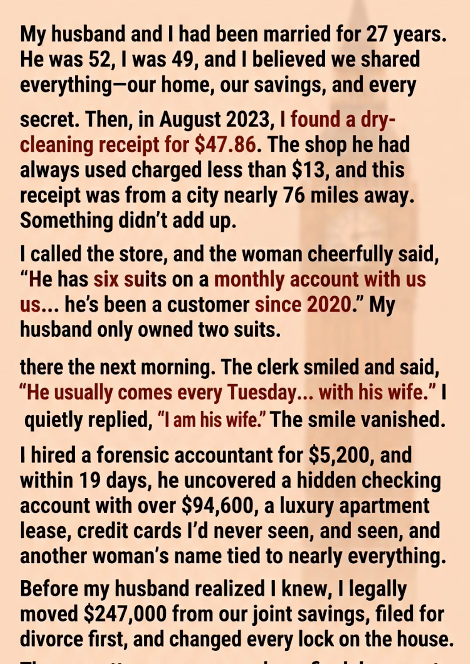
Dry Cleaning: $47.86
That didn’t make sense.
The neighborhood cleaner we’d used for years charged less than thirteen dollars to clean one of Steven’s suits.
I looked more closely.
The receipt wasn’t even from our town.
It came from a business nearly seventy-six miles away.
When Steven came downstairs, I casually asked,
“Did you have a meeting out of town?”
He barely looked up from his phone.
“No.”
“Just the usual office.”
I folded the receipt and said nothing.
The next morning, curiosity got the better of me.
I called the number printed on it.
A cheerful employee answered.
“Good morning! Harper Cleaners.”
I explained that I was trying to identify an old receipt.
She immediately recognized the account.
“Oh, yes!”
“Mr. Collins.”
“He has six business suits on a monthly account with us.”
“We’ve looked after his clothes since 2020.”
I stared at the wall.
“Six suits?”
“Yes.”
“We’re expecting him again Tuesday.”
My husband owned exactly two suits.
One charcoal gray.
One navy blue.
Both hanging in our bedroom closet.
I thanked her and hung up.
For the first time in twenty-seven years, I seriously wondered whether I knew the man I’d married.
Tuesday morning, I drove to the dry cleaner.
I arrived fifteen minutes before opening.
At exactly 8:40, Steven’s SUV pulled into the parking lot.
He wasn’t alone.
A woman stepped out of the passenger seat.
She laughed as he held the door open for her.
Inside the store, I waited until they left.
Then I approached the counter.
The same employee smiled warmly.
“Oh!”
“You just missed your husband.”
“My…”
“…husband?”
“Yes.”
“He usually comes every Tuesday with his wife.”
I quietly replied,
“I am his wife.”
The smile disappeared.
I drove home in complete silence.
I didn’t confront Steven.
Not yet.
Instead, I hired a forensic accountant.
It cost me $5,200.
The best money I ever spent.
Nineteen days later, the accountant placed a thick report on my dining room table.
“You’re going to want to sit down.”
Hidden accounts.
Transfers I’d never authorized.
A checking account containing more than $94,600.
Credit cards issued to an address I’d never seen.
A luxury apartment leased under Steven’s name.
Utility bills.
Insurance documents.
The same woman listed as an emergency contact.
The evidence suggested he’d been living a carefully concealed second life.
The accountant also found something else.
Large sums of money moving through accounts that didn’t match Steven’s salary.
“I can’t tell you this is illegal,” he said carefully.
“But I can tell you these transactions deserve explanation.”
That was enough for me.
I contacted an attorney.
Before Steven realized what I knew, my attorney helped me take lawful steps to protect my interests.
We documented every joint account.
Preserved financial records.
Filed for divorce.
Requested appropriate temporary court orders.
Where permitted under the law and with legal advice, we transferred funds from joint accounts into an attorney-managed account so they would remain available for the court to divide rather than disappear.
Everything was documented.
Everything was legal.
Then I changed the locks after Steven moved out pursuant to the temporary orders.
When he was served with divorce papers, he called immediately.
“You’ve lost your mind.”
“No.”
“I finally found it.”
He denied everything.
Claimed the apartment belonged to a client.
Said the woman was “just helping with work.”
Insisted the hidden accounts were innocent.
My attorney simply smiled.
“We’ll let the documents speak.”
During the financial disclosure process, another surprise emerged.
One of Steven’s business ventures had involved falsified invoices and misrepresented financial records.
The civil investigation eventually estimated questionable transactions exceeding $1.2 million.
Whether every allegation would ultimately be proven was for investigators and the courts to determine—not for me.
But the discovery explained why so much money had been moving through accounts I’d never known existed.
The affair, devastating as it was, turned out to be only one piece of a much larger pattern of deception.
The divorce lasted almost eighteen months.
It wasn’t easy.
It wasn’t quick.
But because detailed financial records had been preserved early, there was a clear paper trail for the court to evaluate.
That mattered far more than angry arguments ever could.
One afternoon, after everything was finally over, my attorney handed me the original dry-cleaning receipt.
“I thought you might want this.”
I laughed.
“Why would I keep it?”
He smiled.
“Because sometimes the smallest document changes the direction of an entire life.”
He was right.
Today, people sometimes ask what finally convinced me something was wrong.
They assume it was discovering another woman.
Or the hidden apartment.
Or the bank accounts.
It wasn’t.
It was a receipt for $47.86.
Because deception often unravels the same way a loose thread unravels a sweater.
At first, it looks insignificant.
Then you pull gently.
And eventually you discover the whole fabric was never as solid as it seemed.
The hardest lesson I learned wasn’t that my husband had secrets.
It was that trust should never require us to ignore facts that don’t make sense.
Sometimes the truth begins with one small question:
“Why would two suits suddenly cost forty-seven dollars and eighty-six cents to clean?”