When my six-year-old daughter, Lily, came home after her first week of first grade in 2025, I expected stories about new friends, crayons, and recess games.
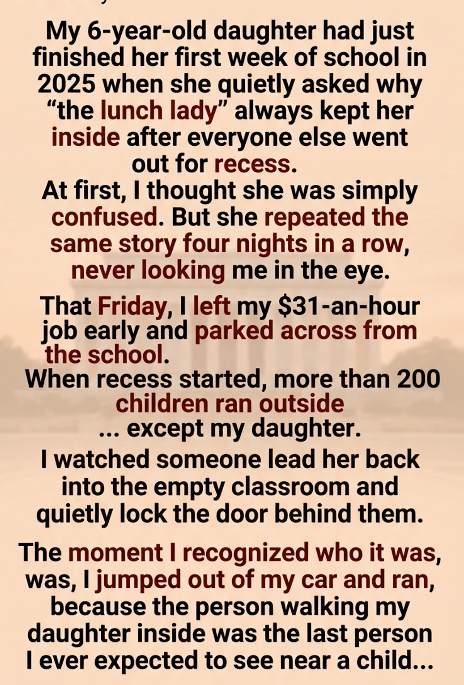
Instead, while we were eating dinner, she quietly asked,
“Mom… why does the lunch lady always keep me inside after everyone else goes to recess?”
I looked up from my plate.
“What do you mean?”
She shrugged.
“She says I have to stay.”
I assumed she’d misunderstood.
Children often mix up teachers, aides, and cafeteria staff.
So I smiled.
“I’m sure there’s a reason.”
She nodded.
But she didn’t look convinced.
The next evening, she mentioned it again.
Then again on Wednesday.
And again on Thursday.
Always the same story.
Always looking down at her hands.
She wasn’t dramatic.
She wasn’t crying.
If anything, she sounded confused.
That worried me even more.
By Friday, I decided I needed to see for myself.
I left my $31-an-hour office job early, parked across the street from the school, and waited.
At noon, the recess bell rang.
More than 200 children burst through the doors laughing and running toward the playground.
Only one child stayed behind.
Lily.
I watched an adult gently take her hand and lead her back toward the building.
Then the classroom door closed.
A moment later, I heard the lock click.
My heart began pounding.
I jumped out of my car and ran toward the school.
Inside the front office, I identified myself immediately.
“My daughter is in Room 104.”
“I just saw someone lock the classroom door.”
The secretary stood up at once.
Instead of looking surprised, she picked up the phone.
Within seconds, the principal hurried into the hallway.
“Mrs. Harris?”
“Come with me.”
We walked quickly toward Lily’s classroom.
The principal unlocked the door.
Inside, Lily sat smiling at a small table.
Beside her was not the lunch lady.
It was the school’s reading intervention specialist.
The woman stood immediately.
“I’m so sorry this frightened you.”
The principal looked equally concerned.
“We’ve clearly made a mistake by not explaining this.”
I looked at Lily.
“Sweetheart… what’s happening?”
She pointed to a stack of colorful books.
“I get special reading time.”
The reading specialist gently explained that during Lily’s first-week literacy screening, she had shown signs of struggling to recognize certain letter sounds.
The school had enrolled her in a short, one-on-one reading intervention during the first fifteen minutes of recess, with my signed beginning-of-year academic screening forms serving as permission for educational support if recommended.
Then she showed me the paperwork.
My signature was there.
Buried in a packet of forms I’d completed weeks before school started.
I had missed that section entirely.
“But why did she say the lunch lady kept her inside?”
The principal smiled.
“The reading room is next to the cafeteria.”
“Our intervention specialist also supervises lunch before beginning her reading sessions.”
To a six-year-old, she was simply “the lunch lady.”
Everything suddenly made sense.
I turned to Lily.
“Why didn’t you tell me you were reading books?”
She looked embarrassed.
“I didn’t want you to know I was behind.”
My heart broke.
She had thought she was in trouble.
The reading specialist knelt beside her.
“You aren’t behind.”
“Everyone learns differently.”
“This is just extra practice.”
Lily looked up.
“Really?”
“Really.”
The principal apologized for not communicating more clearly with parents.
Beginning the following week, the school sent home written schedules explaining every intervention period, along with the name and role of the staff member working with each child.
Parents were also invited to observe the reading program if they wished.
Over the next four months, Lily’s confidence grew.
She began sounding out words that had once frustrated her.
By spring, she proudly read her very first chapter book aloud to me.
When she finished the last page, she grinned and said,
“Can we read another one?”
I smiled through tears.
“I’d love that.”
Looking back, I don’t regret following my instincts.
When a child repeatedly says something that worries you, it’s important to listen and ask questions.
I’m grateful the school took my concern seriously, explained what was happening, and improved how they communicated with families afterward.
That frightening Friday reminded me of two important truths:
Children deserve adults who believe them enough to investigate.
And sometimes the most reassuring answer comes not from assuming the worst—but from making sure we understand the whole story.