When my marriage ended after eighteen years, I thought the divorce would be the hardest chapter of my life.
I was wrong.
The divorce itself lasted almost a year.
The arguments lasted even longer.
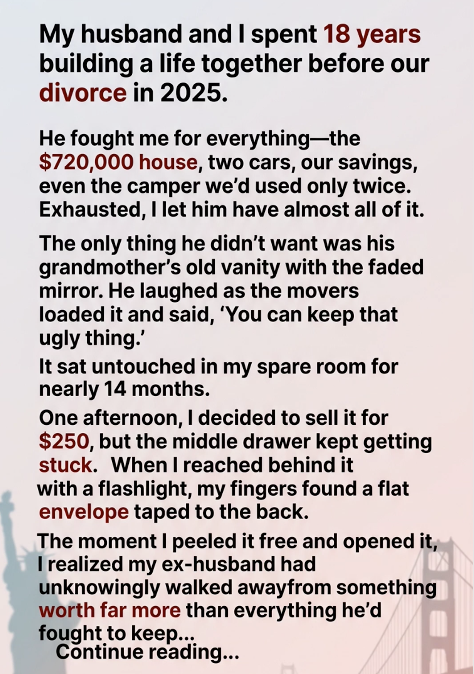
My ex-husband wanted everything.
The $720,000 family home.
Both cars.
Most of our savings.
The camper we’d used exactly twice.
Furniture.
Electronics.
Even the expensive coffee machine we’d bought on our anniversary.
By the end, I was exhausted.
I stopped fighting.
Peace became more valuable than possessions.
There was only one item he refused to take.
His grandmother’s old vanity.
The faded mirror had dark spots around the edges.
One drawer never closed properly.
The finish had worn away decades earlier.
As the movers carried it toward my truck, he laughed.
“You can keep that ugly thing.”
I shrugged.
“Fine.”
It was easier than arguing.
The vanity sat untouched in my spare bedroom for nearly fourteen months.
It collected dust.
Eventually I decided to sell it online.
I listed it for $250.
Within an hour, someone wanted to buy it.
Before they arrived, I thought I should at least make sure all the drawers opened properly.
That’s when I discovered the middle drawer was completely stuck.
I removed the top drawer.
Then the bottom.
Still nothing.
Finally, I grabbed a flashlight and looked inside the empty space behind the middle drawer.
Something white caught my eye.
An envelope.
It had been taped flat against the back panel.
The tape had turned brittle with age.
I carefully peeled it loose.
Across the front, in elegant handwriting, were four words.
“For Whoever Finds This.”
Inside were three items.
The first was a handwritten letter.
The second was a tiny brass key.
The third was an old bank envelope containing several original stock certificates issued decades earlier.
I had no idea whether they were still worth anything.
The letter explained everything.
“If you’re reading this,” it began,
“then you’ve looked more carefully than most people ever do.”
The letter was signed by my ex-husband’s grandmother.
She explained that during the late 1980s, she had purchased shares in a small local manufacturing company.
She hid the certificates because she worried they would be accidentally discarded during a family move.
Over the years, she forgot exactly where she’d hidden them.
The key matched a small safe-deposit box at a local bank.
I contacted the bank.
After following the necessary legal procedures and working through the estate representatives, we confirmed that the box had remained unopened for decades.
Inside were family documents, jewelry with primarily sentimental value, and additional paperwork relating to the old investments.
The bank could not simply hand everything over without verifying ownership, but it pointed us toward the estate attorney who had handled my former grandmother-in-law’s affairs.
With legal guidance, the estate records were reviewed.
Some of the original shares had later been exchanged through corporate mergers.
Others had been redeemed years earlier.
After months of research, it became clear that there was legitimate value associated with the holdings, although determining the exact amount required professional evaluation.
What mattered most wasn’t a dramatic surprise fortune.
It was that something everyone had dismissed as worthless had contained an important piece of family history all along.
I called my former husband.
“I found something inside your grandmother’s vanity.”
He laughed.
“Keep it.”
“It’s probably junk.”
“I don’t think so.”
When I explained what I’d found, there was a long silence.
Finally, he asked,
“You’re telling me the only thing I left behind turned out to matter?”
“Yes.”
He sighed.
“You know what the funny part is?”
“What?”
“I never wanted the vanity because I thought it was ugly.”
I looked at the old mirror standing in my spare room.
“I almost sold it for two hundred and fifty dollars.”
We both laughed.
For the first time in years, there wasn’t any anger between us.
Just amazement at how close we had come to throwing away something irreplaceable.
The estate attorney ultimately ensured that everything was distributed according to the applicable probate documents and the law.
Some items belonged to the estate.
Some belonged to designated heirs.
The process took patience, paperwork, and professional advice.
It wasn’t as dramatic as television makes these things seem.
But it was fair.
And it honored his grandmother’s intentions.
Before the vanity left my house to be restored by another family member, I stood in front of the faded mirror one last time.
I realized something that had nothing to do with money.
During the divorce, we had spent months fighting over the obvious things.
The expensive things.
The things everyone could see.
Yet the object both of us valued least quietly held the greatest surprise.
Looking back, I don’t think the real treasure was hidden behind the drawer.
It was the reminder that appearances can be remarkably misleading.
People fight over what looks valuable.
They overlook what requires patience to discover.
Sometimes an old piece of furniture is just an old piece of furniture.
And sometimes, behind a drawer everyone ignores, waits a story that survived long after the arguments were forgotten.