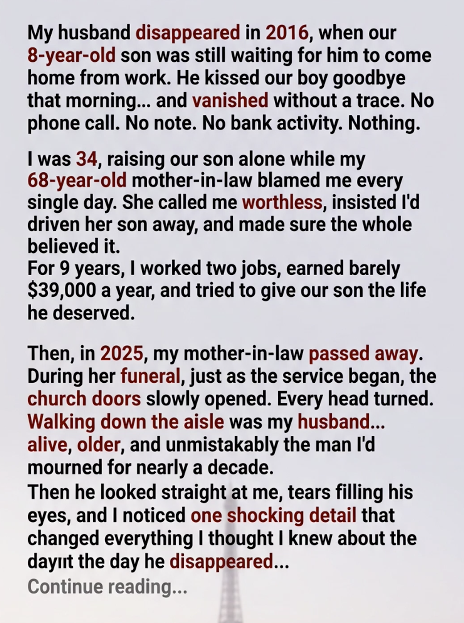
The last time I saw my husband was an ordinary Tuesday morning in 2016.
He kissed our eight-year-old son on the forehead.
Grabbed his lunch from the kitchen counter.
Turned back at the front door.
“I’ll be home before dinner.”
Those were the last words I heard from him.
He never came home.
At first, I assumed something terrible had happened.
I called his phone.
Straight to voicemail.
I called his office.
They told me he’d left work shortly after lunch for what was supposed to be a quick meeting and never returned.
The police took a report.
Searches were organized.
Hospitals were contacted.
His bank accounts remained untouched.
His credit cards were never used.
His passport stayed in our house.
Weeks turned into months.
Months became years.
No answers ever came.
I was thirty-four years old.
Our son needed school clothes.
Food.
Stability.
I took two jobs.
Some years I earned barely $39,000.
It wasn’t enough to make life easy, but it kept a roof over our heads.
Every birthday, our son asked the same question.
“Do you think Dad still knows it’s my birthday?”
I never knew how to answer.
The hardest part wasn’t the uncertainty.
It was my mother-in-law.
She refused to believe her son would disappear willingly.
So she blamed me.
She told neighbors I’d driven him away.
She told relatives I’d ruined his life.
Eventually, people stopped asking how I was doing.
They’d already decided they knew the story.
I stayed silent.
Not because I agreed.
Because I was too exhausted to fight.
Nine years passed.
Then, in 2025, my mother-in-law died.
Despite everything, I attended her funeral.
She had still been my son’s grandmother.
The church filled quietly.
The minister stepped to the front.
Just as he began speaking…
The heavy wooden doors slowly opened.
Every head turned.
A man stood in the doorway.
Older.
Thinner.
Gray streaks in his hair.
But unmistakably…
My husband.
The room fell completely silent.
Someone gasped.
My son—now seventeen—stood so suddenly his chair nearly fell over.
I couldn’t move.
My husband slowly walked down the center aisle.
Tears streamed down his face.
Then I noticed something that stopped me cold.
He wasn’t wearing a wedding ring.
He wasn’t carrying luggage.
He was walking with a cane.
And along the side of his head, disappearing into his hairline, was a long surgical scar I’d never seen before.
After the service, he asked quietly,
“May I explain?”
Every emotion I’d buried for nine years rushed back at once.
Anger.
Relief.
Confusion.
I nodded once.
We sat in a small room beside the church while our son waited with another relative.
My husband took a deep breath.
“I didn’t leave you.”
“I disappeared.”
I stared at him.
“What does that even mean?”
He removed several worn medical documents from a folder.
According to the records, the afternoon he vanished he had been involved in a serious traffic collision while driving alone on a rural highway.
He suffered a traumatic brain injury.
For months, he had no reliable memory of who he was.
Because he carried no identification after his wallet was apparently lost at the crash scene, he entered the medical system as an unidentified patient.
The investigation at the time had never connected him to the missing-person report.
His recovery was slow.
Fragments of memory returned over several years.
A first name.
A street.
The sound of a child’s laughter.
Eventually, he remembered enough to begin searching.
But he couldn’t remember our last name.
Or the town where we lived.
Every clue came back in pieces.
“So why now?”
I asked.
He looked toward the sanctuary.
“My mother’s obituary.”
It had appeared online with family names listed.
When he saw our son’s unusual middle name, something clicked.
He contacted authorities, who compared fingerprints and old records.
The identification was confirmed.
Only then did he learn how many years had passed.
I wanted to be angry.
Part of me was.
Nine years of birthdays.
Nine years of questions.
Nine years of grief.
But I also saw the hospital records.
The rehabilitation notes.
The therapy reports.
They described years of relearning ordinary tasks most of us never think about.
Walking.
Writing.
Remembering.
The next conversation belonged to our son.
Not me.
He sat across from the father he barely remembered.
For a long time, neither spoke.
Finally, my husband whispered,
“I’m so sorry.”
Our son looked at him carefully.
“I spent years wondering why you didn’t come home.”
“I know.”
“I don’t know if I can call you Dad yet.”
My husband nodded.
“You don’t have to.”
“I just hope you’ll let me earn the chance.”
Healing didn’t happen in a single afternoon.
It couldn’t.
Trust isn’t rebuilt because someone walks through a church door.
It grows one conversation at a time.
One visit.
One honest answer.
One shared memory.
Our son chose the pace.
We all respected it.
Months later, we visited the cemetery together.
My husband stood silently beside his mother’s grave.
“I wish she’d known.”
I looked at the headstone.
“So do I.”
For years, she’d believed I had driven her son away.
She never learned that neither of us had chosen what happened.
People sometimes ask whether our family went back to the way it was before.
The answer is no.
Too much time had passed.
Too much had changed.
We didn’t get our old life back.
Instead, we slowly built a different one—based not on pretending those nine years never happened, but on facing them together.
Sometimes life doesn’t give you the ending you imagined.
Sometimes it gives you the chance to begin again, carrying both the scars you’ve earned and the hope you almost lost forever.