When my husband and I got engaged, there was one conversation I insisted we have before setting a wedding date.
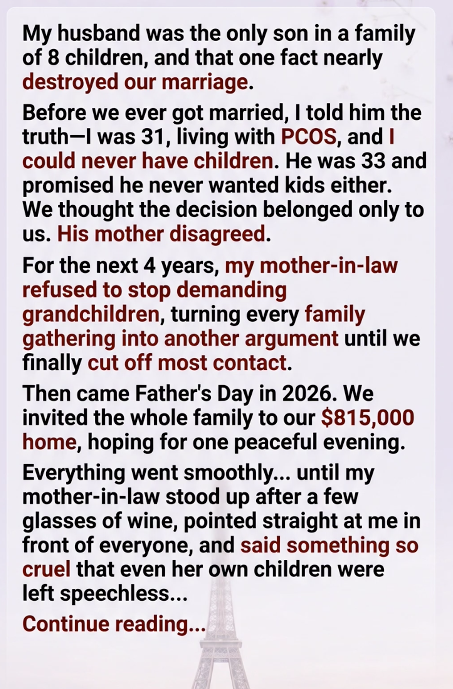
I was thirty-one.
I had been living with PCOS for years.
My doctors had explained that having biological children might be very difficult, and I had already made peace with the possibility that it might never happen.
I looked at Daniel and said,
“If being a father is something you truly want, I need you to tell me now.”
He didn’t hesitate.
He reached across the table, took my hand, and smiled.
“I want a life with you.”
“Not a checklist.”
That answer was enough.
Or so I thought.
Daniel was the only son among eight children.
His seven sisters all had families of their own.
By the time we married, his mother already had more than a dozen grandchildren.
Yet somehow…
ours was the only house she seemed interested in.
Every holiday brought the same questions.
“So…”
“When are you finally giving me a grandson?”
At first, we laughed them off.
Then came the advice.
Then the lectures.
Then the accusations.
She suggested miracle supplements.
Special diets.
Doctors we’d never heard of.
Religious retreats.
She even handed me the phone number of a stranger who claimed she’d become pregnant after drinking a particular herbal tea.
Every time I politely said,
“We’re happy with our life.”
She acted as though I had personally insulted her.
Eventually, family gatherings became exhausting.
We stopped attending many of them.
Not because we wanted distance.
Because we wanted peace.
Four years passed.
Then Father’s Day arrived in 2026.
Daniel suggested inviting everyone to our house.
“Our place is big enough.”
The home we’d worked years to buy had become our pride and joy.
It wasn’t perfect.
But it was ours.
I hesitated.
“What if your mom starts again?”
“She won’t.”
“I asked her not to.”
I wanted to believe him.
So I agreed.
The afternoon was surprisingly pleasant.
Children played in the backyard.
The grill stayed busy.
Everyone laughed.
For a few hours, I thought maybe things had finally changed.
Then, after dessert, someone opened another bottle of wine.
His mother stood up to make what everyone assumed would be a toast.
She lifted her glass.
Smiled.
Then pointed directly at me.
“I suppose we should all be grateful,” she said loudly,
“that at least my son found someone who knows how to decorate a house…”
She paused.
“…since she’ll never know how to fill one.”
The room fell completely silent.
No one moved.
No one laughed.
Even the children stopped talking.
She took another sip.
Then added,
“A woman who can’t give her husband children shouldn’t expect to keep him forever.”
I felt every eye in the room turn toward me.
Before I could speak, one of Daniel’s sisters quietly whispered,
“Mom…”
“Stop.”
She ignored her.
“You stole my son’s chance to have a real family.”
Daniel slowly stood up.
He looked at his mother for several long seconds.
When he finally spoke, his voice was calm.
“Mom.”
“You owe my wife an apology.”
She laughed.
“For telling the truth?”
“No.”
“For insulting the woman I love.”
She folded her arms.
“I’m waiting.”
“So am I,” he replied.
She looked around the room.
No one supported her.
Not one of her daughters.
Not one son-in-law.
Not even her husband.
Finally she said,
“If she can’t handle honesty…”
Daniel interrupted gently.
“No.”
“This dinner is over.”
He walked to the front door.
Opened it.
Then looked back.
“You are welcome in our home only if you treat everyone inside it with respect.”
“Tonight, you didn’t.”
For the first time in my life, I saw my mother-in-law speechless.
She quietly picked up her purse and left.
No one followed her.
The remaining guests stayed.
One by one, Daniel’s sisters came over to hug me.
The oldest quietly admitted something I’d never known.
“She said similar things to every one of us.”
“Different reasons.”
“Different targets.”
“It was never really about children.”
“It was about control.”
Several weeks later, Daniel received a handwritten letter from his mother.
It wasn’t perfect.
It wasn’t dramatic.
But it contained something we’d never heard before.
“I was wrong.”
She admitted that she’d allowed her own expectations to matter more than her son’s happiness.
She didn’t ask for immediate forgiveness.
Only for the chance to do better.
We met her for coffee a month later.
The first thing she said was,
“I’m sorry.”
Not,
“I’m sorry you were offended.”
Not,
“I’m sorry, but…”
Just,
“I’m sorry.”
It didn’t erase the hurt.
But it was a beginning.
Looking back, I realized something important.
The most painful part of that Father’s Day wasn’t the cruel words.
It was believing, for a moment, that silence from everyone else might follow.
Instead, something unexpected happened.
The family chose kindness over comfort.
They chose to speak up instead of looking away.
And my husband reminded me that a marriage isn’t measured by whether two people have children.
It’s measured by whether they stand beside each other when the rest of the room goes quiet.
That Father’s Day wasn’t the day our family fell apart.
It was the day we finally learned who was willing to protect it.