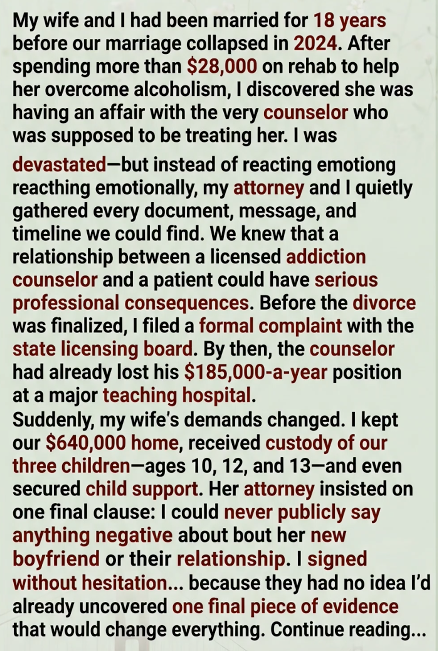
After eighteen years of marriage, I thought we’d survived the hardest years.
We’d raised three children.
We’d weathered layoffs, illnesses, and financial setbacks.
When my wife developed a serious alcohol dependency, I didn’t walk away.
I stayed.
I drove her to appointments.
I sat in waiting rooms.
I spent more than $28,000 on treatment because I genuinely believed recovery was possible.
I wasn’t trying to save a marriage.
I was trying to save the person I loved.
For a while, things seemed to improve.
She came home hopeful after counseling sessions.
She smiled more.
She started talking about the future again.
I thought the treatment was finally working.
Then little things stopped making sense.
Appointments that ran hours longer than scheduled.
Late-night messages she hid when I entered the room.
Unexplained weekend meetings.
When I asked, she always had an answer.
I wanted to believe her.
Until I couldn’t.
One afternoon, I discovered messages that made my stomach turn.
They weren’t between my wife and a stranger.
They were between my wife and the counselor responsible for her treatment.
I read them twice because I couldn’t believe what I was seeing.
The relationship had crossed professional boundaries.
I closed the phone.
Walked outside.
And sat in my car for nearly an hour.
Friends urged me to expose everything immediately.
I didn’t.
Instead, I called an attorney.
His first advice surprised me.
“Don’t post anything online.”
“Don’t contact the counselor.”
“Don’t destroy evidence.”
“Let the proper process handle it.”
That became our plan.
Over the following weeks, we carefully organized documents.
Appointment records.
Financial statements.
Messages that had already been lawfully available to me.
A timeline showing when the professional relationship appeared to overlap with the personal one.
We didn’t speculate.
We didn’t exaggerate.
We simply gathered what we could document.
Because allegations involving licensed healthcare professionals deserve to be handled through the appropriate regulatory process—not through social media.
My attorney helped me file a formal complaint with the state licensing board.
What happened after that wasn’t in my control.
Nor should it have been.
The board conducted its own investigation.
Hospital administrators reviewed their policies.
The counselor was placed on leave while the matter was investigated.
Eventually, his employment ended.
Any further professional consequences resulted from the board’s independent review, not from anything I could decide.
Meanwhile, our divorce continued.
Like many divorces, it involved difficult negotiations over parenting time, finances, and the family home.
The court focused on the children’s best interests.
Independent evaluations.
Financial disclosures.
Parenting plans.
After months of mediation and hearings, we reached a final agreement.
I remained in the family home.
The parenting arrangement reflected what the court determined was best for our children at that time.
Financial support was ordered according to the applicable law.
Just before everything was finalized, my wife’s attorney requested one additional clause.
Neither of us would publicly disparage the other or discuss private matters in ways that violated the agreement.
My attorney reviewed the language carefully.
He smiled.
“You can live with this.”
I signed.
So did my wife.
Several days later, while organizing old household files, I found one last folder.
Inside were documents I hadn’t realized I’d kept.
They weren’t explosive.
They weren’t dramatic.
They were my journal from the first year of her recovery.
Every meeting.
Every doctor visit.
Every receipt.
Every encouraging note I’d written to remind myself not to give up.
Tucked inside was a letter she’d written years earlier while still in treatment.
It began:
“Thank you for believing in me when I couldn’t believe in myself.”
I sat quietly for a long time.
I showed the letter to my attorney.
“Does this change anything legally?”
He shook his head.
“No.”
“It changes something more important.”
“What?”
“It reminds you who you were.”
For months, I’d been consumed by betrayal.
By investigations.
By legal documents.
By court dates.
That letter reminded me of something I’d almost forgotten.
I had acted with compassion.
I had supported someone through addiction.
I had done everything I reasonably could.
The marriage ended anyway.
But its ending didn’t erase the integrity with which I’d entered it.
Years later, my youngest child asked me,
“Dad… do you hate Mom?”
I answered honestly.
“No.”
“I hate what happened.”
“That’s different.”
People often expect stories like this to end with revenge.
Mine didn’t.
The licensing board handled professional accountability.
The court handled the divorce.
Time handled the healing.
The final piece of evidence I found wasn’t the one that destroyed someone else.
It was the one that reminded me not to destroy myself by carrying bitterness forever.
In the end, the most important thing I won wasn’t the house or the legal case.
It was the ability to look my children in the eye and know that, even on the hardest days of my life, I chose to let the truth speak louder than anger.