After seventeen years of marriage, I believed trust was the strongest part of our relationship.
I never imagined it could disappear in a single afternoon.
The notification arrived while I was finishing work.
$9,860.
A few seconds later…
$12,475.
Then another.
$7,940.
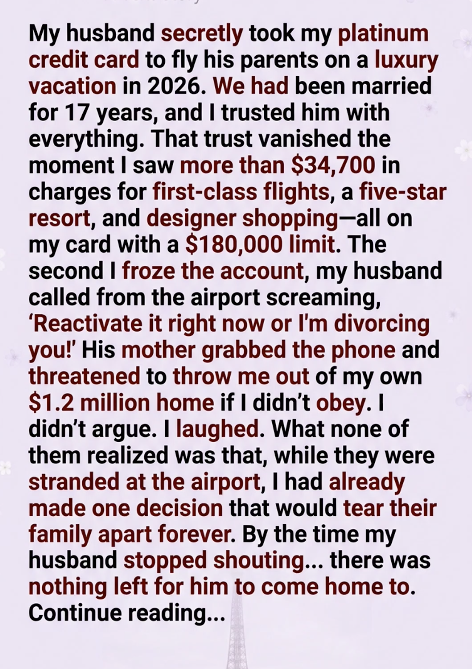
By the time I opened my banking app, more than $34,700 had been charged to my platinum credit card.
First-class airline tickets.
A five-star resort.
Luxury shopping.
Airport lounge access.
I stared at the screen, convinced someone had stolen my card.
In a way…
Someone had.
I called the credit card company immediately.
The representative confirmed the purchases had been made using my physical card.
My purse was sitting beside me.
I opened it.
The card was gone.
Then I remembered.
The night before, my husband had borrowed my wallet while looking for our insurance information.
He’d returned it without me checking inside.
I called him.
He answered almost immediately.
Background announcements echoed through the airport terminal.
“What did you buy?” I asked.
He laughed.
“You’ll understand later.”
“No,” I replied.
“I won’t.”
Then he admitted it.
He had booked a luxury vacation for his parents.
Using my credit card.
Without asking.
“It’s family money,” he said.
“No,” I answered calmly.
“It’s a credit account in my name.”
I froze the card while we were still on the phone.
Within seconds he started yelling.
“Reactivate it right now or I’m divorcing you!”
Before I could answer, his mother grabbed the phone.
“If you don’t fix this, you’ll be out of this family!”
Then she added,
“And don’t expect to stay in that house!”
I looked around the living room.
The same house I’d purchased years before we were married.
The deed had never changed.
I couldn’t help laughing.
Then I quietly ended the call.
While they argued with airline staff about the declined transactions, I wasn’t plotting revenge.
I was protecting myself.
I called my attorney.
Then my bank.
Then my financial adviser.
Every step I took was based on professional advice.
I changed passwords.
Opened a new personal account for future income.
Removed access where I legally could.
Documented every disputed charge.
Requested copies of every transaction.
Nothing dramatic.
Nothing illegal.
Just careful preparation.
Late that evening, my husband stormed through the front door.
His trip had ended before it began.
“How could you humiliate my parents?” he shouted.
I slid a folder across the kitchen table.
Inside were copies of the credit card statements, correspondence with the bank, and a letter from my attorney.
“I didn’t embarrass anyone.”
“I refused to pay for a vacation I never agreed to.”
He flipped through the papers.
His anger slowly gave way to silence.
Over the next several weeks, we entered mediation.
Like most divorces, it wasn’t settled by dramatic speeches.
It was settled by financial disclosures, legal documents, and difficult conversations.
Every asset was identified.
Every debt was reviewed.
The unauthorized credit card charges became one issue among many.
The court process took months.
Real life usually does.
One afternoon, his mother called.
For the first time in years, her voice was quiet.
“I shouldn’t have threatened you.”
“No,” I replied.
“You shouldn’t have.”
There wasn’t much else to say.
Nearly a year later, I was sitting on the back patio of my house.
The same home I’d worked hard to buy before marriage.
A friend asked whether I regretted freezing the card.
I smiled.
“Not at all.”
“The credit card wasn’t the real problem.”
“What was?”
“The moment someone decided they could spend my trust as freely as they spent my money.”
Looking back, I realized the decision that changed everything wasn’t freezing the account.
It was deciding that I would no longer confuse love with unlimited permission.
Marriage is built on partnership.
Partnership requires honesty.
The vacation never happened.
The marriage didn’t survive.
But my self-respect did.
And that turned out to be worth far more than any first-class ticket ever could be.