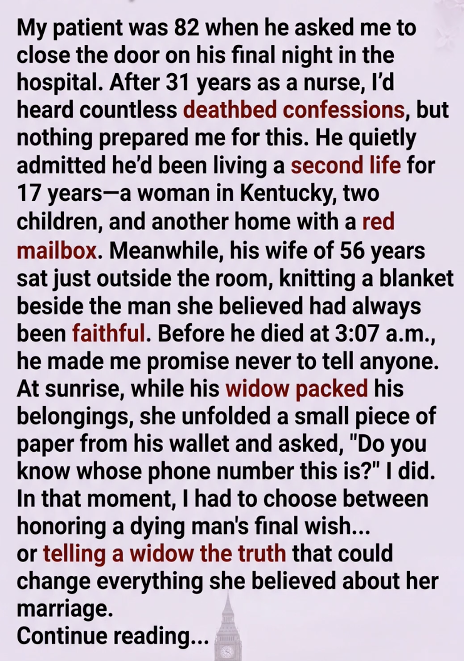
After thirty-one years as a nurse, I believed I’d heard every kind of final confession.
People apologized.
They forgave.
They admitted regrets they’d hidden for decades.
Most of those secrets died with them.
Then I met Mr. Harrison.
He was eighty-two.
Terminally ill.
Calm.
Kind.
The sort of patient who thanked everyone who entered his room.
His wife, Eleanor, hardly left his side.
For fifty-six years, they’d built a life together.
She knitted while he slept.
Read aloud from his favorite mystery novels.
Adjusted his blankets before anyone else noticed they had slipped.
Watching them together, I thought I was seeing one of life’s great love stories.
I was wrong.
Late one evening, Mr. Harrison motioned for me to close the door.
“Could we have a few minutes?”
I nodded.
After checking that he was comfortable, I pulled a chair beside his bed.
He stared at the ceiling for a long time before speaking.
“I’ve carried something for seventeen years.”
His voice trembled.
“I don’t think I should carry it any longer.”
He explained that years earlier, while traveling regularly for work, he had begun another relationship in Kentucky.
According to him, it lasted far longer than he ever intended.
He said two children had been born during those years.
He supported them financially in secret.
Visited whenever business trips provided an excuse.
Maintained another small house with a bright red mailbox.
Then he closed his eyes.
“I betrayed everyone.”
Outside the room, Eleanor quietly knitted a baby blanket for their newest great-grandchild.
She had no idea what I was hearing.
Mr. Harrison looked at me.
“When I’m gone…”
“…please don’t tell her.”
“I’ve already taken enough from her.”
Before I could respond, he squeezed my hand.
“Promise me.”
As nurses, we often receive deeply personal confidences.
But we also learn that some promises cannot override our professional responsibilities or other people’s rights.
So I answered carefully.
“I’ll continue caring for you with dignity.”
“I’ll respect your privacy as the law and my professional duties require.”
He nodded.
“I understand.”
Those were the last meaningful words we exchanged.
At 3:07 the following morning, Mr. Harrison died peacefully.
His wife held his hand until the very end.
She kissed his forehead.
Whispered,
“I’ll miss you forever.”
No one in the room spoke.
After sunrise, I helped Eleanor gather his belongings.
She folded his glasses into their case.
Placed his wedding ring into a small velvet pouch after it had been removed.
Then she opened his worn leather wallet.
A tiny folded slip of paper fell onto the bed.
She picked it up.
Looked at the handwritten phone number.
Then looked at me.
“Do you know whose number this is?”
My heart sank.
I recognized it.
He had quietly shown it to me the night before while explaining his story.
For a moment, I couldn’t breathe.
Everything I’d learned during decades of nursing came rushing back.
Patients deserve confidentiality.
Families deserve honesty about matters affecting their care.
But nurses are not the people who settle lifelong family secrets after someone dies.
Those decisions don’t belong to us.
I answered as truthfully as I ethically could.
“I recognize it from a conversation I had with your husband.”
She looked at me carefully.
“Did he ask you not to tell me something?”
I couldn’t discuss the substance of confidential conversations.
“I can’t talk about private conversations I had with him.”
She nodded slowly.
“I thought that might be the answer.”
She stared at the number for a long time.
Then quietly said,
“I think I know what this might be.”
There was sadness in her voice.
Not surprise.
Just sadness.
“I’ve wondered for years.”
She folded the paper and placed it gently into her purse.
“I’m not asking you to break your professional obligations.”
“I just needed to know whether I was imagining things.”
A few weeks later, I received a handwritten letter from Eleanor.
She thanked the staff for caring for her husband.
Near the end, she wrote something I have never forgotten.
“I eventually contacted the number.”
“Some questions deserved answers.”
“Those answers came from the people who owned them—not from the nurses who cared for him.”
“You did exactly what you were supposed to do.”
That letter stayed in my desk for years.
Not because it made the situation less heartbreaking.
It didn’t.
A family still had to face painful truths.
Another family had to grieve a father in their own way.
But it reminded me of something every healthcare professional eventually learns.
Compassion does not mean taking control of someone else’s story.
Sometimes the most difficult part of caring for people is recognizing where your role ends.
I was there to provide comfort.
To preserve dignity.
To honor my professional responsibilities.
I was not there to rewrite a family’s history.
Looking back, the hardest choice I made that morning wasn’t choosing between one person and another.
It was choosing to remain faithful to the trust placed in me as a nurse—even when my heart ached for everyone involved.