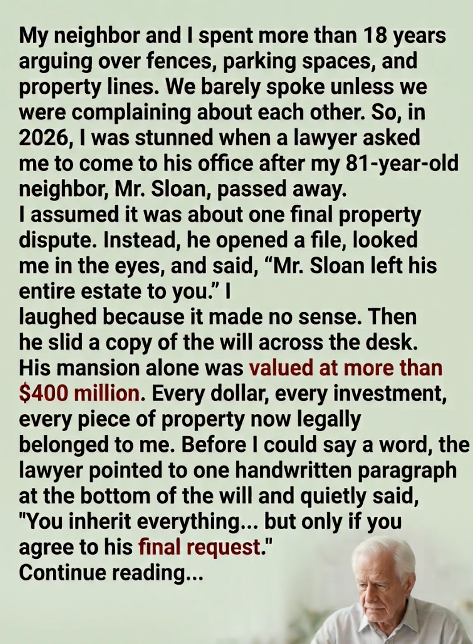
For eighteen years, my neighbor, Harold Sloan, and I disagreed about almost everything.
It started with a fence.
He insisted it was six inches over the property line.
I insisted it wasn’t.
Surveyors came.
Lawyers exchanged letters.
Neither of us backed down.
That should have been the end of it.
It wasn’t.
After that came the parking complaints.
The overhanging tree branches.
His leaves blowing into my yard.
My hedge blocking his view.
If one of us was outside, the other usually went back inside.
The neighborhood joked that we could argue over sunshine.
Looking back, they weren’t entirely wrong.
Mr. Sloan was eighty-one when he passed away in 2026.
I heard about it from another neighbor.
I felt sad.
Not because we had been close.
Because we never had the chance to be.
A week later, I received a call from a law office.
“We’d like you to come in regarding Mr. Sloan’s estate.”
I assumed there had been another issue involving our adjoining properties.
Maybe an easement.
Maybe an old boundary agreement.
Instead, the attorney opened a file.
Looked directly at me.
And said,
“Mr. Sloan named you as the primary beneficiary of his estate.”
I laughed.
“I’m sorry?”
He turned the will toward me.
“There isn’t a mistake.”
The estate was substantial.
The house.
Investment accounts.
Several commercial properties.
Everything.
I couldn’t process what I was hearing.
“There has to be another Harold.”
“There isn’t.”
Then the attorney pointed to a handwritten page attached to the will.
“Mr. Sloan included one personal request.”
I slowly began reading.
“If you are reading this,” it began,
“then I finally lost our last argument.”
I couldn’t help smiling.
Even in a will, he sounded like himself.
The letter continued.
“For eighteen years, we’ve wasted more time proving who was right than discovering who we really were.”
“I’d like to change that, even if I’m no longer here to do it.”
His request wasn’t about the money.
It wasn’t about the house.
It wasn’t about preserving his name.
He asked me to do one thing.
“Before you decide what to do with anything I’ve left behind…”
“Spend one full day inside my home.”
“Open every room.”
“Read every notebook in my study.”
“Then decide whether you still think you knew me.”
The attorney smiled.
“He made it clear this wasn’t legally binding.”
“It was simply the condition he hoped you’d honor.”
I agreed.
Not because I wanted the inheritance.
Because I suddenly needed answers.
The following Saturday, I unlocked Mr. Sloan’s front door.
For the first time in eighteen years.
Inside, everything looked exactly as he’d left it.
Neat.
Quiet.
Ordered.
On the desk in his study sat twelve notebooks.
One for each year after his wife had died.
They weren’t financial records.
They were journals.
The first entry read:
“The new neighbor moved in today.”
“Seems stubborn.”
“I probably am too.”
I laughed despite myself.
Then I kept reading.
Over the next several hours, I learned more about Harold Sloan than I had in nearly two decades living twenty feet away.
He wrote about missing his wife.
About learning to cook after she’d died.
About being lonely.
About pretending to care more about fences than admitting the silence in his house frightened him.
One sentence stopped me cold.
“Arguing with my neighbor gives me someone to talk to.”
I closed the notebook.
Tears filled my eyes.
Near the back of the final journal was an envelope addressed to me.
Inside was another letter.
“You probably think I left you my estate because I liked you.”
“That’s only partly true.”
“I respected you.”
“You never lied to me.”
“You never tried to flatter me.”
“You fought for what you believed was right.”
“My lawyers, advisers, and distant relatives all wanted something from me.”
“You only wanted me to stop parking on your side of the driveway.”
I laughed out loud.
Then I reached the final paragraph.
“I’ve already established charitable gifts for the causes that mattered most to me.”
“The remaining estate is yours to manage as you think best.”
“Just promise me one thing.”
“Before you argue with someone again…”
“Knock on their door first.”
I never forgot those words.
In the months that followed, I honored the charitable commitments Harold had already arranged.
I kept his house exactly as it was for nearly a year before deciding what to do with it.
I also funded a neighborhood mediation program in his memory—one that helped neighbors resolve disputes through conversation before turning to lawyers.
It felt like something he would have appreciated.
People still ask whether I deserved such an inheritance.
I honestly don’t know.
What I do know is this:
The greatest thing Harold Sloan left me wasn’t wealth.
It was perspective.
For eighteen years, I believed the man next door was simply difficult.
He probably believed the same about me.
The tragedy wasn’t that we argued over fences.
The tragedy was that neither of us ever knocked on the other’s door just to say hello.
Sometimes the longest distance between two people isn’t measured in miles.
Sometimes it’s measured by the width of a property line—and the pride that keeps both neighbors standing on opposite sides of it.