The last conversation I had with my father lasted less than five minutes.
He was weak.
His breathing was shallow.
He squeezed my hand and whispered,
“Take care of your mother.”
I nodded.
“I will.”
He smiled.
Those were the last words he ever spoke to me.
I never imagined that promise would shape the next twelve years of my life.
After Dad passed away in 2013, my mother struggled to live alone.
At first, the expenses were small.
Groceries.
Utility bills.
A few repairs around the house.
Then came doctor’s appointments.
Prescription medications.
Physical therapy.
Eventually, surgery and rehabilitation.
Each year brought another unexpected bill.
I paid them.
Not because I expected anything in return.
Because I had made a promise.
I wasn’t wealthy.
Every payment required sacrifices.
I postponed vacations.
Delayed replacing my aging car.
Worked overtime whenever I could.
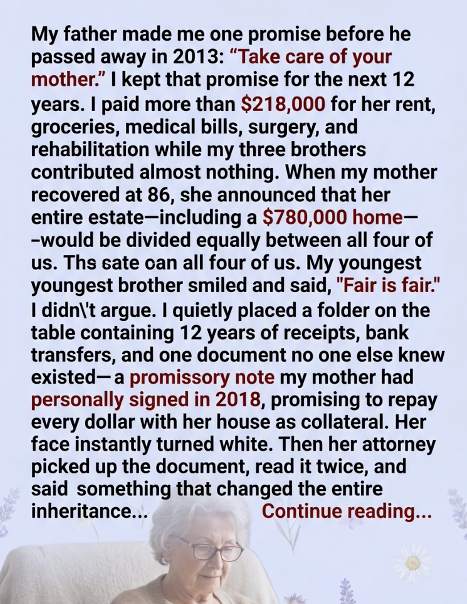
Over twelve years, I spent more than $218,000 helping my mother.
I kept every receipt.
Not because I planned to ask for repayment.
Because my accountant advised me to maintain accurate records whenever I paid significant expenses for someone else.
At the time, it seemed like sensible bookkeeping.
Nothing more.
My three brothers visited often.
They brought flowers on holidays.
Took family photographs.
Posted cheerful pictures online.
When it came to paying bills, however, they always had reasons they couldn’t help.
One was changing jobs.
Another had college tuition to pay.
The youngest insisted he’d “help next year.”
Next year never came.
I stopped asking.
In 2018, after a lengthy conversation, my mother surprised me.
She insisted she didn’t want me carrying the financial burden alone.
“I may never be able to repay you,” she said.
“But I want to acknowledge what you’ve done.”
At her request, we met with an attorney.
He prepared a simple promissory note documenting the amounts I had advanced and explaining how repayment would work if her estate ever had sufficient assets.
She signed it voluntarily.
I put it in a folder.
Neither of us spoke about it again.
By 2025, my mother’s health had improved remarkably.
At eighty-six, she gathered all four of us for a family meeting.
Her attorney sat beside her.
“I’ve updated my estate plan,” she announced.
“My house and the rest of my estate will be divided equally among my four children.”
My youngest brother grinned.
“Fair is fair.”
No one looked at me.
I quietly reached into my briefcase.
I placed a thick folder on the table.
Inside were twelve years of receipts.
Canceled checks.
Bank transfers.
Medical invoices.
Insurance statements.
And finally…
The promissory note.
“I don’t object to your estate plan,” I said calmly.
“But before we discuss inheritance, I think everyone should understand these records.”
The room became silent.
My mother’s attorney picked up the promissory note.
He adjusted his glasses.
Read it once.
Then read it again more slowly.
Finally, he looked around the table.
“This changes the discussion.”
My youngest brother frowned.
“What do you mean?”
The attorney folded his hands.
“This document appears to create a debt owed by the estate, assuming it is valid and enforceable under the applicable law.”
He immediately added,
“That doesn’t determine the outcome today. The estate will still need to be administered according to the law, and all relevant documents must be reviewed.”
My mother slowly lowered her head.
“I’d forgotten.”
I looked at her gently.
“I hadn’t.”
She began to cry.
“I never meant for you to carry all of this alone.”
“I know.”
“You asked your brothers for help?”
“For years.”
She turned toward them.
“Is that true?”
None of them answered.
The oldest finally spoke.
“I didn’t realize how much you were paying.”
I slid the receipts across the table.
“You never asked.”
“You always said everything was under control.”
“It was.”
“Because I made sure it was.”
The attorney suggested ending the meeting and reviewing everything carefully before any decisions were made.
Over the following weeks, he examined the records, confirmed many of the documented expenses, and explained how estate debts and distributions are typically handled under the applicable law.
He also encouraged the family to consider a negotiated settlement rather than a prolonged legal dispute.
Eventually, after many difficult conversations, my siblings agreed that the documented financial support should be recognized before the remaining estate was divided.
No one received exactly what they had originally expected.
But everyone understood why.
A few months later, my mother asked to speak with me alone.
“I spent years worrying that I hadn’t treated my children equally.”
She paused.
“I finally realized equality and fairness aren’t always the same thing.”
I squeezed her hand.
“I never helped you because I wanted the house.”
“I know.”
“You helped because your father asked you to.”
When my mother passed away peacefully two years later, we were able to grieve together instead of fighting in court.
The receipts went back into the folder.
The promissory note was placed beside them.
I kept both—not as proof of money spent, but as reminders of two promises.
One made by my father.
One made by my mother.
Both had been kept.
Looking back, the document that changed everything wasn’t valuable because it involved a house.
It mattered because it preserved something far more important:
The truth.
And sometimes, when families face painful questions about fairness, the truth is the only inheritance that can still bring peace.