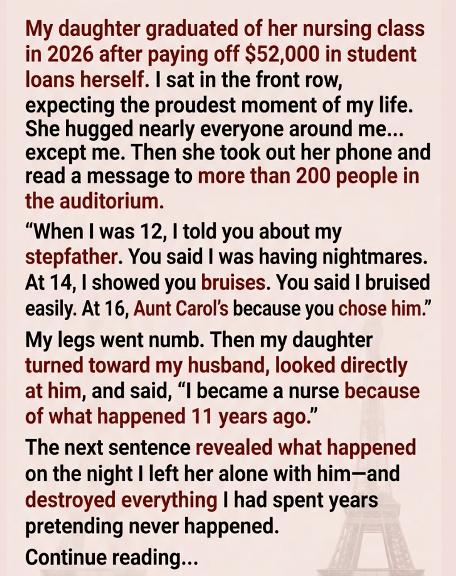
My daughter graduated at the top of her nursing class in 2026.
She had done it herself.
She’d worked weekends.
Studied until midnight.
And somehow paid off $52,000 in student loans without asking me for a dollar.
I sat in the front row of the auditorium, expecting the proudest moment of my life.
I thought she’d walk across that stage, receive her diploma, and finally look at me the way she used to when she was little.
I was wrong.
When the ceremony ended, my daughter hugged almost everyone around me.
Her classmates.
Her professors.
Aunt Carol.
Even a few people I’d never met.
Then she walked past me.
She didn’t hug me.
She didn’t even look at me.
Instead, she pulled out her phone.
The auditorium was still filled with more than 200 people.
She stood near the podium.
Then she began reading.
“When I was twelve, I told you about my stepfather.”
My stomach dropped.
“You said I was having nightmares.”
“When I was fourteen, I showed you bruises.”
“You said I bruised easily.”
“When I was sixteen, I left for Aunt Carol’s…”
“…because you chose him.”
The room became completely silent.
I couldn’t move.
My daughter looked directly at me.
Her voice didn’t shake.
But mine did.
“Please don’t do this here,” I whispered.
She continued.
“I spent years wondering whether I had imagined everything.”
“Then I realized I hadn’t.”
“I became a nurse because of what happened eleven years ago.”
I felt my legs go numb.
My husband was sitting several rows behind me.
I turned toward him.
He looked terrified.
My daughter looked directly at him.
Then she said:
“That night taught me exactly what happens when a person in pain is ignored by the person who is supposed to protect them.”
I couldn’t breathe.
She wasn’t describing everything.
She didn’t need to.
Everyone in that auditorium understood enough.
She told them that when she was twelve, she had tried to tell me something was wrong.
I’d dismissed it.
At fourteen, she’d shown me injuries.
I’d believed my husband when he said she’d been careless.
At sixteen, she’d finally packed a bag and gone to Aunt Carol’s.
And I’d let her go without asking the question I should have asked years earlier:
“Why are you afraid of him?”
Aunt Carol stood up.
“I tried to tell you.”
I looked at her.
“What?”
She was crying.
“I called you.”
“Three times.”
“I told you she was terrified.”
“You said she needed time.”
I shook my head.
“I don’t remember.”
She answered quietly.
“I know.”
“You didn’t want to remember.”
My daughter turned back toward the audience.
“I didn’t become a nurse because I wanted to spend my life thinking about him.”
“I became one because I wanted to become the person I needed when I was twelve.”
She paused.
“The person who notices.”
“The person who listens.”
“The person who doesn’t tell a frightened child that it’s all in their head.”
Then she looked at me.
And said something I will never forget.
“Mom, I don’t hate you.”
“I wish I did.”
“Because hating you would be easier.”
“I spent eleven years waiting for you to ask me what happened.”
“You never did.”
I started crying.
“I was wrong.”
She nodded.
“I know.”
“I should have believed you.”
“I know.”
“I’m sorry.”
She looked at me for several seconds.
Then she said:
“I needed you to be sorry eleven years ago.”
My husband left the auditorium before the ceremony ended.
Later that evening, the truth finally came out.
There were messages I’d ignored.
Old photographs.
Statements from people I’d dismissed.
Records from the years when my daughter had stayed with Aunt Carol.
And evidence that my husband had deliberately convinced me that my daughter was exaggerating.
He had counted on my trust.
And I had given it to him without questioning what it was costing my child.
I spent years telling myself I was protecting my family.
The truth was uglier.
I was protecting my version of my family.
Because admitting my daughter had been telling the truth meant admitting I’d failed her.
So I chose the easier explanation.
Nightmares.
Teenage behavior.
Accidents.
Misunderstandings.
Anything except the truth.
My daughter eventually began working at a children’s hospital.
She became known for being especially attentive with frightened young patients.
One evening, she called me.
“I saw a little girl today.”
I held my breath.
“What happened?”
“Nothing serious.”
“She was just scared.”
My daughter paused.
“She kept asking if anyone believed her.”
My eyes filled with tears.
“What did you tell her?”
“I told her yes.”
We didn’t repair our relationship overnight.
There were no magical hugs.
No single apology that erased eleven years.
I had to earn back trust slowly.
I went to counseling.
I listened when she wanted to talk.
I stayed silent when she didn’t.
I stopped defending myself.
Most importantly, I stopped asking her to make me feel better about what I’d done.
She didn’t owe me forgiveness.
Months later, she invited me to her new apartment.
Her nursing diploma was hanging above the desk.
Beside it was a photograph of her and Aunt Carol.
I looked at the diploma.
“You really did it.”
She smiled.
“Yes.”
“I’m proud of you.”
She looked at me.
“I know.”
That was all.
But this time, it was enough.
I used to think the worst thing that happened that night was hearing my daughter expose our family’s secret in front of hundreds of people.
I was wrong.
The worst thing happened eleven years earlier.
It happened when a frightened twelve-year-old girl finally found the courage to tell her mother something was wrong…
and her mother chose not to listen.
My daughter didn’t become a nurse because of what happened to her.
She became a nurse because she refused to let what happened to her define the kind of person she would become.
And I’ll carry one sentence from her graduation with me for the rest of my life:
“I became the person I needed when nobody believed me.”