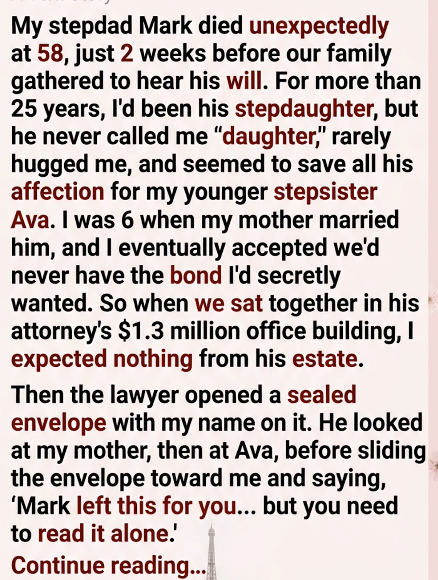
My stepfather Mark died unexpectedly at 58.
It happened just two weeks before our family was supposed to gather for the reading of his will.
For more than 25 years, I’d been his stepdaughter.
But Mark never called me “daughter.”
He rarely hugged me.
He didn’t ask about my day.
He didn’t come to my school events unless my mother insisted.
And whenever there was a family photograph, somehow he always ended up standing beside my younger stepsister, Ava.
Ava was his favorite.
At least, that’s what I believed.
I was only six when my mother married Mark.
I remember hoping he’d become my dad.
I remember making him a Father’s Day card.
I remember waiting by the window for him to come home.
But eventually, I stopped waiting.
By the time I was a teenager, I’d learned not to expect affection from him.
When Ava was born, everything became even clearer.
He adored her.
He carried her everywhere.
He called her “my little girl.”
He framed her drawings.
He attended every school event.
Meanwhile, I became the child who quietly learned how to take care of herself.
So when Mark died, I didn’t expect anything from his estate.
I wasn’t even sure I’d be mentioned in the will.
Two weeks later, our family gathered at his attorney’s office.
The building was worth around $1.3 million.
Everything about the place felt cold and formal.
My mother sat beside me.
Ava sat across the table.
I expected the usual division of property.
House.
Investments.
Retirement accounts.
Maybe some sentimental items.
Then the attorney closed the main file.
He reached into a separate drawer.
And pulled out a sealed envelope.
My name was written across the front.
My name.
Not Ava’s.
Not Mom’s.
Mine.
The attorney looked at my mother.
Then at Ava.
Then back at me.
He slowly slid the envelope across the table.
“Mark left this for you.”
I stared at it.
“What is it?”
The attorney shook his head.
“I don’t know.”
“Then why are you looking at them?”
He took a breath.
“Because Mark gave me very specific instructions.”
He pointed toward the door.
“He said you must read it alone.”
Ava immediately looked annoyed.
“What could he possibly have left her?”
Mom said nothing.
I picked up the envelope.
It was heavier than I expected.
I stood.
The attorney directed me into a private conference room.
I closed the door.
Then opened the envelope.
Inside was a letter.
The first line made my hands tremble.
“I’m sorry I spent twenty-five years making you believe you weren’t my daughter.”
I stopped reading.
Then started again.
Mark wrote that when I was six, he had made a promise to my mother.
He would protect me.
But he had been afraid of becoming too attached.
Not because he didn’t love me.
Because he knew something my mother had never told me.
My biological father wasn’t actually the man I believed he was.
Mark had known the truth from the beginning.
And he had made a terrible decision.
He thought keeping emotional distance would protect me from the complicated circumstances surrounding my birth.
Instead, he’d made me believe I wasn’t wanted.
I kept reading.
Mark explained that Ava had been different.
With her, he allowed himself to be openly affectionate.
Because there was no secret.
No fear.
No uncertainty.
He realized too late that I’d interpreted the difference as rejection.
The next paragraph made me cry.
“Every time you thought I was choosing Ava over you, I was actually trying not to reveal something your mother wasn’t ready to tell you.”
Then came the truth.
Mark wasn’t my biological father.
But he had been the person who had legally protected me when I was six.
He had adopted me quietly.
I’d always assumed the adoption paperwork was simply part of my mother’s marriage.
It wasn’t.
Mark had fought to make sure I couldn’t be taken away by my biological father.
And he’d never told me because my mother had begged him not to.
But there was more.
Mark had left me something.
Not just money.
A house.
A small investment portfolio.
And a trust worth nearly $840,000.
I stared at the number.
I didn’t understand.
Why me?
Why not Ava?
Then I reached the final page.
“Ava has always had my affection.”
“You needed something different.”
“You needed certainty.”
“So I built it for you.”
“The trust becomes yours because I wanted you to know that I never saw you as less.”
Then came the sentence that broke me:
“I didn’t know how to be your father, so I tried to become the man who would never let the world take you away from him.”
I sat there crying.
For twenty-five years, I’d believed Mark didn’t love me.
He had watched me graduate without saying much.
He’d been distant at my wedding.
He’d barely spoken to me during holidays.
I had spent years thinking I simply wasn’t important to him.
And now I learned that he’d been quietly protecting me the entire time.
Badly.
Painfully.
But intentionally.
When I returned to the conference room, everyone was waiting.
My mother looked frightened.
Ava looked curious.
The attorney simply watched me.
Mom whispered,
“What did he say?”
I looked at her.
“You knew.”
She began crying.
“Yes.”
“All these years?”
She nodded.
“Mark promised me he’d tell you eventually.”
“When?”
“After he died.”
I couldn’t believe it.
“You both decided I should spend twenty-five years thinking he didn’t love me?”
Mom covered her face.
“I thought I was protecting you.”
I shook my head.
“You weren’t.”
Ava started crying too.
“I didn’t know.”
I looked at her.
She was my sister.
She hadn’t created the distance between Mark and me.
She’d simply been the child who received the affection he was capable of giving.
I reached across the table.
She took my hand.
For the first time, we cried together about the same thing.
The attorney then gave me one final item.
A small wooden box.
Inside was my Father’s Day card from when I was six.
The one I’d made for Mark.
The corners were worn.
The paper had turned yellow.
On the back, he’d written something.
I had never seen it before.
“She thinks I don’t love her.”
Then beneath it:
“I hope someday she knows I do.”
I took the card home.
I placed it beside the photograph of Mark and me from my wedding.
For years, I’d looked at that photograph and wondered why he wasn’t smiling.
Now I knew.
He’d been trying not to cry.
I had simply never noticed.
I still wish Mark had told me the truth while he was alive.
I wish he’d hugged me.
I wish he’d called me daughter.
I wish he’d told me that the distance wasn’t rejection.
Because inheritance can pay bills.
A trust can create security.
But neither can give you back twenty-five years.
Still, I finally understood something I’d spent my entire childhood getting wrong.
Mark hadn’t left me nothing.
He’d left me the one thing I’d wanted from him all along.
Proof that I had mattered.
And at the bottom of his letter, he’d written one final sentence:
“I was never good at saying I loved you.”
“So I spent twenty-five years trying to prove it without saying the words.”