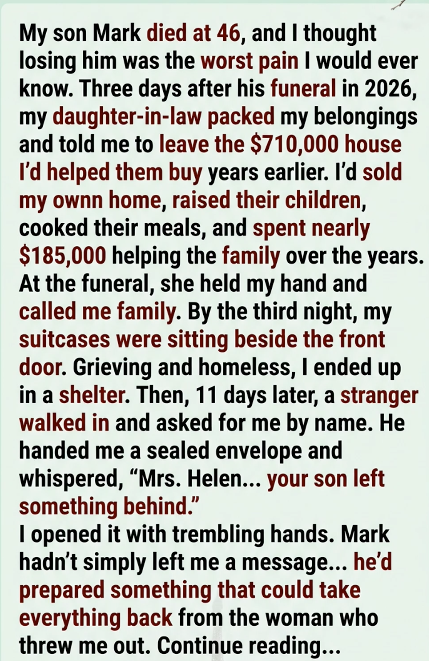
My son Mark died at 46.
I thought losing my child would be the worst pain I’d ever experience.
I was wrong.
Three days after his funeral, my daughter-in-law told me to leave the house.
The same $710,000 house I’d helped them buy years earlier.
The same house where I’d cooked their meals.
Raised their children.
Paid bills.
And quietly spent nearly $185,000 helping the family over the years.
At Mark’s funeral, she had held my hand.
She’d cried against my shoulder.
She’d called me family.
Three nights later, my suitcases were beside the front door.
“Where am I supposed to go?” I asked.
She wouldn’t look at me.
“You can’t stay here anymore.”
“This is my son’s home.”
“It’s my home now.”
I stared at her.
“Mark wouldn’t want this.”
She finally looked at me.
“Mark isn’t here.”
Those four words destroyed something inside me.
Not because they were cruel.
Because they were true.
I had nowhere to go.
I’d sold my own small house years earlier to help Mark and his wife with the down payment.
I’d thought I was investing in my family.
I never imagined I’d eventually be standing outside that same house with two suitcases.
I spent the first night at a cheap motel.
Then my money began running low.
Within days, I was sleeping at a shelter.
I was 68 years old, grieving my son, and suddenly homeless.
I didn’t know how my life had fallen apart so quickly.
Then, 11 days after Mark’s funeral, a stranger walked into the shelter.
He asked for me by name.
“Mrs. Helen?”
I stood up.
“Yes?”
He was wearing a dark suit and carrying a leather briefcase.
He handed me a sealed envelope.
“Your son left something behind.”
My hands began shaking.
“Mark?”
He nodded.
“He gave me instructions before he died.”
I opened the envelope.
Inside was a letter.
The first line made my knees weak.
“Mom, if you’re reading this, then she did exactly what I was afraid she’d do.”
I sat down.
I read every word.
Mark had known his health was deteriorating.
He had also known his wife was becoming increasingly hostile toward me.
He had seen the arguments.
He had noticed money disappearing.
And he’d started documenting everything.
Then I found the sentence that changed everything:
“The house was never supposed to belong entirely to her.”
I read it twice.
Mark explained that when I sold my home to help fund the purchase, he had insisted on documenting my contribution.
There was a legal agreement.
My money wasn’t a gift.
It was an investment.
And I’d never seen the final paperwork because Mark had handled it himself.
The stranger introduced himself as Mark’s attorney.
He placed another document in front of me.
It was a recorded agreement.
My name was on it.
So was Mark’s.
The document stated that my contribution toward the house gave me a substantial legal interest in the property.
But there was more.
Mark had created a trust.
And I was the beneficiary.
I stared at the paperwork.
“Why didn’t Mark tell me?”
The attorney sighed.
“He wanted to tell you after the refinancing was completed.”
“Why?”
“Because he was afraid your daughter-in-law would try to pressure you into giving up your rights.”
My heart sank.
“So he knew.”
“He suspected.”
Then the attorney handed me another envelope.
Inside was a flash drive.
“Mark recorded several conversations.”
I looked at him.
“Why?”
“He believed you might eventually need evidence.”
I plugged the drive into his laptop.
The first recording was Mark talking to his wife.
His voice was weak.
But clear.
“My mother helped us buy this house.”
His wife replied:
“She gave us that money.”
Mark answered:
“No. She invested it.”
Then his wife said something that made my blood run cold.
“Once you’re gone, I’m not keeping her here.”
I covered my mouth.
The attorney stopped the recording.
“There’s more.”
There were bank transfers.
Text messages.
Emails.
Documents showing that Mark had repeatedly told his wife that I had a legal interest in the property.
She knew.
She had known the entire time.
She had thrown me out anyway.
The attorney then said:
“Your son also anticipated that she might try to sell the house.”
“She can’t.”
“Correct.”
“Why?”
He slid one final document toward me.
Mark had placed the property into a trust shortly before his death.
His wife could live there under certain conditions.
But she couldn’t sell it without satisfying the trust’s obligations.
And one of those obligations was recognizing my financial interest.
For the first time since Mark died, I felt something other than grief.
Not happiness.
Not revenge.
Something closer to relief.
My son had protected me.
Even when I didn’t know I needed protection.
The following week, we went to court.
My daughter-in-law arrived with her attorney.
She looked at me across the courtroom.
For the first time, she didn’t look angry.
She looked frightened.
Her attorney reviewed the documents.
Then leaned over and whispered something to her.
Her face went pale.
The judge reviewed the trust.
The investment agreement.
The bank records.
The recordings.
And the final instructions Mark had left.
Then came the decision.
The house could not simply be treated as hers.
My documented contribution had to be recognized.
The trust remained in effect.
And because she had removed me from the property despite knowing my legal interest, she could not continue to act as though I had no rights.
The judge ordered the matter to be resolved according to the trust and the original financial agreement.
I didn’t get my son back.
Nothing could do that.
But I got something else.
I got the security he’d tried to leave me.
After court, I returned to the house.
I stood on the front porch for a long time.
This wasn’t just a $710,000 house.
It was where Mark had taken his first steps.
Where his children had grown up.
Where I’d cooked Thanksgiving dinner.
Where I’d sat beside my son during his illness.
I touched the front door.
Then I whispered:
“You were still protecting me.”
Months later, I moved into a small apartment of my own.
It wasn’t the mansion people imagine when they hear about inheritance.
But it was mine.
Safe.
Quiet.
And paid for.
My grandchildren still visited me.
They never stopped loving me.
And eventually, my relationship with my daughter-in-law became distant but civil.
I didn’t need revenge.
Mark had already made sure the truth would speak for itself.
I used to think the worst thing my daughter-in-law did was throw me out after my son’s funeral.
I was wrong.
The worst part was believing, for eleven days, that my son was truly gone and there was nobody left to protect me.
Then a stranger walked into that shelter carrying an envelope.
Inside wasn’t simply a goodbye.
It was proof that Mark had spent his final months preparing for the possibility that I would be pushed aside.
He hadn’t left me a fortune.
He’d left me something more meaningful.
He left me the truth.
And because of that truth, the woman who thought she could erase me from my son’s life discovered something she never expected:
Mark was gone—but the promises he’d made to his mother were still legally standing.