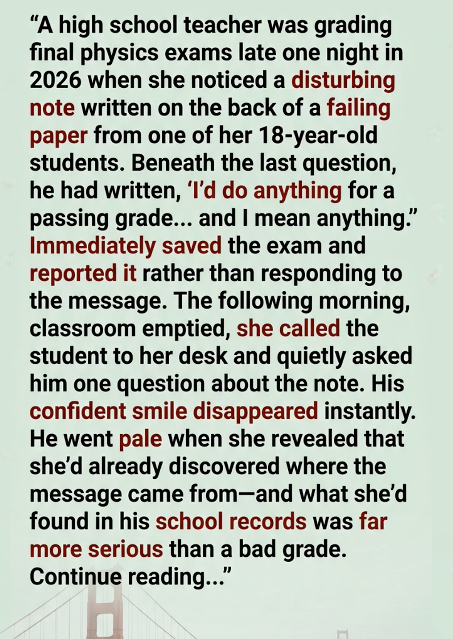
I was grading final physics exams late one night in 2026 when I came across a note that made me stop cold.
It was written on the back of one of my students’ papers.
He was eighteen.
His exam was failing.
Beneath the final question, he’d written:
“I’d do anything for a passing grade… and I mean anything.”
I stared at the sentence for several seconds.
I didn’t respond.
I didn’t write anything back.
Instead, I saved the exam, documented the message, and reported it to the appropriate school administrator.
At first, everyone assumed the student was simply desperate.
But I wasn’t convinced.
The following morning, after the classroom emptied, I asked him to stay behind.
He walked to my desk with a confident smile.
“Did you want to talk about my grade?”
I placed his exam on the desk.
He glanced at the note.
His smile vanished.
I asked him one question:
“Who told you that you needed to write this?”
His face immediately went pale.
“I don’t know what you’re talking about.”
I turned the paper around.
“Then explain this.”
He stared at it.
“I was joking.”
“That’s a serious statement to put on an exam.”
“I just wanted you to know I really need to pass.”
“Why?”
He hesitated.
Then looked toward the classroom door.
I knew immediately that this wasn’t about physics.
I opened the student’s school record.
There were several unusual entries.
His attendance had changed dramatically during the semester.
He’d missed almost every Monday morning class for several months.
There were also notes from the counseling office.
Repeated concerns about his behavior.
One teacher had documented that he’d become withdrawn.
Another had reported that he seemed frightened whenever a particular staff member entered the room.
Then I saw a name repeated several times.
An assistant coach.
I looked at the student.
“Does Mr. Harris know you wrote this?”
His eyes widened.
For the first time, his confidence disappeared completely.
“Why would you ask that?”
“Because his name appears in your records.”
He stared at the floor.
I waited.
Finally, he whispered:
“He told me what to write.”
The room went silent.
I asked him to tell me everything.
He explained that he’d been struggling academically, but the note wasn’t really about getting a better grade.
Mr. Harris had been pressuring him to do favors in exchange for academic help and access to opportunities.
The student had become frightened that refusing would affect his future.
He didn’t know who he could tell.
So he’d written the note on the exam, hoping I would understand that something was wrong.
I immediately stopped the conversation and brought in the school’s safeguarding personnel.
The student was not questioned repeatedly or forced to explain everything again.
Instead, trained staff handled the matter and contacted the appropriate authorities.
His family was notified.
The assistant coach was removed from contact with students while the investigation began.
Then something even more troubling emerged.
Other students had reported similar behavior.
The school discovered that the coach had been using his position to pressure vulnerable students for months.
Some had stayed silent because they feared losing opportunities.
Others had convinced themselves that what was happening wasn’t serious enough to report.
The student’s failing exam had accidentally become the doorway through which the truth finally surfaced.
Weeks later, I saw the student again.
He came to my classroom after school.
“I wanted to say thank you.”
“You don’t have to thank me.”
He shook his head.
“You believed me.”
I looked at him.
“You made it easy to believe you.”
He smiled faintly.
“I almost didn’t write it.”
“Why did you?”
He looked down.
“Because I didn’t know how else to ask for help.”
His grade was still the grade he’d earned.
I didn’t change it.
Neither did anyone else.
Instead, the school arranged academic support so he could complete the course honestly.
He passed the class later through legitimate work.
But the grade was no longer the most important thing.
He had learned that asking for help didn’t have to cost him his dignity.
I kept a copy of that exam for the investigation.
Sometimes I think about the sentence he wrote:
“I’d do anything for a passing grade.”
I initially read it as desperation.
Now I understand it differently.
He wasn’t bargaining for an A.
He was trying to tell an adult that someone was putting him in a situation where he felt he had no safe choices.
The most important thing I did that night wasn’t deciding what grade he deserved.
It was recognizing that the sentence beneath a failing paper might be saying something much more serious than:
“Please pass me.”
It might actually be saying:
“Please notice that something is wrong.”