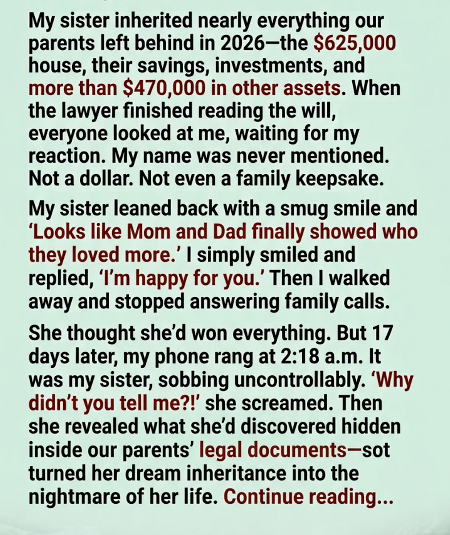
My sister inherited nearly everything our parents left behind in 2026.
The $625,000 house.
Their savings.
Their investments.
And more than $470,000 in other assets.
When the lawyer finished reading the will, the room became painfully quiet.
Everyone looked at me.
Waiting for anger.
Waiting for tears.
Waiting for me to demand an explanation.
My name hadn’t appeared anywhere.
Not once.
Not a dollar.
Not even one family keepsake.
My sister leaned back in her chair with a smug smile.
Then she said:
“Looks like Mom and Dad finally showed who they loved more.”
I looked at her.
And smiled.
“I’m happy for you.”
She looked almost disappointed.
I stood up.
Walked out.
And stopped answering family calls.
For the next few days, my sister celebrated.
She posted photographs of the house.
Talked about renovations.
Started making plans for the money.
She called relatives and told them that our parents had “finally made things fair.”
I said nothing.
Because there was something she didn’t know.
And I had no intention of being the person who told her.
On the 17th day, my phone rang.
It was 2:18 a.m.
My sister.
I almost ignored it.
Then I heard her voice.
She was sobbing.
“Why didn’t you tell me?!”
I sat up.
“Tell you what?”
She screamed:
“Why didn’t you tell me what Dad did?”
My heart started pounding.
“What are you talking about?”
“I found the other documents!”
“What documents?”
“The ones they hid from us!”
She was crying so hard I could barely understand her.
I told her to calm down.
She refused.
“Do you know what you inherited?”
“Yes.”
“No!”
“You inherited their debts too!”
I froze.
“What debts?”
She started reading numbers.
Mortgages.
Loans.
Guarantees.
Tax obligations.
Legal settlements.
And one enormous liability I’d never known about.
The total was more than $1.3 million.
I was silent.
Then I asked:
“How?”
She said:
“The will gave me the assets.”
“But the trust agreement attached the liabilities to whoever accepted the inheritance.”
My stomach tightened.
She had inherited the house.
But it still carried a large mortgage.
She had inherited the investments.
But some were pledged as collateral.
She had inherited business interests.
But those businesses had outstanding obligations.
The more she investigated…
the worse it became.
And then she found the document that changed everything.
A handwritten letter from our father.
It was dated years earlier.
And it was addressed to me.
My sister read it aloud.
“If you’re reading this, then your mother and I are gone.”
“We know the will appears to favor your sister.”
“That appearance is intentional.”
I closed my eyes.
I already understood.
Dad had anticipated exactly what would happen.
“Your sister has always wanted the appearance of wealth.”
“You have always wanted security.”
Then came the sentence that made my sister stop reading.
“The assets listed in the will are not the true inheritance.”
There was a separate trust.
My name was the beneficiary.
The trust contained the assets my parents actually intended to pass directly to me.
Cash.
Investments.
Property.
And a protected account worth more than $900,000.
But there was one condition.
I wasn’t allowed to claim anything until my sister formally accepted the estate.
The moment she signed the inheritance acceptance documents…
the trust became active.
My sister was crying again.
“You knew?”
I told her the truth.
“No.”
“Then why didn’t you react?”
“Because I trusted Mom and Dad.”
She went silent.
Then whispered:
“Did you know this was going to happen?”
“No.”
“Then how did you know not to fight?”
I thought about our parents.
About the strange look Mom had given me before the will was read.
About Dad’s final conversation with me.
He’d said:
“Don’t worry about what is written down.”
“Worry about what isn’t.”
At the time, I hadn’t understood.
Now I did.
My sister had assumed she had won because she saw the visible assets.
The house.
The money.
The investments.
She never noticed the legal structure underneath them.
My parents had deliberately separated appearance from ownership.
They wanted to test something.
Not their daughters.
Their daughter’s character.
They knew my sister would celebrate.
They knew I might walk away.
And they knew that once she accepted everything without investigating…
the real estate plan would activate.
My sister asked:
“So you get the protected trust?”
“Yes.”
“And I get the debts?”
“Some of them.”
She started crying again.
“I thought they hated you.”
I shook my head.
“No.”
“They loved us differently.”
She laughed bitterly.
“Apparently.”
Then she asked me the question I had been expecting.
“Are you going to help me?”
I sat silently for a moment.
Then said:
“I’ll help you understand the documents.”
“But I won’t erase the consequences.”
She didn’t argue.
For the first time in years, she couldn’t.
We met with the attorney the next morning.
He explained everything.
Our parents hadn’t actually disinherited me.
They had created two separate structures.
One was the visible estate.
The other was the protected family trust.
My sister’s inheritance gave her control over the estate’s assets.
But also responsibility for the obligations attached to them.
My trust was structured separately and could not be used to satisfy her personal liabilities.
My sister looked at me.
“Why didn’t Mom and Dad just tell us?”
The attorney answered:
“Because they believed telling you would change how you behaved.”
I looked at my sister.
She looked away.
That answer hurt.
But it was honest.
Months passed.
My sister eventually sold the house.
She used part of the proceeds to settle the debts.
She kept some investments.
She lost others.
It wasn’t the fortune she’d imagined.
But it wasn’t ruin either.
She survived.
And gradually, the resentment between us began to fade.
One evening, she came to my house.
She brought an old photograph.
It showed the four of us at a family picnic.
She was smiling.
I was standing beside Mom.
Dad was holding both of us.
She placed the photograph on my table.
“I found this in the attic.”
I smiled.
“What does it have to do with anything?”
She looked at me.
“I used to think that picture proved they loved me more.”
“And now?”
She shook her head.
“Now I think it proves they loved both of us.”
She paused.
“Just differently.”
I nodded.
Then she said:
“I’m sorry for what I said at the will reading.”
I smiled.
“I know.”
“I was awful.”
“You were excited.”
She laughed.
“I was greedy.”
I shrugged.
“We all make mistakes.”
Then she looked at me.
“Do you remember what you said?”
“What?”
“After they left everything to me.”
I smiled.
“I said I was happy for you.”
She nodded.
“Why?”
I thought about it.
“Because I knew that whatever Mom and Dad had planned, they hadn’t forgotten me.”
She started crying.
I reached across the table.
And this time, she took my hand.
The strangest part of the inheritance wasn’t the money.
It wasn’t the house.
It wasn’t the hidden trust.
It was realizing that my parents had understood something about us that we hadn’t understood about ourselves.
My sister had always measured love by what she could see.
I had learned, over time, to measure it by what people quietly protected.
Seventeen days after she stood there smiling and told me our parents had finally chosen her…
she called me at 2:18 a.m. because she’d discovered the truth.
She hadn’t inherited everything.
She had inherited the responsibility attached to what she could see.
And I hadn’t been forgotten.
I had been protected.
The last line of my father’s letter said it best:
“Never confuse the loudest inheritance with the most important one.”