My father bought an annuity in 2008.
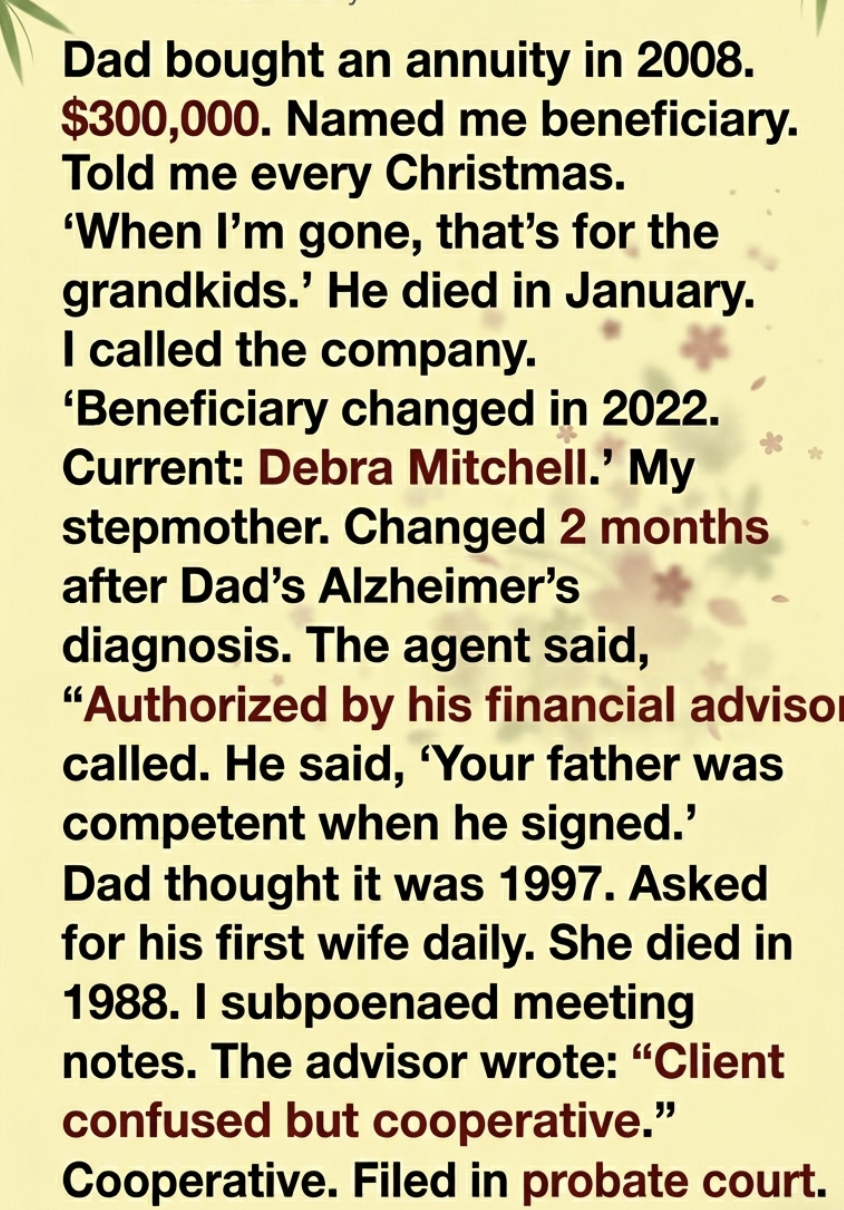
Three hundred thousand dollars.
Not because he was wealthy.
Because he was careful.
He worked thirty-seven years at the same manufacturing plant.
Overtime.
Weekends.
Holidays.
He saved every spare dollar.
Every Christmas he reminded me about the annuity.
Always the same words.
“When I’m gone, that’s for the grandkids.”
Not for me.
For them.
Their college.
Their future.
Their start in life.
He repeated it so often that eventually it became a family joke.
Then Dad died in January.
The grief was still fresh when I called the annuity company.
I expected paperwork.
Forms.
Processing delays.
Instead, the representative said something that made my stomach drop.
“The beneficiary was changed in 2022.”
I froze.
“What?”
“The current beneficiary is Debra Mitchell.”
My stepmother.
I nearly dropped the phone.
Dad had married Debra six years earlier.
She wasn’t a bad person.
At least, I didn’t think she was.
But this made no sense.
Absolutely none.
Then the representative gave me the date.
The beneficiary change occurred two months after Dad’s Alzheimer’s diagnosis.
Two months.
I stared at the wall.
Trying to process it.
Dad couldn’t remember breakfast.
Couldn’t remember conversations.
Couldn’t remember what year it was.
Yet somehow he changed a major financial document?
I called the financial advisor immediately.
His answer came too quickly.
“Your father was competent when he signed.”
The certainty bothered me.
Because I’d been there during that period.
Dad thought it was 1997.
Every day.
He asked for his first wife constantly.
My mother.
The woman who died in 1988.
At least three times a week he would ask when she was coming home.
Every answer broke his heart all over again.
And somehow that man was considered competent enough to redirect three hundred thousand dollars?
I hired an attorney.
The consultation cost nearly everything I’d saved.
But something felt wrong.
Very wrong.
The attorney immediately requested records.
Meeting notes.
Emails.
Internal communications.
Anything related to the beneficiary change.
Weeks later, one document arrived.
A single page.
The advisor’s meeting notes.
I read one sentence.
Then read it again.
And again.
“Client confused but cooperative.”
My hands started shaking.
Confused.
But cooperative.
Those words changed everything.
Because competence isn’t about cooperation.
It’s about understanding.
And the advisor had documented confusion himself.
The lawsuit was filed within days.
Probate court opened an investigation.
Then more records surfaced.
Phone logs.
Appointment records.
Medical evaluations.
Each one painted the same picture.
Dad wasn’t improving.
He was declining rapidly.
Then came the deposition.
The financial advisor sat across from my attorney.
Confident at first.
Until the questions became specific.
“Did Mr. Mitchell correctly identify the current year?”
“No.”
“Did he correctly identify the sitting president?”
“No.”
“Did he recognize all family members present?”
“No.”
“Yet you concluded he fully understood a beneficiary change worth three hundred thousand dollars?”
Silence.
The advisor shifted uncomfortably.
Then said:
“He appeared agreeable.”
My attorney smiled.
Not because it was funny.
Because the case was effectively over.
Several weeks later, another witness emerged.
A receptionist.
She remembered the appointment vividly.
Because Dad had become upset.
According to her, he repeatedly asked for my mother.
Not Debra.
My mother.
The woman dead for more than thirty years.
Then came the detail nobody expected.
Security footage.
The advisor’s office retained lobby recordings for years.
The footage showed Debra filling out paperwork before Dad arrived.
Then pointing repeatedly to signature lines.
Then physically turning pages for him.
The image wasn’t criminal.
But it was powerful.
Very powerful.
By the time the hearing began, the judge had reviewed hundreds of pages.
Medical records.
Expert evaluations.
Witness statements.
Financial documents.
The courtroom was silent when the judge began speaking.
He summarized the evidence carefully.
Methodically.
Then he reached the advisor’s note.
The one sentence that started everything.
“Confused but cooperative.”
The judge removed his glasses.
Looked directly at the advisor.
And asked:
“Can you explain how confusion supports informed consent?”
Nobody answered.
Because nobody could.
The ruling came two weeks later.
The beneficiary change was invalidated.
The court concluded Dad lacked sufficient capacity to understand the transaction.
The annuity reverted to the prior designation.
The one he’d chosen years earlier.
The one he’d repeated every Christmas.
For the grandkids.
When I told my children, they didn’t celebrate.
They didn’t cheer.
Instead, my oldest grandson asked a question that stayed with me.
“Does that mean Grandpa won?”
I thought about it for a moment.
Then shook my head.
“No.”
Because Grandpa wasn’t there to see it.
He wasn’t there to smile.
Or tell another story.
Or remind everyone for the hundredth time about that annuity.
But later that night, sitting alone in my living room, I realized something.
Maybe he did win.
Not because of the money.
Because the truth mattered.
His wishes mattered.
His voice mattered.
Even after Alzheimer’s tried to take it away.
Every Christmas, Dad told us what he wanted.
And in the end, despite confusion, despite paperwork, despite signatures and legal arguments…
those wishes were finally heard.
Exactly as he intended.