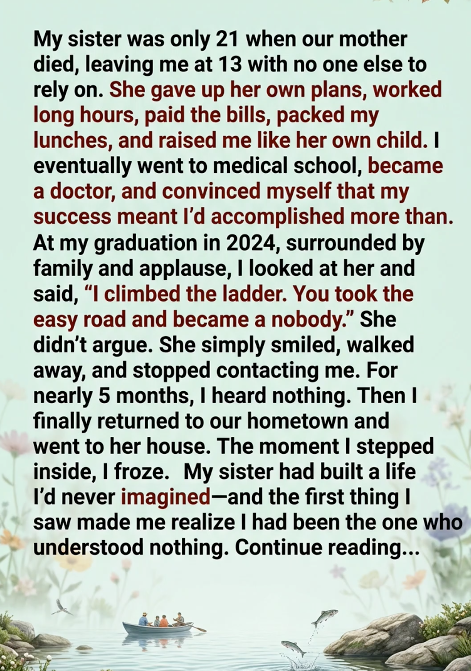
My sister was only 21 when our mother died.
I was 13.
Overnight, my sister stopped being just my sister.
She became everything.
She made breakfast.
Packed my lunch.
Went to parent-teacher meetings.
Worked long hours.
Paid our bills.
Made sure I had clean clothes.
And whenever I asked what would happen to her dreams, she smiled and said:
“You’re going to have the life Mom wanted for us.”
I didn’t understand what she was giving up.
I only knew she kept telling me to study.
I eventually went to college.
Then medical school.
Then residency.
Years passed.
I became a doctor.
My sister stayed in our hometown.
She worked.
Bought a small house.
Built a life.
Whenever relatives asked what she did, she’d simply say:
“I work with families.”
I never thought much about it.
To me, she hadn’t gone anywhere.
I had.
I was climbing.
She was staying behind.
At least, that’s the story I told myself.
At my graduation in 2024, our entire family was there.
People were congratulating me.
Taking photographs.
Talking about how far I’d come.
My sister stood near the back.
She looked exhausted.
But she was smiling.
She hugged me.
“I’m proud of you.”
I don’t know what possessed me to say what I said next.
Maybe pride.
Maybe arrogance.
Maybe I needed to believe my success had been entirely mine.
I looked at her and said:
“I climbed the ladder. You took the easy road and became a nobody.”
The smile on her face disappeared.
Not anger.
Not outrage.
Just disappointment.
She nodded.
“Congratulations.”
Then she walked away.
She stopped contacting me.
One month.
Two.
Three.
Nearly five months passed.
I told myself she was still angry.
I told myself she’d eventually get over it.
Then one weekend, I returned to our hometown.
I decided to visit her.
I expected the little house I remembered.
Instead, when I opened her front door, I froze.
The walls were covered with awards.
Certificates.
Photographs.
Newspaper articles.
There were pictures of schools.
Community centers.
Food banks.
Medical clinics.
Children standing beside my sister.
I turned toward her.
“What is all this?”
She looked uncomfortable.
“I didn’t think you’d care.”
I picked up the first framed certificate.
It was for a nonprofit organization.
My sister was listed as the founder.
I read the name again.
“Family Bridge Foundation.”
“What does this do?”
She smiled.
“We help families who are about to lose everything.”
I stared at her.
“Since when?”
“About twelve years.”
Twelve years.
I hadn’t known.
She showed me the organization’s offices through photographs.
A counseling center.
A food distribution warehouse.
A scholarship program.
Emergency housing.
Childcare assistance.
Then she showed me the financial report.
The foundation had helped thousands of families.
It had raised millions of dollars.
I looked at her.
“How did you do all this?”
She shrugged.
“I learned.”
“Where?”
“Everywhere.”
She smiled.
“I never had the luxury of waiting for someone to teach me.”
Then she opened another file.
Inside were architectural plans.
A medical clinic.
I recognized the name immediately.
It was named after our mother.
“What is this?”
My sister looked at me.
“Your future project.”
“My what?”
“You’ve become a doctor.”
She pointed toward the plans.
“I’ve spent years building the infrastructure.”
She paused.
“You can provide the medical care.”
I couldn’t speak.
Then she showed me a photograph from years earlier.
She was standing beside a government official.
They were opening a community health center.
Another photograph showed her speaking at a university.
Another showed her receiving an award.
She’d apparently spent years working in community development.
She had negotiated grants.
Built partnerships.
Created programs.
And quietly become one of the most respected people in our hometown.
I looked around again.
“You never told me.”
She smiled.
“You were busy.”
“Why didn’t you tell me?”
“Because you never asked.”
That hurt.
Because it was true.
I’d been so busy measuring my accomplishments that I had never bothered to measure hers.
Then she took me upstairs.
There was a small room filled with boxes.
My old school papers.
My childhood photographs.
Every report card.
Every acceptance letter.
Every medical school document.
She had saved all of it.
I picked up a letter I’d written to her when I was sixteen.
It said:
“Someday I’ll make you proud.”
She’d written something underneath.
“You already do.”
I started crying.
I looked at her.
“I was awful to you.”
She smiled sadly.
“Yes.”
“I thought I was better than you.”
“I know.”
“I thought you stayed behind because you couldn’t do more.”
She shook her head.
“I stayed because you needed someone.”
Then she said:
“There is a difference between being left behind and choosing to stay.”
That sentence destroyed me.
She explained that after Mom died, she had postponed college because she knew I needed stability.
She’d planned to return later.
But while working, she’d discovered a talent for organizing community programs.
One opportunity led to another.
She realized she could help not just me…
but hundreds of families like ours.
“So you chose this?”
“Eventually.”
I stared at her.
“And you don’t regret it?”
She smiled.
“I regret that you ever thought it was the easy road.”
Then she showed me one final document.
A scholarship fund.
It had been created in our mother’s name.
The beneficiaries were students who had lost a parent and were raising younger siblings.
I looked at the eligibility criteria.
It was basically our story.
I started crying again.
“You built this because of us.”
She nodded.
“Because I know what it feels like to be twenty-one and suddenly become responsible for a thirteen-year-old.”
Then she smiled.
“I wanted someone else to have help.”
I finally understood.
At my graduation, I’d thought the applause proved I had climbed higher than her.
I hadn’t climbed higher.
I had climbed because someone had held the ladder steady.
My sister had spent years giving me the freedom to become a doctor.
Meanwhile, she’d built an entire organization designed to keep other children from losing their futures the way she nearly lost hers.
I looked at her.
“Can you forgive me?”
She took a long breath.
“I already did.”
“How?”
“Because I know you were wrong.”
She smiled.
“But now you know.”
I nodded.
“I do.”
Before I left, she handed me a folder.
Inside was the final plan for the medical center.
“You wanted to climb the ladder,” she said.
I smiled sadly.
“Yes.”
She pointed toward the plans.
“Then help me build one for everyone else.”
We opened the clinic together the following year.
She handled the foundation.
I handled the medical program.
The clinic served families who couldn’t afford private care.
And above the entrance was a small plaque bearing our mother’s name.
Sometimes people asked how we became partners.
I tell them:
“My sister raised me.”
They assume I’m being sentimental.
I’m not.
She really did.
I spent years thinking success meant going farther than the person who raised you.
Now I understand that real success is recognizing who helped you get there.
At my graduation, I told my sister:
“I climbed the ladder. You took the easy road and became a nobody.”
Five months later, standing inside the life she’d built, I finally understood how wrong I had been.
She hadn’t taken the easy road.
She had built the road.
And while I was busy climbing toward a title…
my sister had spent her life making sure people like us wouldn’t have to climb alone.