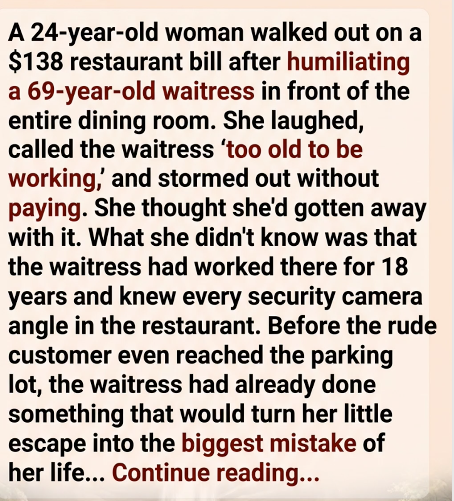
The restaurant was packed that Friday evening when a 24-year-old woman finished her dinner and asked for the check.
The total was $138.
When the 69-year-old waitress brought it over, the woman glanced at the amount and suddenly rolled her eyes.
“Seriously?”
The waitress smiled politely.
“Is there a problem?”
The woman looked around the dining room.
Then laughed.
“You’re still working at your age?”
The conversation at the nearby tables suddenly stopped.
The waitress remained calm.
“I’m sorry you feel that way.”
The woman picked up her purse.
“You should be retired.”
Then she stood.
The waitress gently said:
“Ma’am, your bill hasn’t been paid.”
The woman laughed again.
“Send it to whoever owns this place.”
Then she walked toward the exit.
The waitress didn’t chase her.
She didn’t yell.
She didn’t threaten her.
Instead, she calmly turned toward the security monitor behind the host stand.
She had worked at the restaurant for 18 years.
She knew every camera angle.
The entrance.
The parking lot.
The side exit.
The license-plate camera.
And most importantly…
she knew exactly what the restaurant’s security system automatically recorded.
Before the woman even reached her car, the waitress had already called the manager.
“Pull the footage from Table 14.”
The manager looked confused.
“Why?”
“Because we’re going to need it.”
The footage showed everything.
The woman deliberately leaving without paying.
Her mocking the waitress.
The unpaid bill.
And, most importantly, the moment she had placed her purse on the table and opened her wallet.
Her driver’s license had been visible for several seconds.
The manager froze.
“She practically gave us her identity.”
The waitress nodded.
“Exactly.”
But the waitress wasn’t finished.
She asked the manager to check the customer’s name against the restaurant’s reservation system.
The woman had made the reservation online.
Her full name.
Phone number.
Email.
Everything was there.
Then the manager discovered something else.
She wasn’t a first-time customer.
She’d eaten there three times during the previous two months.
And every time, she’d left a small unpaid amount by claiming she’d forgotten her wallet.
This time, she’d simply decided not to pay at all.
The manager immediately called the police.
The officers arrived while the woman was still in the parking lot.
She was shocked.
“What?”
The manager pointed toward the security camera.
“You’re being accused of leaving without paying for your meal.”
The woman laughed.
“It’s only $138.”
The waitress stepped outside.
“It’s not about $138.”
The woman glared at her.
“Then what is it about?”
The waitress calmly replied:
“It’s about believing you can humiliate someone and walk away without consequences.”
The woman was required to return inside.
The bill was paid.
But then the waitress asked the manager to show her something.
The previous two incidents.
The camera footage.
The reservation records.
The unpaid amounts.
The woman’s face changed.
She realized this wasn’t a one-time mistake.
There was a pattern.
Then the waitress noticed something else.
The woman had left her phone charger at the table.
When she returned to collect it, the waitress handed it to her.
Then quietly said:
“There’s something you should know.”
The woman looked confused.
“You embarrassed me in front of everyone tonight.”
“I could have argued.”
“I could have shouted.”
“But I didn’t.”
The woman stared at her.
The waitress continued:
“I’ve been working here for eighteen years.”
“I’ve watched thousands of people walk through those doors.”
“Some are wealthy.”
“Some are struggling.”
“But the ones I remember aren’t the people who spent the most money.”
She paused.
“They’re the people who treated others with dignity.”
The woman lowered her eyes.
For the first time that evening, she didn’t have a sarcastic answer.
“I’m sorry,” she whispered.
The waitress nodded.
“Apology accepted.”
But she wasn’t allowed to simply walk away.
The restaurant required her to settle the previous unpaid charges as well.
The total came to $197.
She paid every cent.
Before leaving, she approached the waitress again.
“I shouldn’t have said those things.”
The waitress smiled.
“You’re right.”
“I was disrespectful.”
“Yes.”
The woman took a breath.
“Why didn’t you yell at me?”
The waitress looked at her.
“Because I’ve spent too many years learning that anger rarely teaches people what they need to learn.”
Then she smiled.
“But consequences sometimes do.”
The story could have ended there.
But several weeks later, the woman returned.
This time, she wasn’t alone.
She brought her mother.
She walked directly to the waitress.
“I wanted you to meet someone.”
The waitress looked confused.
The woman introduced her mother.
Then said:
“She taught me something after that night.”
The waitress smiled.
“What?”
The young woman laughed nervously.
“That the way you treat someone who has nothing to offer you says more about you than anything else.”
The waitress nodded.
“Your mother sounds wise.”
The young woman smiled.
“She is.”
The waitress eventually forgot the woman’s name.
But she never forgot the lesson.
The young woman had thought the worst thing that would happen was being caught with an unpaid $138 bill.
She was wrong.
The real consequence was being forced to see herself from the other side of the dining room.
And the waitress never needed to chase her.
She simply used the cameras, the records, and the truth.
Because after 18 years behind those tables, she had learned something the rude customer hadn’t:
“You don’t have to shout to stand up for yourself.”
“Sometimes the calmest person in the room is the one who already knows exactly what to do.”