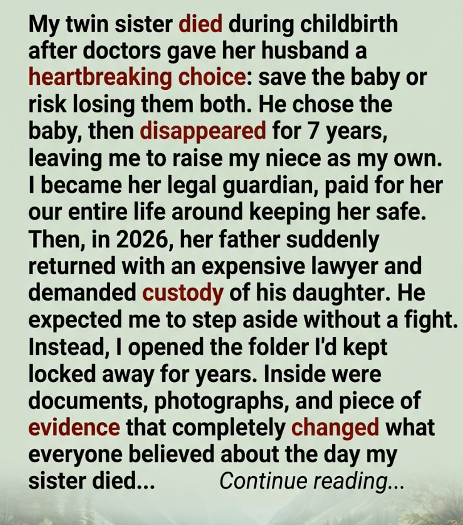
My twin sister died during childbirth.
She was only 29.
The doctors gave her husband a heartbreaking choice:
Save the baby…
or risk losing them both.
He chose the baby.
My niece survived.
My sister didn’t.
I thought that decision would haunt all of us forever.
I never imagined what would come next.
—
After my sister’s funeral, her husband disappeared.
He didn’t visit.
He didn’t call.
He didn’t ask about his daughter.
For **seven years**, I raised that little girl as my own.
I became her legal guardian.
I paid for her school.
Bought her clothes.
Attended every parent-teacher meeting.
Held her through nightmares.
Celebrated every birthday.
When she asked where her father was, I never spoke badly about him.
I’d simply say:
“He’s somewhere trying to figure things out.”
The truth was…
I didn’t know where he was.
—
Then, in **2026**, he suddenly came back.
Not alone.
He arrived in an expensive car with a high-powered lawyer.
He walked into my home wearing a tailored suit.
Then calmly said:
“I’m here for my daughter.”
I stared at him.
“She’s not a package you can pick up after seven years.”
He looked toward my niece.
“I have legal rights.”
His lawyer immediately began explaining custody laws.
He seemed completely confident.
As though he expected me to step aside.
As though seven years meant nothing.
Then he said:
“You’re not her mother.”
I looked at him.
“No.”
I paused.
“But I’ve been the one raising her.”
—
He demanded custody.
I refused.
The lawyer warned me that the court would likely favor the biological father.
I nodded.
“Then we’ll go to court.”
My niece was terrified.
She didn’t even recognize him.
To her, he was a stranger.
She hid behind me whenever he visited.
One night she asked:
“Why does that man keep saying he’s my dad?”
I hugged her.
“Because he is.”
She looked confused.
“But you’re my mom.”
I started crying.
“I’m your aunt.”
She shook her head.
“You’re my family.”
—
The custody hearing was scheduled.
My attorney told me we needed everything.
Medical records.
School records.
Financial documents.
Evidence of caregiving.
I gave her everything.
Everything except one folder.
A folder I’d kept locked away for seven years.
She looked at me.
“What is this?”
I put the folder on the table.
“I’ve never opened it since the day my sister died.”
“Why?”
“Because I wasn’t ready.”
—
The folder contained photographs.
Hospital documents.
Doctor’s notes.
A handwritten statement from one of the nurses.
And a sealed envelope.
I stared at it for several seconds.
Then finally opened it.
Inside was something that made my hands shake.
A recording.
A copy of the hospital’s emergency-room log.
And a document signed by my sister’s husband.
The date was the day she died.
—
I read the first page.
The official story said he had been given a choice:
Save his wife…
or save the baby.
He chose the baby.
But the document in my hand told a different story.
The doctors had not actually told him that.
They had told him that immediate intervention was necessary because my sister was already deteriorating.
The baby could be saved.
And there was still a chance of saving my sister.
But someone had refused permission for an emergency procedure.
I stared at the signature.
It was my brother-in-law’s.
—
I couldn’t breathe.
He hadn’t simply chosen the baby.
He had signed a refusal.
The refusal delayed the procedure.
By the time the doctors were finally allowed to intervene, my sister’s condition had become critical.
She died shortly afterward.
I looked at my attorney.
“Why was this never in the original report?”
She shook her head.
“I don’t know.”
Then she found something even more disturbing.
A second page had been removed from the hospital file.
—
We requested the complete medical record.
It showed that my sister had been conscious for part of the emergency.
A nurse had documented her final request.
She had asked:
**”Please don’t let him take her.”**
I stared at the sentence.
“Who was she talking about?”
The nurse had written:
*”Patient appears frightened of husband. Requests sister be guardian of infant if patient does not survive.”*
My hands went numb.
—
The nurse’s statement explained that my sister had become frightened during the pregnancy.
She had told medical staff that her husband had been pressuring her to sign financial documents.
She had also expressed concern that he wanted control of a family inheritance.
She had made the nurse promise to tell me if anything happened.
Then, on the day she died, she’d repeated the request.
The nurse had recorded it.
—
Suddenly, his seven-year disappearance looked different.
He hadn’t simply abandoned his daughter.
He had left immediately after the funeral because he knew an investigation might uncover what had happened.
He had spent years living under another name.
He had eventually returned when he discovered that my niece’s inheritance would become accessible when she turned eight.
I looked at the lawyer.
“How much?”
She checked the documents.
Nearly **$1.2 million**.
—
That changed everything.
His custody request wasn’t about suddenly wanting to be a father.
It was about gaining control of his daughter’s inheritance.
My sister had apparently left the money in a protected trust.
The trust required the guardian to manage it for the child’s benefit.
My brother-in-law wanted control.
And because he was the biological father, he believed custody would give him access.
—
At the hearing, his attorney presented him as a grieving father who had made an impossible decision seven years earlier.
Then my attorney presented the hospital records.
The refusal document.
The nurse’s statement.
The emergency logs.
My sister’s final request.
And the financial records showing my brother-in-law had attempted to access the trust shortly after returning.
The courtroom became completely silent.
—
The judge looked at him.
“Why did you leave the child for seven years?”
He had no good answer.
“I was grieving.”
The judge asked:
“Why did you make no attempt to maintain contact?”
Silence.
Then:
“Why did you seek custody shortly before the trust became accessible?”
He looked toward his attorney.
He couldn’t answer that either.
—
The court ordered an investigation.
My niece remained in my care.
Her father’s custody request was denied pending further proceedings.
The hospital reopened its internal review.
The evidence surrounding my sister’s death was formally investigated.
And eventually, authorities determined that there had been serious irregularities in the handling of her final medical treatment.
My brother-in-law faced legal consequences.
—
My niece eventually learned a carefully explained version of what had happened.
I never told her every detail.
She was still a child.
She only needed to know that her mother had loved her.
That her mother had wanted me to protect her.
And that none of what happened was her fault.
One night, she asked me:
“Did Mommy know you would take care of me?”
I smiled through tears.
“Yes.”
“How?”
I held her close.
“Because she knew me.”
—
Years earlier, I thought the hardest part of losing my twin sister was knowing I’d never hear her voice again.
Then I learned something worse:
Her final hours had not happened the way we’d all been told.
For seven years, I’d believed her husband had sacrificed his marriage to save their child.
The truth was much more complicated.
He had made a decision that affected both of them…
and then disappeared.
When he returned with an expensive lawyer demanding custody, he expected me to be frightened.
He expected me to surrender.
He didn’t know that I’d kept one folder locked away for seven years.
Inside it was the truth my sister had tried to leave behind.
And the most important document wasn’t the inheritance record.
It wasn’t the hospital report.
It was the nurse’s final note:
**”Patient requests sister be guardian of infant if she does not survive.”**
My sister couldn’t protect her daughter after that day.
So I did.
And seven years later, when her father came back demanding custody, I finally understood why she’d asked me to promise one thing:
**”Don’t let him take her.”**