My parents abandoned me when I was **16**.
They left without warning.
No explanation.
No goodbye.
Just a suitcase, a note, and a sentence my mother said before walking out:
“You’re old enough to take care of yourself.”
I wasn’t.
But I had no choice.
My uncle was the only person who stepped in.
He gave me a room.
Bought groceries.
Helped me finish school.
And when I was old enough to work, he taught me everything he knew about managing money and building a life.
He became the closest thing I had to a parent.
My actual parents rarely called.
Years passed.
I built my own career.
Bought my own home.
And eventually stopped expecting them to come back.
Then my uncle died.
—
At the will reading, I sat quietly across from the attorney.
My parents were there too.
I hadn’t seen them in years.
My mother looked completely comfortable.
My father sat beside her with his arms crossed.
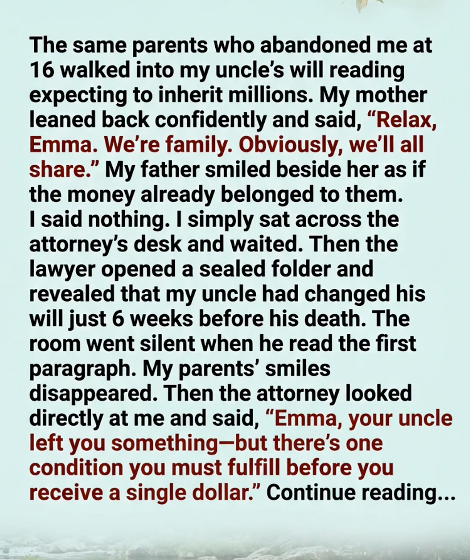
Before the attorney even opened the file, my mother leaned back and smiled.
“Relax, Emma.”
“We’re family.”
“Obviously, we’ll all share.”
I stared at her.
My father nodded.
“We’re not here to fight.”
I said nothing.
I simply waited.
—
The attorney opened a sealed folder.
“This will was amended six weeks before Mr. Carter’s death.”
My mother’s smile disappeared slightly.
The attorney continued:
“Several provisions of his previous will have been completely replaced.”
He began reading.
The first paragraph made the room silent.
My parents’ expressions changed.
Then the attorney looked directly at me.
“Emma, your uncle left you the majority of his estate.”
My mother immediately sat forward.
“What?”
The attorney continued.
“The estate includes the family home, investment accounts, several properties, and approximately $4.2 million in liquid assets.”
My father stared at him.
“He can’t do that.”
The attorney calmly replied:
“He did.”
—
My mother turned toward me.
“You knew about this?”
“No.”
“You’ve been manipulating him for years!”
I stared at her.
“Really?”
She slammed her hand on the table.
“You took advantage of your uncle!”
The attorney cleared his throat.
“Mrs. Carter, I strongly suggest you let me finish.”
She fell silent.
Then he picked up another document.
“This is the condition attached to Emma’s inheritance.”
I looked at him.
“A condition?”
He nodded.
“You cannot receive a single dollar until you fulfill it.”
—
My father laughed bitterly.
“So there is the catch.”
The attorney looked at me.
“Your uncle required you to do one thing.”
He paused.
“You must open the locked storage unit listed in this document.”
My stomach tightened.
“What is in it?”
“I don’t know.”
“He left instructions that the contents must be reviewed by you personally.”
My mother immediately said:
“Then we’ll go with her.”
The attorney shook his head.
“No.”
“Only Emma.”
—
The following morning, I went to the storage facility.
The attorney gave me a key.
Unit 214.
The lock opened.
Inside were dozens of boxes.
Old photographs.
Letters.
Financial records.
And a wooden trunk.
The trunk had my name on it.
I opened it.
Inside was a letter from my uncle.
The first line read:
**”Emma, if you’re reading this, your parents have probably already shown up expecting my money.”**
I laughed through my tears.
That sounded exactly like him.
—
The letter continued.
*”I know they will tell you that blood makes them entitled to what I’ve built.”*
*”It doesn’t.”*
*”But I also don’t want you to spend the rest of your life angry at them.”*
I stopped reading.
Then came the condition.
*”Before you accept the inheritance, you must learn why I never confronted your parents after they abandoned you.”*
I stared at the page.
“What?”
He had known something.
Something I’d never been told.
—
I opened the next box.
Inside were letters my mother had written to my uncle.
They were dated from the year they abandoned me.
I read the first one.
*”We can’t raise her anymore.”*
Another:
*”We need to start over.”*
Another:
*”Please don’t interfere.”*
My hands began shaking.
Then I found the final letter.
It was from my father.
*”Tell Emma we’re doing this because we have no choice.”*
I stopped.
No choice?
I read the next sentence.
*”If she ever finds out why, she may understand.”*
—
Underneath the letters was a medical file.
It belonged to my father.
He had been seriously ill at the time.
There were hospital records.
Treatment plans.
Insurance denials.
And debts.
My parents hadn’t simply walked away because they didn’t want me.
They had been drowning financially and emotionally.
But that wasn’t the whole story.
—
I found another document.
A life-insurance policy.
My uncle had paid the premiums.
My parents had signed paperwork agreeing that if something happened to my father, my uncle would become responsible for me.
But then there was a second page.
My mother had refused.
She had signed a statement saying:
**”We want complete freedom from parental obligations.”**
I sat down on the concrete floor.
My parents had not been forced to leave me.
They had chosen to.
Even while my uncle was offering to help.
—
Then I found a recording.
My uncle had apparently recorded a conversation with my parents years later.
My mother’s voice said:
“She’ll be better off without us.”
My uncle replied:
“She’s sixteen.”
My father said:
“We’ve made our decision.”
Then my uncle said something that broke my heart:
**”One day she’ll understand that you chose yourselves.”**
The recording ended.
—
I returned to the attorney.
“I found everything.”
He nodded.
“Your uncle wanted you to understand the truth before accepting the inheritance.”
“Why?”
“Because he didn’t want money to become another reason you hated your parents.”
I looked down.
“What else did he leave?”
The attorney smiled.
“Something much more valuable.”
He handed me another envelope.
—
Inside was a letter addressed to my parents.
My uncle had written:
*”You abandoned Emma when she was sixteen.”*
*”I raised her.”*
*”I watched her become the person you refused to become parents for.”*
*”You will not inherit what you did not earn.”*
Then came the sentence that destroyed their confidence at the will reading:
**”If Emma chooses to share anything with you, that will be her decision—not your entitlement.”**
—
My parents demanded a copy.
The attorney refused.
They threatened to challenge the will.
He calmly explained that the documents had been prepared and notarized properly.
The inheritance belonged to me.
But there was still one final decision.
The condition required me to meet my parents one more time.
Not to forgive them.
Not to give them money.
Just to tell them what I’d learned.
—
We met in the attorney’s office.
My mother cried.
My father looked older than I remembered.
She said:
“We made mistakes.”
I nodded.
“You did.”
“We were scared.”
“I know.”
“We didn’t know what else to do.”
I looked at her.
“My uncle did.”
She started crying.
“He helped you when we couldn’t.”
“No.”
I shook my head.
“He helped me when you wouldn’t.”
—
My father lowered his eyes.
“Do you hate us?”
I thought about it.
“No.”
He looked surprised.
“Why?”
“Because I had 20 years with my uncle.”
“He gave me the family you chose not to give me.”
My mother began sobbing.
“And now?”
I took a breath.
“Now I don’t need you to explain why you left.”
“I already know.”
—
I eventually accepted the inheritance.
Not because it made me wealthy.
Because it represented everything my uncle had sacrificed to give me.
But I followed his final instruction.
I didn’t spend my life punishing my parents.
I simply stopped allowing them to rewrite the past.
They were my parents.
They abandoned me.
Both things could be true at the same time.
—
I never gave them the millions.
I didn’t owe them that.
But I did send them one small gift.
A copy of the old photograph of me and my uncle.
On the back, I wrote:
**”This is what family looked like when I needed it most.”**
Then I moved forward.
Because my uncle hadn’t spent his life building an estate for me to spend mine fighting over it.
He wanted me to understand something much simpler:
**Inheritance isn’t about who shares your blood.**
**It’s about who showed up when you had nothing.**
And when my parents walked into that will reading expecting millions, they thought the money would prove they were still my family.
Instead, my uncle’s final condition forced them to face the truth:
**They had walked away from me when I was 16.**
**He was the one who stayed.**