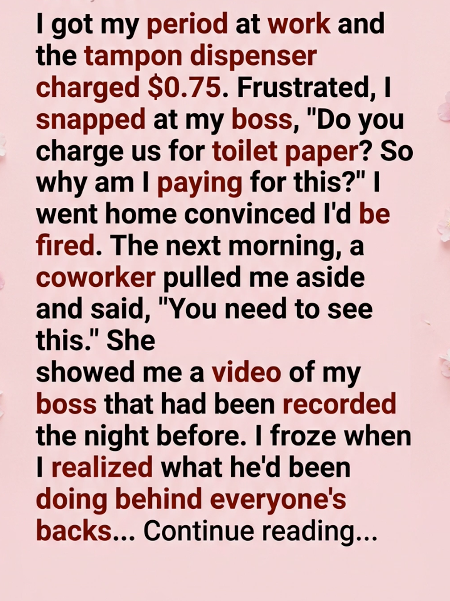
I got my period unexpectedly at work.
I rushed to the restroom and found myself staring at the tampon dispenser.
I put in **$0.75**.
Then another thought hit me.
Why was I paying for something I needed at work?
I went back to my desk frustrated.
My boss was nearby.
I snapped:
“Do you charge us for toilet paper? So why am I paying for this?”
The room went quiet.
My boss looked embarrassed.
Then irritated.
“Watch your attitude.”
I immediately regretted saying it that way.
I went home convinced I’d be fired.
I barely slept that night.
—
The next morning, one of my coworkers pulled me aside.
“You need to see this.”
She looked nervous.
“What happened?”
She opened her phone.
There was a video.
It had been recorded the previous evening after most employees had gone home.
I watched my boss walk into the restroom.
Then he opened the tampon dispenser.
My stomach dropped.
He was removing the coins from inside.
But that wasn’t the worst part.
He was also taking boxes of free menstrual products from a locked cabinet and placing them into a separate bag.
—
I stared at the screen.
“Why would he do that?”
My coworker shook her head.
“We found out this morning.”
“How?”
“Someone checked the storage records.”
Apparently, the company had been receiving free menstrual products through a supplier wellness program.
They were supposed to be available to employees at no cost.
But my boss had been locking them away.
Then he installed the coin-operated dispensers.
The $0.75 charges were being collected from employees for products the company had received for free.
—
I couldn’t believe it.
“How long?”
My coworker answered:
“Almost two years.”
Two years of employees paying for something their employer had received at no cost.
Then she showed me another spreadsheet.
The dispenser revenue.
Hundreds of dollars every month.
Thousands of dollars over time.
And the money wasn’t going into the company’s general fund.
It was being transferred into a private account.
My boss’s.
—
I suddenly understood why he reacted so strongly when I questioned the charge.
I hadn’t just complained about a tampon.
I’d accidentally touched a secret revenue stream.
The video was forwarded to HR.
Then to the company’s compliance department.
Within hours, an internal investigation began.
—
My boss called me into his office.
He closed the door.
“I heard you were spreading videos.”
I stayed silent.
He continued:
“You could lose your job.”
I looked at him.
“Am I being threatened?”
He stared at me.
“I’m telling you to be careful.”
I placed a copy of the video on his desk.
Then said:
“I think you should be careful.”
His face changed instantly.
—
The investigation uncovered much more than the dispenser.
The free products weren’t the only employee supplies being diverted.
Basic hygiene products.
First-aid items.
Even some medical supplies intended for workplace use had been removed from company storage.
The dispenser scheme was only one part of a much larger pattern.
My boss was suspended.
An outside audit was conducted.
And the company discovered that employees had paid thousands of dollars for products that should have been free.
—
A week later, the company sent an announcement.
Starting immediately, menstrual products would be provided free in every restroom.
Employees who had paid for them were invited to submit records for reimbursement.
The coin-operated dispensers disappeared.
So did my boss.
—
At a staff meeting, the HR director thanked the employees who had brought the issue forward.
Then she looked at me.
“I’d especially like to thank the employee who asked one uncomfortable question.”
Everyone laughed.
I smiled.
I hadn’t intended to expose anything.
I had just been angry about paying **$0.75** for a tampon.
But sometimes the smallest question can uncover a much bigger problem.
—
A month later, my coworker showed me the original video again.
She laughed.
“Your angry bathroom complaint started all this.”
I smiled.
“I thought it was going to get me fired.”
She shook her head.
“Instead, it got someone else fired.”
I laughed.
Then she said:
“You know what the funniest part is?”
“What?”
“He probably thought nobody would notice seventy-five cents.”
—
I learned something that week.
It’s easy to dismiss a small unfairness.
A tiny charge.
A minor inconvenience.
Something that seems too insignificant to complain about.
But sometimes those little things are clues.
That **$0.75** wasn’t really about the tampon.
It was about a system designed to make employees pay for something their company had already provided for free.
And the next morning, when my coworker showed me that video, I finally understood why my boss had been so angry at one simple question:
**I hadn’t complained about a tampon.**
**I’d accidentally asked where the money was going.**