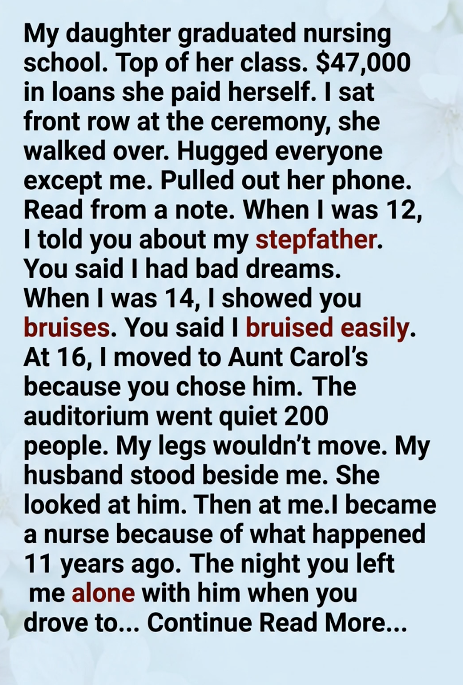
My daughter graduated at the top of her nursing class.
She had worked incredibly hard.
She had paid off **$47,000 in student loans** herself.
I sat proudly in the front row of the auditorium.
When her name was called, everyone stood and applauded.
I was crying.
I thought she would come over to hug me.
Instead, she walked past me.
She hugged almost everyone around me.
Her professors.
Her classmates.
Her friends.
Everyone except me.
Then she pulled out her phone.
The auditorium slowly became quiet.
She looked at the audience and began reading from a note.
Her voice was steady.
But I could barely breathe.
—
“When I was 12, I told you about my stepfather.”
“You said I was having bad dreams.”
“When I was 14, I showed you bruises.”
“You said I bruised easily.”
“When I was 16, I moved to Aunt Carol’s because you chose him.”
The auditorium went completely silent.
Nearly **200 people** were staring at me.
My legs felt weak.
I couldn’t move.
Then my daughter looked directly at my husband.
Then back at me.
And said:
**”I became a nurse because of what happened 11 years ago.”**
—
My husband stood beside me.
His expression changed.
For the first time, I saw fear in his eyes.
My daughter continued.
“I spent years wondering whether anyone would ever believe me.”
“I spent years wondering whether I was the problem.”
“I wasn’t.”
She took a breath.
“Mom, you had a choice.”
“You could have protected me.”
“Instead, you protected him.”
—
I wanted to disappear.
But she wasn’t finished.
She looked at the audience again.
“The night everything finally changed, Mom left me alone with him.”
“She said she was only going to be gone for an hour.”
“She told me not to cause trouble.”
“She told me he was tired.”
I stared at my husband.
He couldn’t look at me.
—
My daughter read the next sentence slowly.
“That night, I stopped believing my mother would ever save me.”
“I realized I had to save myself.”
“When I finally left at 16, Aunt Carol believed me.”
“She took me in.”
“She helped me finish high school.”
“And she encouraged me to become a nurse.”
My eyes filled with tears.
I wanted to tell her I was sorry.
But I knew this wasn’t my moment to speak.
—
Then she said something that completely broke me:
“I became a nurse because I wanted to become the person I needed when I was 12.”
“The person who notices.”
“The person who listens.”
“The person who doesn’t tell a child that their bruises are nothing.”
“The person who doesn’t look away.”
Several people in the auditorium were crying.
—
Then she turned toward my husband.
“You told my mother I was lying.”
“You told her I was trying to destroy the family.”
“You told her nobody would believe me.”
She paused.
“But someone did.”
She looked toward the back of the auditorium.
Aunt Carol stood there.
My daughter smiled at her.
“She did.”
—
Then came the final revelation.
My daughter held up her phone.
“I didn’t bring this evidence here to humiliate you.”
“I brought it because for years, you told me that nobody would believe me.”
“Today, I wanted you to see how many people finally did.”
She turned the screen toward the audience.
It contained medical records.
School counseling records.
Photographs.
And a statement from a former teacher who had reported concerns years earlier.
I stared at the screen.
I remembered that teacher.
I’d ignored her.
I told myself she misunderstood.
—
My husband finally whispered:
“Stop.”
My daughter looked at him.
“No.”
“I was a child.”
“You were supposed to be the adult.”
He said nothing.
Then she turned back to me.
“I don’t hate you.”
That sentence somehow hurt more than anything else.
“I just don’t trust you.”
—
She folded the note.
Then said:
“Mom, this isn’t about ruining your life.”
“It’s about ending the lie.”
“The lie that I imagined it.”
“The lie that I was difficult.”
“The lie that I wasn’t worth protecting.”
She wiped away a tear.
“I know now that none of it was my fault.”
—
The ceremony continued.
But I barely heard anything.
When my daughter received her nursing degree, the entire auditorium stood again.
Everyone applauded.
She smiled.
Not at me.
At the people who had believed her.
At Aunt Carol.
At the teachers.
At the friends who had stood beside her.
At the person she had become.
—
After the ceremony, I found Aunt Carol outside.
“Please,” I said.
“I need to talk to her.”
Aunt Carol looked at me for a long moment.
“You can ask.”
“But whether she wants to talk to you is her decision.”
I nodded.
“I understand.”
For the first time, I truly did.
—
My daughter eventually agreed to meet me.
Not that night.
Several weeks later.
We sat across from each other in a quiet café.
She didn’t yell.
She didn’t insult me.
She simply asked:
“Why didn’t you believe me?”
I started crying.
“I was afraid.”
“Of what?”
“I was afraid of losing my marriage.”
She looked at me.
“And you decided losing me was acceptable.”
I couldn’t answer.
Because she was right.
—
I apologized.
Not with excuses.
Not with explanations.
Just the truth.
“I failed you.”
She nodded.
“Yes.”
“I should have protected you.”
“Yes.”
“I am sorry.”
She looked down.
“I don’t know if I’ll ever forgive you.”
I nodded.
“You don’t have to.”
“But I want you to know something.”
“What?”
“I’m proud of the nurse you became.”
She finally looked at me.
“Thank you.”
—
I don’t know what the future holds for our relationship.
Maybe one day she’ll forgive me.
Maybe she won’t.
But I finally understand the truth.
My daughter didn’t become a nurse because I supported her.
She became a nurse because she survived the years when I didn’t.
She took the pain I refused to see and turned it into a career built around protecting vulnerable people.
And the sentence I’ll never forget is the one she read in front of **200 people**:
**”I became a nurse because of what happened 11 years ago.”**
She wasn’t asking the auditorium to feel sorry for her.
She was showing me what happened when a child stopped waiting for an adult to save her…
and learned to become the person who would save others instead.