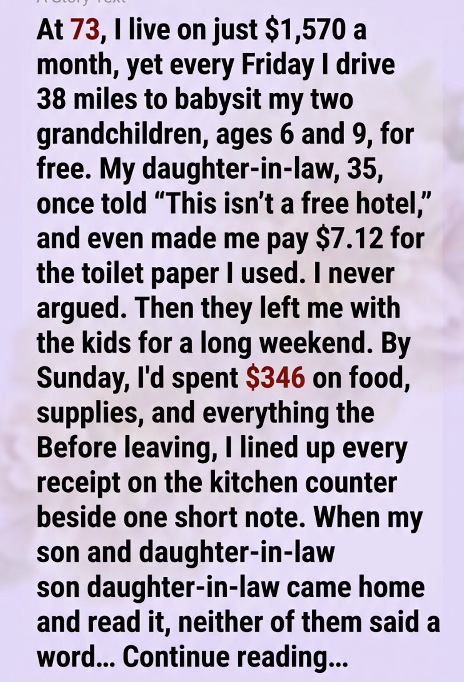
At **73**, I lived on just **$1,570 a month**.
It wasn’t much.
I had a small apartment.
An old car.
And a carefully planned budget that left very little room for unexpected expenses.
But every Friday, I drove **38 miles** to babysit my two grandchildren.
They were six and nine.
I loved those children more than anything.
So I never asked my son or daughter-in-law for money.
I never charged them for gas.
Never charged for my time.
Never complained when they changed their schedule at the last minute.
I simply showed up.
—
My daughter-in-law wasn’t exactly warm toward me.
One afternoon, when I mentioned that I’d forgotten to bring toilet paper for myself, she looked at me and said:
**”This isn’t a free hotel.”**
I laughed awkwardly.
Then she handed me a receipt for **$7.12**.
“For the toilet paper you used.”
I stared at it.
I thought she was joking.
She wasn’t.
I paid her.
I never argued.
I didn’t want my grandchildren caught in the middle.
—
A few weeks later, my son and daughter-in-law asked me to keep the children for a long weekend.
“Friday through Sunday,” my son said.
“We’ll be back Sunday afternoon.”
I smiled.
“Of course.”
The children were excited.
They wanted pancakes.
A movie night.
A trip to the park.
Then the weekend became more expensive than I expected.
The refrigerator was almost empty.
The children needed school supplies.
One needed medication.
They needed breakfast, lunch, dinner, snacks, fruit, milk, and a few other things.
I used my own money.
By Sunday afternoon, I’d spent **$346**.
That was a significant amount for me.
But I didn’t tell them.
—
When my son and daughter-in-law finally came home, the children ran to them.
“Mom!”
“Dad!”
I smiled.
I was tired.
But happy.
I helped carry their bags inside.
Then I placed every receipt I’d collected on the kitchen counter.
Grocery receipts.
Pharmacy receipts.
School supplies.
Gas.
Everything.
I lined them up carefully.
Then I placed one short note beside them.
My son picked it up.
My daughter-in-law stood beside him.
They read it.
Neither said a word.
—
The note said:
**”I never wanted to be paid for loving my grandchildren. I only hoped you’d remember that sometimes the person helping you has less than the person being helped.”**
My son read it again.
My daughter-in-law’s face changed.
She picked up the receipts.
Then slowly added them together.
**$346.**
She looked at me.
“I didn’t know.”
I smiled.
“You never asked.”
—
My son sat down.
“Mom…”
I shook my head.
“It’s okay.”
“No.”
He looked at the receipts again.
“You drove 38 miles every Friday.”
“Yes.”
“You’ve been doing that for years.”
“Yes.”
“And we made you pay for toilet paper?”
I shrugged.
“It was $7.12.”
He looked ashamed.
“I was wrong.”
My daughter-in-law began crying.
“I thought you were taking advantage of us.”
I looked at her.
“How?”
She couldn’t answer.
—
Then my six-year-old grandson walked into the kitchen.
He saw the receipts.
“Grandma, are you leaving?”
I knelt beside him.
“No.”
“You’re coming Friday?”
I smiled.
“Yes.”
He hugged me.
My nine-year-old granddaughter joined him.
For a moment, nobody spoke.
My daughter-in-law wiped her eyes.
Then quietly said:
“We owe you an apology.”
I stood up.
“You don’t owe me anything.”
She looked confused.
I continued:
“But I need you to understand something.”
—
“I come here because I love these children.”
“Not because I have endless money.”
“Not because I have unlimited energy.”
“And not because my time is worthless.”
I paused.
“At 73, every dollar matters.”
“Every mile matters.”
“Every hour matters.”
“But your children matter more.”
My son looked down.
Then whispered:
“I’m sorry, Mom.”
—
The next Friday, I arrived at their house as usual.
This time, my son was waiting outside.
He had a full tank of gas for my car.
My daughter-in-law came out carrying a large bag.
Inside were groceries and supplies specifically for the weekend.
Then she handed me an envelope.
I opened it.
The **$346** was inside.
I immediately shook my head.
“No.”
My son smiled.
“It’s not payment.”
“It’s reimbursement.”
My daughter-in-law added:
“And it’s not enough.”
—
She then handed me another envelope.
Inside was a handwritten note from both of them.
It said:
**”We thought you were helping because you had nothing better to do.”**
**”We understand now that you were helping because you loved us.”**
**”We’re sorry we treated your generosity like an obligation.”**
I folded the note.
Then hugged them both.
—
Things changed after that.
Not because I demanded anything.
Because they finally started noticing.
My son began driving the 38 miles to my house sometimes.
They stopped charging me for anything.
They started buying groceries for the weekends.
And when I told them I was too tired to come one Friday, nobody made me feel guilty.
My daughter-in-law simply said:
“Rest, Mom.”
—
A few months later, my granddaughter asked me:
“Grandma, why do you always come here?”
I smiled.
“Because I love you.”
She thought about it.
Then asked:
“Is that why you bought all the food?”
I laughed.
“Yes.”
She hugged me.
“Then I love you too.”
—
I still live on **$1,570 a month**.
My budget hasn’t magically changed.
I’m still 73.
I still have to be careful with money.
But one thing has changed completely.
My family finally understands that generosity isn’t the same thing as having money to spare.
Sometimes the person giving the most is the person who has the least.
And those **$346 in receipts** weren’t meant to make my son and daughter-in-law feel guilty.
They were meant to show them something I’d been too proud to say for years:
**I was never asking them to pay me for being Grandma.**
**I was simply hoping they’d recognize what it cost me to keep showing up.**