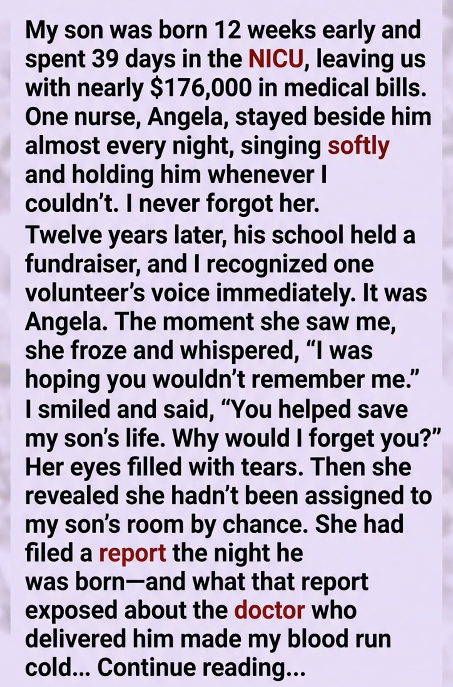
My son was born **12 weeks early**.
He weighed barely enough to fit in my arms.
For **39 days**, he lived inside an incubator in the NICU while machines breathed, monitored, and fought for him.
My husband and I spent every day terrified.
And the medical bills kept growing.
By the time our son came home, we were facing nearly **$176,000 in medical expenses**.
But there was one person I never forgot.
Her name was **Angela**.
She was a NICU nurse who seemed to be beside our son every night.
Whenever I couldn’t stay awake, she stayed.
Whenever I couldn’t bring myself to touch the machines, she calmly explained them.
And when our baby cried, Angela would pick him up whenever the doctors allowed it.
Sometimes she would simply sit beside his incubator and sing softly.
I never forgot her voice.
—
Twelve years later, my son’s school held a fundraiser.
Parents and local volunteers were helping serve food and organize activities.
I was walking past a table when I heard someone laugh.
I stopped.
I knew that voice.
I turned around.
Angela.
For a second, I couldn’t believe it.
She looked older.
Her hair was different.
But I knew immediately.
She saw me too.
Her smile disappeared.
Then she froze.
And quietly whispered:
**”I was hoping you wouldn’t remember me.”**
I laughed softly.
“You helped save my son’s life.”
“Why would I forget you?”
Her eyes filled with tears.
Then she looked around nervously.
“There is something you need to know.”
—
I thought she was going to tell me about how she’d remembered my son.
Instead, she said:
“I wasn’t assigned to his room by chance.”
I frowned.
“What do you mean?”
She took a breath.
“The night he was born, I filed a report.”
My stomach tightened.
“What kind of report?”
She hesitated.
“A safety report.”
“About my son?”
“No.”
She shook her head.
“About the doctor who delivered him.”
—
I stared at her.
“What did you report?”
She lowered her voice.
“I thought something was wrong with the delivery.”
“What happened?”
“Your son was in distress.”
“The monitors were showing it.”
“The doctor should have acted sooner.”
My heart began pounding.
She explained that our son had been born prematurely after complications developed during labor.
But according to Angela, the baby’s condition had worsened before the emergency delivery.
She had documented several concerns in her nursing report.
The report questioned why the doctor had delayed the emergency procedure.
—
I felt sick.
“Was my son in danger because of a mistake?”
Angela shook her head.
“I can’t tell you what the final medical conclusion was.”
“But I can tell you I was concerned enough to file the report.”
I asked:
“Why didn’t anyone tell us?”
She looked down.
“Because the hospital investigated internally.”
“Then what happened?”
“They closed the case.”
I stared at her.
“Without telling us?”
She nodded.
—
Then she pulled a folded document from her bag.
It was a copy of the original nursing report.
My son’s name was on it.
The date.
The delivery time.
The physician’s name.
And a series of notes describing what Angela had observed.
I read them slowly.
Then stopped at one sentence:
**”Physician declined recommended escalation despite repeated signs of fetal distress.”**
My hands started shaking.
—
Angela continued:
“I thought you deserved to know.”
“Why twelve years later?”
She looked ashamed.
“Because I didn’t know whether it was my place.”
“And now?”
“Now I know it wasn’t just a difficult delivery.”
She paused.
“There was another patient.”
My blood ran cold.
“Another patient?”
“The same doctor.”
—
Over the following weeks, Angela helped me understand what had happened.
The hospital had received several complaints involving the same physician.
Some were dismissed as complications that could happen in premature deliveries.
Others were never formally documented.
But Angela had kept her copy of the report.
She hadn’t wanted to forget.
Neither had I.
—
I contacted the hospital.
At first, they refused to discuss an old case.
So I hired an attorney.
The archived records were requested.
Then something shocking surfaced.
There had been an internal review of the doctor’s treatment of several high-risk patients.
My son’s case was included.
The hospital had concluded that the delay had been inappropriate.
But because my son survived, no external action had been taken.
—
I sat at my kitchen table staring at the records.
My son was alive.
Healthy.
Twelve years old.
He played soccer.
He complained about homework.
He ate everything in the refrigerator.
But I realized how close we’d come to losing him.
Angela had known.
She had been standing beside his incubator when we couldn’t even breathe without fear.
And she had quietly documented what she believed was happening.
—
I eventually asked her:
“Why did you keep singing to him every night?”
She smiled through tears.
“He was so tiny.”
“I couldn’t make the machines less frightening.”
“But I could make sure he heard a human voice.”
I cried.
She reached over and squeezed my hand.
“He was a fighter.”
I smiled.
“He still is.”
—
The doctor involved had long since left that hospital.
A review of his record led to further investigation.
Several old cases were reopened.
There were additional complaints.
The hospital agreed to revise some of its procedures for emergency obstetric care.
And I finally understood why Angela had looked frightened when she saw me at the school fundraiser.
She hadn’t been afraid of me.
She was afraid I would ask about the report she had spent twelve years carrying.
—
Before we left the fundraiser that day, I hugged her.
“You should never have been afraid that I’d remember you.”
She cried.
“I remember him every year.”
“I remember how small he was.”
I smiled.
“He remembers you too.”
She looked surprised.
“He does?”
I nodded.
“He doesn’t remember your face.”
“But he remembers what I’ve told him.”
“That a nurse named Angela stayed beside him when he needed someone.”
—
That evening, I showed my son a photograph from the NICU.
He was tiny.
Barely recognizable beneath all the wires.
I pointed to Angela.
“Do you know who that is?”
He looked at the photograph.
“No.”
“She helped take care of you.”
He stared at the picture.
Then smiled.
“Can we find her?”
I laughed through my tears.
“We already did.”
—
Twelve years earlier, I thought Angela was simply the nurse who stayed when I couldn’t.
I thought her singing was kindness.
And it was.
But there was more.
She had also been the person brave enough to document something she believed could have endangered my son.
She filed a report.
The hospital buried it.
And she carried a copy for twelve years.
When she finally told me, I understood why she had whispered:
**”I was hoping you wouldn’t remember me.”**
She wasn’t worried I’d remember her kindness.
She was worried I’d remember the night she had warned the hospital that something was wrong.
And the truth that came out of that old report left me with one overwhelming realization:
**My son didn’t survive that night by luck alone.**
**Someone noticed. Someone documented it. And someone stayed beside him when we couldn’t.**