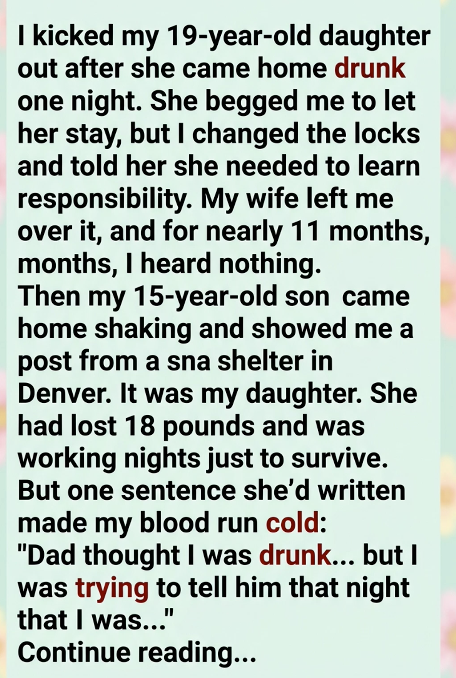
I kicked my **19-year-old daughter** out after she came home drunk one night.
At least, that’s what I thought.
She stumbled through the front door just after midnight.
Her eyes were red.
Her clothes were messy.
And she smelled like alcohol.
I was furious.
“What happened to you?”
She tried to answer, but her words came out broken.
“Dad… please.”
“Please what?”
“I need to tell you something.”
I shook my head.
“You’ve been drinking.”
“I’m not trying to—”
“Enough.”
I pointed toward the stairs.
“Go to bed.”
She started crying.
“Please don’t send me away.”
That sentence should have stopped me.
It didn’t.
—
My anger had been building for months.
She’d been skipping classes.
Missing curfew.
Arguing with me.
I convinced myself she was becoming irresponsible.
So that night, when she came home looking drunk, I decided enough was enough.
I told her:
“You are an adult now. You need to learn responsibility.”
She begged me not to do it.
“Give me one night.”
“Just let me explain.”
“Please, Dad.”
I changed the locks the next morning.
She stood on the porch with one suitcase.
My wife was crying.
My daughter looked at me one last time.
Then whispered:
“I was trying to tell you.”
I didn’t ask what she meant.
I watched her walk away.
—
My wife left me three days later.
She took our younger son with her temporarily.
Her final words were:
“You didn’t even let her finish speaking.”
I told myself everyone was overreacting.
I had done what a father was supposed to do.
Set boundaries.
Teach consequences.
Make her face reality.
Then the weeks passed.
No calls.
No messages.
No birthday cards.
Nothing.
For almost **11 months**, I heard nothing from my daughter.
I told myself she was fine.
I told myself she had learned her lesson.
I was wrong.
—
One afternoon, my **15-year-old son** came home shaking.
He was holding his phone.
“Dad…”
“What happened?”
“Look.”
He showed me a post from a shelter in Denver.
It was a story about a young woman who had been staying there.
The photograph was blurry.
But I knew that face.
My daughter.
She looked thinner.
Much thinner.
She had lost **18 pounds**.
The post said she was working nights whenever she could find shifts.
Sometimes cleaning hotel rooms.
Sometimes washing dishes.
Sometimes sleeping only a few hours before searching for another job.
My hands started shaking.
Then I saw her name beneath the post.
And one sentence she’d written:
**”Dad thought I was drunk… but I was trying to tell him that night that I was…”**
The sentence ended there.
I stared at the screen.
“What?”
My son looked at me.
“There’s more.”
—
I clicked on the original post.
My daughter’s full message appeared.
She had written:
**”Dad thought I was drunk. I wasn’t trying to come home drunk.”**
**”I was drugged.”**
I stopped breathing.
She explained that she’d gone to a party with friends.
She had accepted one drink.
Then she began feeling dizzy.
She remembered almost nothing afterward.
A friend had driven her home.
She had spent the entire ride trying to stay awake.
When she got home, she knew something was seriously wrong.
She wanted to tell me.
But she could barely speak.
—
I read the next sentence.
**”I was trying to tell Dad that night that I was afraid someone had put something in my drink.”**
My knees nearly gave out.
I had thought she’d been disrespectful.
She had actually been terrified.
I had seen her fear…
and mistaken it for drunkenness.
I had heard her ask me to listen…
and decided she’d earned punishment.
—
The post continued.
She’d gone to a hospital the next morning.
Doctors confirmed that she’d likely been drugged.
She didn’t know exactly what happened after the party.
She was too frightened to report everything because she couldn’t remember.
Then she discovered something else.
She was pregnant.
I sat down.
My son covered his mouth.
“What?”
I kept reading.
The pregnancy had been confirmed several weeks after she left.
She had tried calling me.
I’d blocked her number.
She had tried my wife.
My wife had changed her number during our separation.
She had nowhere to go.
So she went to Denver.
—
The final part of her message was the one that broke me.
She wrote:
**”I don’t know if Dad will ever see this.”**
**”But if he does…”**
**”I wasn’t asking to stay because I was trying to get away with something.”**
**”I was asking because I was scared.”**
I couldn’t breathe.
Then she added:
**”I needed my dad.”**
—
I called the shelter immediately.
They confirmed she was there.
But she had left for work.
I asked them to give her a message.
Tell her I was coming.
Tell her I was sorry.
Tell her I should never have changed the locks.
Tell her I should have listened.
I drove to Denver that night.
I didn’t tell myself she had to forgive me.
I didn’t tell myself I deserved another chance.
I only knew I needed to show up.
This time, I was going to listen.
—
I found her the next afternoon outside a small diner.
She was carrying a backpack.
She looked exhausted.
When she saw me, she froze.
Neither of us moved.
Then she said:
“You came.”
I nodded.
“I’m sorry.”
She looked away.
“For what?”
“For everything.”
She laughed bitterly.
“You didn’t even ask what happened.”
I lowered my head.
“I know.”
—
She told me everything.
The party.
The drink.
The dizziness.
The fear.
The hospital.
The pregnancy.
The job at the shelter.
The nights she’d slept in places she never imagined she’d see.
The days she’d gone hungry to save money.
And the worst part:
Every time something went wrong, she kept thinking:
**”Dad would have known what to do.”**
I started crying.
“I should have.”
She looked at me.
“You should have asked.”
I nodded.
“You’re right.”
—
Then she placed a hand over her stomach.
The baby was due in a few months.
I stared.
“You’re keeping the baby?”
She nodded.
“I don’t know what the future looks like.”
I took a breath.
“You’re not doing it alone.”
She looked at me.
“What does that mean?”
“It means I’m here.”
“You don’t have to forgive me.”
“You don’t have to trust me today.”
“But I’m not walking away again.”
—
She didn’t immediately hug me.
She didn’t say everything was forgiven.
Instead, she asked:
“Can I come home?”
I closed my eyes.
“Yes.”
She started crying.
I said:
“Home isn’t a place you have to earn back.”
She looked at me.
Then finally stepped forward.
I held my daughter for the first time in almost a year.
And I wished I could go back to that night.
Not to make her sober.
Not to make her different.
Just to sit down beside her…
and listen.
—
We eventually got her proper medical care.
She worked with a counselor.
The incident at the party was formally reported.
She received support throughout the pregnancy.
My wife returned too.
We both apologized.
Our family was fractured.
But we began rebuilding.
Not quickly.
Not perfectly.
Honestly.
—
Months later, my daughter gave birth to a healthy baby girl.
I was in the hospital room.
My daughter looked exhausted.
But when the baby cried, she smiled.
She looked at me.
“She’s beautiful.”
I nodded.
“She is.”
Then she whispered:
“I was so afraid you wouldn’t want her.”
I started crying.
“I almost lost you because I didn’t listen once.”
“I’m not making that mistake again.”
—
I still think about the night I changed the locks.
I thought I was teaching my daughter responsibility.
Instead, I taught her that when she was terrified, her father might not believe her.
That is something I will carry for the rest of my life.
Because the sentence I heard nearly a year later changed everything:
**”Dad thought I was drunk… but I was trying to tell him that I was afraid.”**
I had mistaken confusion for defiance.
Fear for irresponsibility.
A cry for help for rebellion.
And by the time I finally understood the truth, my daughter had already spent nearly a year surviving without me.
I cannot undo that.
But I can make one promise.
From that day forward, whenever my children say:
**”Dad, I need to tell you something,”**
I will never again decide what they mean before I let them speak.