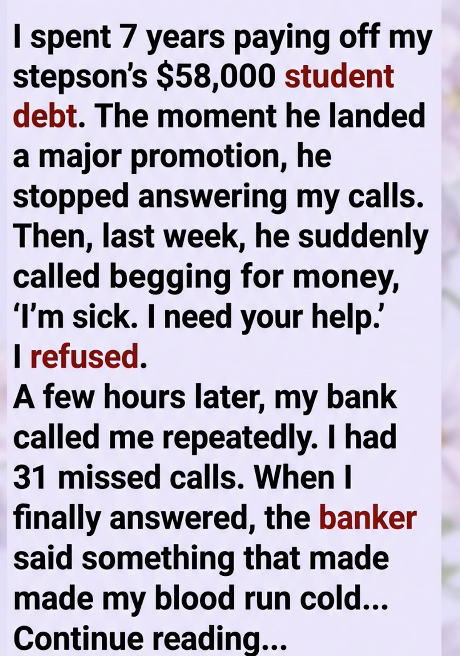
For **7 years**, I paid my stepson’s student debt.
The total came to nearly **$58,000**.
Every month, I made the payment.
I never complained.
I didn’t expect repayment.
I simply wanted him to have a chance to build a good life.
When he finally graduated, I was proud.
When he got his first serious job, I celebrated.
And when he landed a major promotion, I thought he’d finally reached the future we’d worked so hard for.
Then he stopped answering my calls.
At first, I assumed he was busy.
Then weeks became months.
My messages went unanswered.
My calls went straight to voicemail.
I eventually stopped trying.
—
Then, last week, my phone rang.
It was my stepson.
His voice sounded frightened.
“Please, I need your help.”
I immediately asked what happened.
“I’m sick.”
My heart dropped.
“What kind of sick?”
“I can’t explain everything right now.”
“How much do you need?”
He gave me an amount that shocked me.
I refused.
Not because I didn’t care.
Because after years of silence, something about the call felt wrong.
He became upset.
“You paid my debts for seven years, and now you won’t help me?”
I answered quietly:
“I helped you because I loved you.”
“I won’t let you use that love whenever you need money.”
He hung up.
—
A few hours later, my phone started ringing again.
It was my bank.
I ignored it.
Then again.
And again.
By the time I looked at my phone, I had **31 missed calls**.
My stomach tightened.
I called the bank.
A woman answered immediately.
“Thank goodness you returned our call.”
I asked what was happening.
She lowered her voice.
“Sir, we have several attempted transfers from your accounts.”
“What kind of transfers?”
“Large ones.”
“Where are they going?”
She paused.
Then said:
**”To an account registered in your stepson’s name.”**
My blood ran cold.
—
I told her I hadn’t authorized any of them.
She replied:
“That’s what we were afraid of.”
The bank had detected multiple attempts to move money from my savings and investment accounts.
The transactions had been initiated within a short window.
Some had been blocked automatically.
Others were still pending review.
I asked:
“How did he get access?”
The banker said something that made my stomach drop.
“Someone appears to have used your old security information.”
I froze.
“What security information?”
“The answers to your account recovery questions.”
Questions only someone close to me would know.
—
I immediately thought about my stepson.
He had lived with me for years.
He knew my routines.
He knew my favorite places.
He knew my mother’s maiden name.
He knew the name of my first pet.
And he’d recently stopped answering my calls.
I asked the bank to freeze everything.
Then I called my stepson.
He answered immediately.
I asked:
“Did you try to access my accounts?”
There was a long silence.
Then he whispered:
“I didn’t think you’d ever find out.”
My heart sank.
—
He admitted he’d been struggling financially after his promotion.
Not because he was sick.
Because he’d been living far beyond his means.
Luxury apartment.
Expensive car.
Credit cards.
Travel.
Then his debts started piling up.
He’d remembered that I’d once given him access to certain family documents while helping with his student loans.
He used information from those documents to guess my security questions.
But he insisted he’d never intended to steal everything.
He only wanted enough to “fix the situation.”
I stared at my phone.
“How much?”
He whispered:
“About $84,000.”
—
The banker later confirmed that the attempted transfers totaled even more.
The reason they’d called me repeatedly was that the system had detected a pattern suggesting possible financial abuse.
I asked:
“Was the money actually taken?”
The banker answered:
**”Not yet.”**
I closed my eyes.
Not yet.
That phrase kept echoing in my head.
Because if the bank hadn’t noticed…
I might have woken up to discover years of savings gone.
—
I contacted an attorney.
We documented everything.
The bank preserved the transaction records.
The suspicious login activity was traced.
My stepson’s phone and computer were examined as part of the investigation.
Then another discovery surfaced.
The “illness” he’d mentioned wasn’t his.
He had been trying to use someone else’s medical crisis to make me feel guilty enough to give him money willingly.
That was why he’d called me first.
When I refused, he tried another route.
—
I confronted him one final time.
“Why didn’t you just ask me for help?”
He started crying.
“Because I knew you’d say no.”
I shook my head.
“And you thought stealing was better?”
“I panicked.”
“No.”
I looked at him.
“You made a choice.”
He lowered his head.
“You’re right.”
—
The bank eventually recovered the pending funds.
No money was permanently lost.
But I changed every password, froze the accounts, replaced my cards, and removed every piece of shared financial information.
I also changed my will.
Not because I wanted revenge.
Because trust has consequences too.
—
Months earlier, I’d thought my greatest mistake was paying off **$58,000** of someone else’s student debt.
It wasn’t.
The real mistake was believing that helping someone automatically meant they would value the sacrifice.
My stepson eventually apologized.
I accepted the apology.
But I didn’t restore his access to my finances.
He asked:
“After everything you did for me, can’t you trust me again?”
I answered:
“Trust isn’t something you get because someone loved you.”
“It’s something you rebuild after you break it.”
—
When I think about those **31 missed calls**, I realize how close I came to losing everything I’d spent years building.
My bank didn’t call because I was sick.
They called because someone who knew me very well was trying to use that knowledge against me.
And the person I had spent seven years helping was the one who nearly emptied the accounts I’d spent my life protecting.
He once needed me to pay his debts.
Then, when he became successful, he disappeared.
When he needed money again, he returned.
But the moment my bank called, I finally understood the truth:
**He wasn’t calling because he was sick.**
**He was calling because he needed access to the one person he thought would always rescue him.**