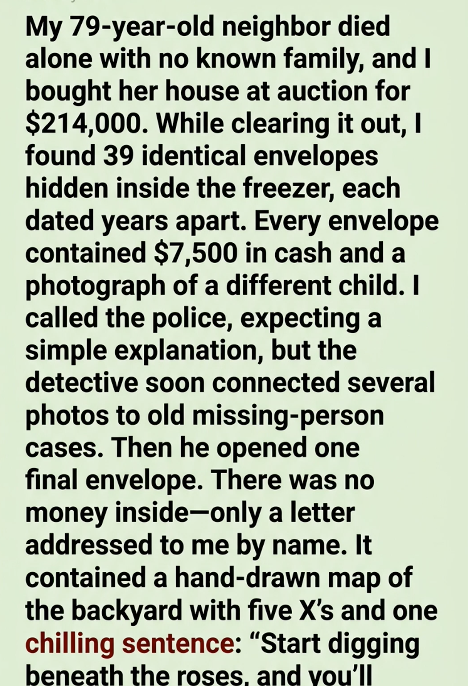
My 79-year-old neighbor died alone.
She had no known family.
After her death, her house went to auction.
I ended up buying it for **$214,000**.
The house needed work, but I thought it would be a good investment.
I never imagined what I’d find inside.
—
While clearing out the kitchen, I opened the old freezer.
Behind several bags of frozen vegetables was a cardboard box.
Inside were **39 identical envelopes**.
Each had a date written across the front.
Some were from decades ago.
Others were much more recent.
I opened the first one.
Inside was exactly **$7,500 in cash**.
And a photograph.
A child.
Maybe six or seven years old.
I opened another.
Same amount.
Another child.
Another date.
Another photograph.
All 39 envelopes contained the same thing.
Cash.
And a picture of a different child.
—
I immediately called the police.
I expected them to tell me it was some strange personal savings system.
Instead, a detective arrived and started examining the photographs.
He became increasingly serious.
“Where did you find these?”
“In the freezer.”
He looked at another photograph.
Then another.
Finally, he pulled out his phone.
“This child was reported missing in 1989.”
My stomach dropped.
He checked another.
“She’s connected to a missing-person case too.”
I stared at the envelopes.
“Are you saying these children were missing?”
He nodded.
“We need to take all of this.”
—
The police removed the envelopes.
Every photograph was photographed and catalogued.
Detectives began comparing the children to old missing-person records.
Several matches appeared.
But nobody could explain why an elderly woman who had lived quietly in that house had possessed photographs of them.
Or why each envelope contained **$7,500**.
Then the detective opened the final envelope.
Unlike the others, it contained no money.
No photograph.
Only a letter.
My name was written on the front.
I froze.
“How would she know my name?”
The detective opened it.
Inside was a hand-drawn map of the backyard.
There were **five X’s** marked across it.
Beneath the map was one sentence:
**”Start digging beneath the roses, and you’ll find…”**
The sentence stopped there.
—
The detective looked at me.
“Did you know this woman well?”
“Only as a neighbor.”
“Did she ever talk about children?”
“No.”
“Did she ever ask you to buy the house?”
“No.”
He folded the letter.
“Then we need to search the backyard.”
The next morning, investigators arrived.
The first X was beneath an old rose bush.
They dug carefully.
Nothing.
The second X was beside a broken garden bench.
Nothing.
The third was near the fence.
Still nothing.
Then they reached the fourth mark.
The shovel hit something hard.
Everyone stopped.
The detective knelt down.
A small metal box was buried beneath the soil.
—
Inside were more photographs.
But this time, they weren’t photographs of missing children.
They were photographs of adults.
Some of the faces belonged to people whose childhood pictures had been inside the envelopes.
The detective stared at one.
“This man was one of the missing children.”
“He’s alive?”
“He disappeared in 1987.”
“But this photo was taken recently.”
My heart started pounding.
“Then what does that mean?”
The detective didn’t answer.
He simply ordered the team to keep digging.
—
The fifth X was beneath the oldest rose bush.
This time, they found a much larger metal container.
Inside were dozens of newspaper clippings.
Missing-person articles.
Court records.
Adoption documents.
And a handwritten ledger.
Every child’s name appeared in it.
Beside each name was a date.
An amount.
And one word:
**”Safe.”**
I stared at the page.
The detective looked equally stunned.
“This woman wasn’t collecting ransom.”
“Then what was she doing?”
He turned another page.
There was a sentence at the bottom:
**”They were taken from people who meant them harm.”**
—
The investigation uncovered something extraordinary.
The woman had spent decades secretly helping children who were in danger.
Some had been victims of abusive homes.
Others had been targeted by criminal relatives.
In several cases, she had arranged for them to disappear from dangerous environments and helped place them somewhere safe.
The $7,500 in each envelope had been money she had saved for their future.
The photographs were records of the children she had helped.
But there was still one enormous mystery.
Why had several of them been listed as missing?
And who had officially reported them?
—
The detectives traced the documents.
They discovered that in many cases, the children’s own relatives had reported them missing after losing control over them.
The woman had never kidnapped them.
She had worked through a network of people who helped vulnerable children relocate safely.
Some had gone through legal channels.
Others had not.
That was why she’d kept everything hidden.
She feared that if the wrong people discovered her records, the children could be found.
—
Then the detective found one final file.
It contained a photograph of the woman when she was young.
Standing beside her was a teenage boy.
The detective recognized him immediately.
He had been one of the children whose photograph was in the freezer.
Except he wasn’t a child anymore.
He was now a respected judge living several states away.
And according to the file, he had been the first child she ever helped.
—
The judge was contacted.
He confirmed everything.
The elderly woman had saved him from an abusive household when he was nine.
She’d helped him get to relatives who could protect him.
Over the years, he had become successful and secretly helped her continue the work.
The envelopes were part of a private fund.
The money was meant to be distributed to the people she’d helped if anything happened to her.
The final map had been her way of making sure the records weren’t destroyed.
—
But why was the letter addressed to me?
The detective finally found the answer in another note.
The woman had written:
**”The new owner will find what I could no longer protect.”**
She had apparently watched me for years.
She knew I was honest.
She believed I would call the police instead of hiding what I found.
The map was her final attempt to make sure someone trustworthy uncovered everything after her death.
—
The phrase beneath the roses was finally completed.
The full sentence, written in another page, said:
**”Start digging beneath the roses, and you’ll find the proof that they were never abandoned.”**
I sat quietly after hearing that.
For years, people had believed those missing children had simply disappeared.
The truth was more complicated.
Some had been rescued.
Some had grown up safely.
And one elderly woman had spent decades carrying their secrets because she believed protecting them mattered more than protecting herself.
—
The house I bought for **$214,000** suddenly meant something completely different.
It wasn’t just an abandoned property.
It had been a hiding place.
A record room.
A safe harbor.
And the freezer had held the evidence.
I never expected to uncover 39 envelopes containing **$7,500 and a child’s photograph**.
I certainly never expected several of those faces to belong to people listed in old missing-person cases.
But the strangest part was the final envelope.
No cash.
No photograph.
Just a map and a warning addressed to me.
The woman had known I would find it.
And beneath the roses, the detectives discovered the truth she had spent her lifetime protecting:
**Those children hadn’t simply vanished.**
**Someone had been quietly saving them.**