My 6-year-old daughter came home from school with a family-tree assignment.
She was excited.
“I made ours!”
I smiled.
Our family was small.
Me.
My husband.
Our daughter.
Three people.
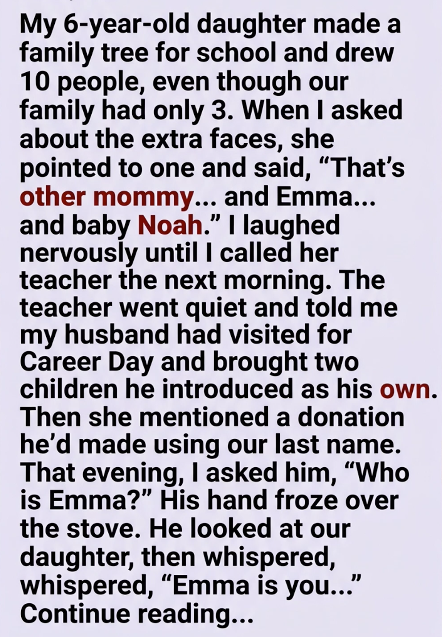
So when she proudly handed me the drawing, I immediately noticed something strange.
There were **10 people** on the page.
I laughed.
“Sweetheart, who are all these people?”
She pointed at the first unfamiliar face.
“That’s Daddy’s other mommy.”
I laughed nervously.
“Other mommy?”
She nodded.
“Then that’s Emma.”
“And baby Noah.”
I stopped smiling.
“Who?”
She looked at me as if I were the one being silly.
“Emma and baby Noah.”
“Where did you meet them?”
“At school.”
My stomach tightened.
“What do you mean?”
She shrugged.
“Daddy brought them.”
—
I tried convincing myself she’d misunderstood something.
Maybe they were characters from a story.
Maybe another family had visited school.
Maybe my daughter had mixed up names.
But she kept insisting.
“Daddy said Emma is my sister.”
I couldn’t sleep that night.
The next morning, I called her teacher.
At first, the teacher sounded normal.
Then I mentioned the family tree.
There was a long silence.
Finally, she said:
“I wasn’t sure whether to call you.”
My stomach dropped.
“Why?”
She lowered her voice.
“Your husband visited during Career Day last month.”
I froze.
“Yes?”
“He brought two children with him.”
“What children?”
She hesitated.
“Emma and Noah.”
I couldn’t breathe.
“What did he tell you?”
The teacher replied:
“He introduced them as his children.”
—
I stared at the wall.
“Are you sure?”
“Yes.”
“He said they were his?”
“Exactly.”
Then she added something else.
“He also made a very generous donation to the school.”
“Using your family name.”
My heart started pounding.
“What donation?”
“Enough to fund the new reading corner.”
“Why would he do that?”
She sighed.
“I assumed you both had discussed it.”
I hadn’t.
Not even close.
—
That evening, my husband was cooking dinner.
I stood in the doorway.
He looked happy.
Normal.
Like nothing had happened.
I asked:
“Who is Emma?”
His hand froze over the stove.
He didn’t turn around.
“Why are you asking?”
“Our daughter drew her in the family tree.”
Silence.
Then I asked:
“And Noah?”
He slowly turned around.
His face had gone pale.
He looked at our daughter.
Then back at me.
Finally, he whispered:
**”Emma is you.”**
I stared at him.
“What?”
He swallowed.
“Emma is your name.”
I laughed nervously.
“No, my name is…”
Then I stopped.
Because the truth suddenly hit me.
I had been born **Emma**.
I had changed my name legally years before my marriage.
My husband knew.
My daughter didn’t.
But that still didn’t explain the rest.
—
I pointed toward the drawing.
“Then who are the other people?”
My husband sat down.
He looked exhausted.
“I should have told you.”
“Tell me now.”
He took a deep breath.
“Emma is my first child.”
My stomach dropped.
“Your first child?”
“Before I met you, I was married.”
“I had a daughter.”
“Her name was Emma.”
I stared at him.
“But you just said Emma is me.”
He nodded.
“Because that’s what the school records say.”
I didn’t understand.
Then he explained.
His first wife had died when their daughter was very young.
The child’s legal records listed her full name as **Emma Louise**.
But his parents had called her by her middle name.
For years, everyone in the family knew her as **Louise**.
My husband had never told me because he believed the past was painful and irrelevant.
But there was something much bigger.
—
He opened his phone.
There was a photograph.
A teenage girl.
A familiar face.
My face.
I stared at it.
“Who is that?”
He whispered:
**”My daughter.”**
My heart stopped.
“That’s impossible.”
He shook his head.
“No.”
“She looks exactly like you.”
“How?”
He slid another document across the table.
A DNA report.
I stared at the result.
There was a genetic match between me and the young woman in the photograph.
But I still couldn’t understand.
Then he told me the truth.
His first wife had died after giving birth to their daughter.
The baby had been placed temporarily with relatives.
But something had gone wrong.
The family lost contact.
Years later, my husband’s daughter was adopted by another family.
And the adoptive parents gave her a new name.
**Emma.**
—
I stared at him.
“Then why does she look like me?”
He shook his head.
“Because you aren’t unrelated.”
My blood went cold.
He handed me another document.
It was my own birth record.
My biological mother’s name was listed.
And beside it was another surname.
The same surname as my husband’s first wife.
I couldn’t breathe.
“My mother?”
He nodded.
“Your mother and my first wife were sisters.”
I stared at him.
“Emma wasn’t your daughter.”
“She was your cousin.”
He shook his head.
“No.”
He looked at me carefully.
“She was your **half-sister**.”
—
I sat down.
The family tree suddenly made sense.
My daughter had not randomly drawn strangers.
She had heard names from school.
She had seen photographs.
And somehow, through a child’s understanding, she had connected the pieces before I ever did.
But then I noticed the number again.
Ten people.
“Who are the other children?”
My husband looked at the drawing.
“Emma.”
“Emma’s mother.”
“Me.”
“Your mother.”
“Your father.”
“And…”
He stopped.
“Baby Noah.”
I stared at him.
“Who is Noah?”
He closed his eyes.
“My second child.”
My heart dropped.
“Another one?”
He nodded.
“Noah is Emma’s son.”
I stared at him.
“Then why would our daughter call him baby Noah?”
He looked at me.
“Because I brought them to Career Day.”
—
Everything became clear.
The “other mommy” my daughter had drawn wasn’t another wife.
It was the grandmother from her family tree.
Emma was the half-sister she’d never known.
Noah was her nephew.
And my husband had been trying to reconnect two branches of a family that had been separated for decades.
The school donation?
He had made it in honor of the family members who had finally found each other again.
—
I looked at him.
“Why didn’t you tell me?”
He lowered his head.
“Because I was afraid you’d think I had another secret family.”
“You did.”
He nodded.
“I know how it looks.”
“It looked terrible.”
“I’m sorry.”
—
Then my daughter walked into the kitchen.
She looked at us.
“Mom?”
I turned toward her.
“Yes?”
“Are you mad at Daddy?”
I looked at my husband.
Then at the family tree on the table.
“No.”
“Why not?”
I smiled sadly.
“Because Daddy forgot to tell Mommy a very complicated family story.”
She giggled.
“That’s what I said.”
I laughed.
Then she pointed at the drawing.
“I told you Emma is you.”
I froze.
“Why did you say that?”
She shrugged.
“Because Daddy said Emma was family.”
“And you have Mommy’s eyes.”
I looked at my husband.
He smiled faintly.
“Kids notice everything.”
—
Months later, I finally met Emma.
She was an adult now.
She hugged me before we said a word.
“I’m sorry.”
“For what?”
“For being the family secret nobody knew how to explain.”
I smiled.
“You weren’t a secret.”
“You were just a missing piece.”
She started crying.
Then whispered:
“I’ve been looking for you.”
—
Baby Noah became obsessed with my daughter.
They played together every weekend.
Two children who had never known they were family suddenly became inseparable.
And the family tree my daughter had drawn at six years old stayed on our refrigerator.
It had ten people.
Some were relatives we had only recently discovered.
Some were people who had been separated by decades of silence.
And one little girl had somehow connected all of them before the adults were brave enough to tell the truth.
I had asked my husband:
**”Who is Emma?”**
He had looked at our daughter and whispered:
**”Emma is you.”**
At first, I thought he’d lost his mind.
But the truth was stranger than anything I could have imagined.
The “Emma” in my daughter’s drawing wasn’t another woman in my husband’s life.
She was a missing branch of mine.
And the little girl who drew ten people when she was supposed to draw three…
**was the first person in our family to realize that we’d never been just three.**