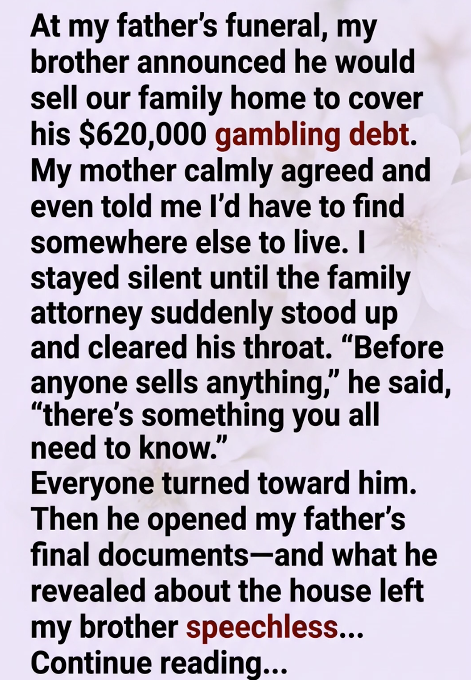
At my father’s funeral, my brother made an announcement that left me completely stunned.
He planned to sell our family home.
Not because Mom wanted to move.
Not because the house was too expensive to maintain.
Because my brother had accumulated nearly **$620,000 in gambling debt**.
He sat beside Mom and spoke as if the decision had already been made.
“We’ll sell the house, pay off the debts, and divide what’s left.”
I stared at him.
“What about Mom?”
He shrugged.
“She can move somewhere smaller.”
My mother nodded quietly.
Then she looked at me.
“You’ll need to find somewhere else to live too.”
I couldn’t believe what I was hearing.
I’d lived in that house for years.
My father had raised us there.
My memories were inside every room.
But my brother acted as if it were nothing more than an asset sitting on a spreadsheet.
—
I said nothing.
I didn’t argue.
I didn’t embarrass him in front of everyone.
Then our family attorney suddenly stood up.
He cleared his throat.
“Before anyone sells anything…”
Everyone turned toward him.
“There is something you all need to know.”
My brother frowned.
“What?”
The attorney opened his briefcase.
Then pulled out a thick folder.
“This concerns your father’s final documents.”
My stomach tightened.
My father had died only days earlier.
I’d never been told about any additional documents.
The attorney looked directly at my brother.
**”Your father anticipated this.”**
—
My brother laughed nervously.
“Anticipated what?”
“That someone might attempt to sell the house against your mother’s wishes.”
My mother’s expression changed.
“What are you talking about?”
The attorney placed a document on the table.
It was a copy of my father’s will.
Then another.
And another.
Finally, he opened a trust agreement.
“The house is not part of your brother’s personal inheritance.”
My brother stared at him.
“What?”
The attorney continued.
“Your father placed the property into a protected family trust.”
My brother’s face went pale.
—
I looked at my mother.
She looked just as surprised as I was.
The attorney explained that my father had created the trust several years before his death.
The house was to remain available as a permanent residence for my mother.
But there was another condition.
If she chose to leave the property, the house could not simply be sold and divided among the children.
Instead, ownership would pass according to the instructions in the trust.
My brother couldn’t use it to pay his creditors.
—
My brother slammed his hand on the table.
“This is ridiculous.”
The attorney remained calm.
“You were aware that your father had a gambling problem in the family.”
“No.”
“You were.”
“And he specifically included protections against debts created by gambling or other personal liabilities.”
My brother stared at him.
Then asked:
“Who gets the house?”
The attorney looked at me.
I stopped breathing.
He said:
**”Your sister.”**
—
Silence filled the room.
My brother looked at me.
“What?”
The attorney explained that my father had divided his estate carefully.
My mother would have lifetime rights to remain in the house.
After her death, ownership would transfer to me.
My brother would receive other assets.
But he could not sell the house.
He could not borrow against it.
And he couldn’t use it to settle his gambling debts.
—
My brother stood up.
“You can’t do this.”
The attorney replied:
“Your father already did.”
My brother looked at Mom.
“Tell him this isn’t what Dad wanted.”
Mom looked down at the papers.
Then quietly said:
“I didn’t know.”
The attorney nodded.
“Your husband wanted you protected.”
“And he wanted the house protected from exactly this situation.”
—
Then the attorney revealed something even more shocking.
My father had known about my brother’s gambling for years.
He had secretly paid some of his debts.
But he had eventually realized that rescuing him only made the problem worse.
So he stopped.
Instead, he created the trust.
The attorney handed my brother a letter.
It was written by Dad.
My brother opened it.
The first sentence read:
**”I love you, but I will not sacrifice your mother’s home to pay for choices you refuse to control.”**
My brother’s hands began shaking.
—
Then my father addressed me.
*”I know you will probably be the one who stays and helps your mother.”*
*”That is why I want you to have the house someday.”*
*”Not because I love you more.”*
*”Because I know you will protect it.”*
I couldn’t stop crying.
My father had understood exactly what was happening long before any of us knew.
—
My brother looked at me.
“You knew about this?”
“No.”
He looked toward the attorney.
“Can I contest it?”
The attorney shook his head.
“Not successfully.”
The documents had been properly prepared.
The trust had been established years earlier.
The house was protected.
My brother’s gambling debts remained his responsibility.
—
For the first time that day, my mother spoke firmly.
“Your father didn’t leave this house so you could gamble it away.”
My brother stared at her.
She continued:
“And I’m not leaving.”
He looked stunned.
“Mom…”
She shook her head.
“This is still my home.”
—
The funeral ended quietly.
Nobody talked about selling the house again.
My brother left angry.
I stayed with Mom.
That night, we sat in my father’s old living room.
She held one of his photographs.
“I didn’t know he had done all of this.”
Neither did I.
Then she smiled sadly.
“Your father always planned ahead.”
I laughed through my tears.
“He certainly did this time.”
—
My brother eventually entered a gambling treatment program.
His debts weren’t magically erased.
He had to sell other assets.
Negotiate with creditors.
And take responsibility for what he’d done.
But the family home remained untouched.
Mom stayed there.
I stayed too.
And eventually, my brother came back.
He apologized.
Not because he wanted the house.
Because he finally understood what Dad had been trying to teach him.
—
Months later, I found the original letter from my father again.
The final line said:
**”A house is only worth protecting if the people inside it matter more than what it can be sold for.”**
I finally understood why Dad had planned everything so carefully.
He wasn’t choosing one child over another.
He was protecting the family member who needed protection most.
And at my father’s funeral, when my brother announced he would sell our childhood home to cover his **$620,000 gambling debt**, he thought the house belonged to whoever shouted the loudest.
He had forgotten one important thing.
**Dad had already decided who would protect it.**