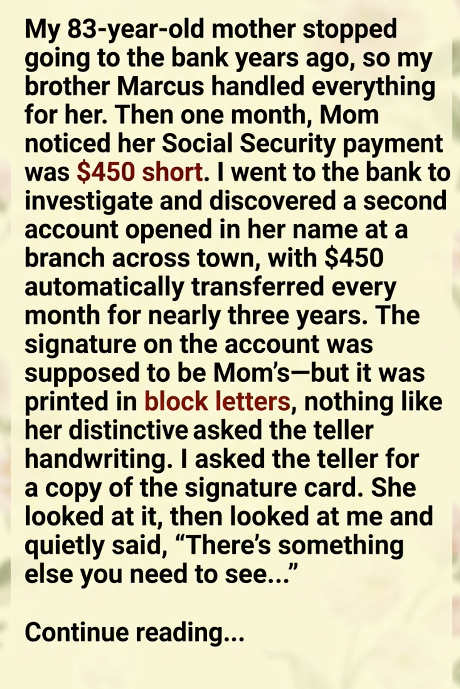
My **83-year-old mother** stopped going to the bank years ago.
She trusted my brother Marcus to handle everything.
Bills.
Deposits.
Appointments.
Whenever Mom needed something financial, Marcus took care of it.
I never questioned him.
Then one month, Mom noticed something strange.
Her Social Security payment was **$450 short**.
She thought it was a mistake.
I told her I’d look into it.
The next morning, I went to her bank.
I expected a simple explanation.
Instead, the teller pulled up her account history and frowned.
“There are automatic transfers.”
“Transfers to where?”
She hesitated.
“Another account.”
I stared at her.
“What account?”
She read me the account information.
It had been opened in Mom’s name at a branch across town.
Every month, exactly **$450** was transferred into it.
The transfers had been happening for nearly **three years**.
My stomach tightened.
“Who opened it?”
The teller checked.
“According to the records, your mother.”
I shook my head.
“My mother hasn’t opened a bank account in years.”
—
I asked for the signature card.
The teller printed a copy.
I looked at the signature.
It was supposed to be Mom’s.
But it wasn’t.
My mother has a distinctive looping signature.
This one was written entirely in block letters.
It didn’t look remotely like hers.
I pointed at it.
“That’s not her signature.”
The teller studied the document.
Then looked at me.
She lowered her voice.
“There is something else you need to see.”
My heart started pounding.
“What?”
She turned her monitor toward me.
On the account-opening record was a copy of the identification used to open the account.
It was my mother’s driver’s license.
But there was something strange about the photograph.
The address was correct.
The birth date was correct.
Everything matched.
Except the person standing beside the teller in the verification photo wasn’t my mother.
It was my brother Marcus.
—
I stared at the screen.
“What is he doing there?”
The teller shook her head.
“He was listed as an authorized representative.”
I felt sick.
“Was he transferring the money?”
She looked at the account history.
“Yes.”
“To whom?”
She hesitated.
Then showed me the destination account.
It wasn’t in Marcus’s name.
It belonged to a company.
A small property-management company.
I recognized the address.
It was connected to an apartment building Marcus had recently purchased.
I couldn’t breathe.
—
I called Marcus.
“Can we talk?”
He sounded nervous.
“About what?”
“Mom’s bank account.”
There was a long silence.
“What about it?”
“$450 is being transferred every month.”
“I know.”
My stomach dropped.
“You know?”
“It’s for Mom.”
“Then why is it going to a property company?”
Another silence.
Finally, he said:
“Don’t do this at the bank.”
I stared at my phone.
“What does that mean?”
“It means there are things Mom doesn’t know.”
—
I went home and told Mom everything.
She looked stunned.
“I never opened another account.”
“I know.”
“Why would Marcus do that?”
I didn’t know.
Then Mom remembered something.
About three years earlier, Marcus had told her he needed her signature on documents related to “helping with her housing expenses.”
She’d signed several pages without reading them.
She assumed he was updating her records.
My heart sank.
He hadn’t needed her signature for anything legitimate.
He had needed her identity.
—
The bank investigation revealed that Marcus had arranged for **$450 every month** to be transferred into the second account.
From there, the money was used to make payments connected to his apartment building.
The total over nearly three years was more than **$16,000**.
It wasn’t enough to make him wealthy.
But it was enough to reveal something more disturbing.
He had been using Mom’s money without telling her.
And the transfers were carefully structured to look like an ordinary recurring payment.
—
Then the bank found something else.
The account wasn’t the only one.
There was a second financial product opened under Mom’s name.
Then another.
All had been accessed using the same authorization information.
My brother had apparently been managing far more of Mom’s finances than any of us realized.
I looked at the records.
Some withdrawals had been labeled as “household expenses.”
Mom didn’t recognize them.
Others were cash withdrawals.
She had never taken the money.
—
I confronted Marcus.
This time, he came to Mom’s house.
He looked exhausted.
I placed the bank records on the table.
“Explain it.”
He stared at the papers.
“I was going to put it back.”
“When?”
“When things got better.”
“How long were you planning to do this?”
He couldn’t answer.
Mom looked at him.
“Marcus.”
He finally broke down.
“I was drowning.”
—
He admitted that his property business had been struggling.
He had taken money from Mom’s account because he believed he could replace it before she ever noticed.
At first, it was a few hundred dollars.
Then regular transfers.
Then he created the second account so the withdrawals wouldn’t be obvious.
He insisted he never intended to permanently steal from her.
But three years had passed.
The money had never been replaced.
Mom stared at him.
“You used my name.”
He lowered his head.
“I know.”
“You used the money that was supposed to pay for my life.”
“I know.”
—
The bank froze the suspicious accounts.
An attorney helped Mom revoke Marcus’s access to her finances.
The fraudulent account was investigated.
The signature card was compared with Mom’s actual signatures.
The evidence was clear.
She hadn’t authorized the account.
Marcus eventually agreed to repay the money.
But the family relationship changed permanently.
Mom couldn’t trust him with financial decisions anymore.
—
A few months later, Mom asked me to help her learn how to manage her own accounts again.
She was 83.
She kept a notebook.
Every payment.
Every transfer.
Every dollar.
She told me:
“I don’t want to be helpless just because I’m old.”
I smiled.
“You’re not.”
Then she added:
“And I don’t want my children to confuse helping me with owning me.”
That sentence stayed with me.
—
I still think about that moment at the bank.
I had gone there because Mom was missing $450.
I expected a billing error.
Instead, I discovered a second account opened in her name, monthly transfers stretching back nearly three years, and a signature that wasn’t hers.
When the teller looked at the signature card and quietly said:
**”There’s something else you need to see…”**
I thought she was about to show me another transaction.
Instead, she showed me the photograph of the person who had been standing beside the teller when the account was opened.
It was my brother.
And that was the moment I realized the missing $450 wasn’t a mistake.
**Someone inside our own family had been quietly taking money from the woman who trusted him most.**