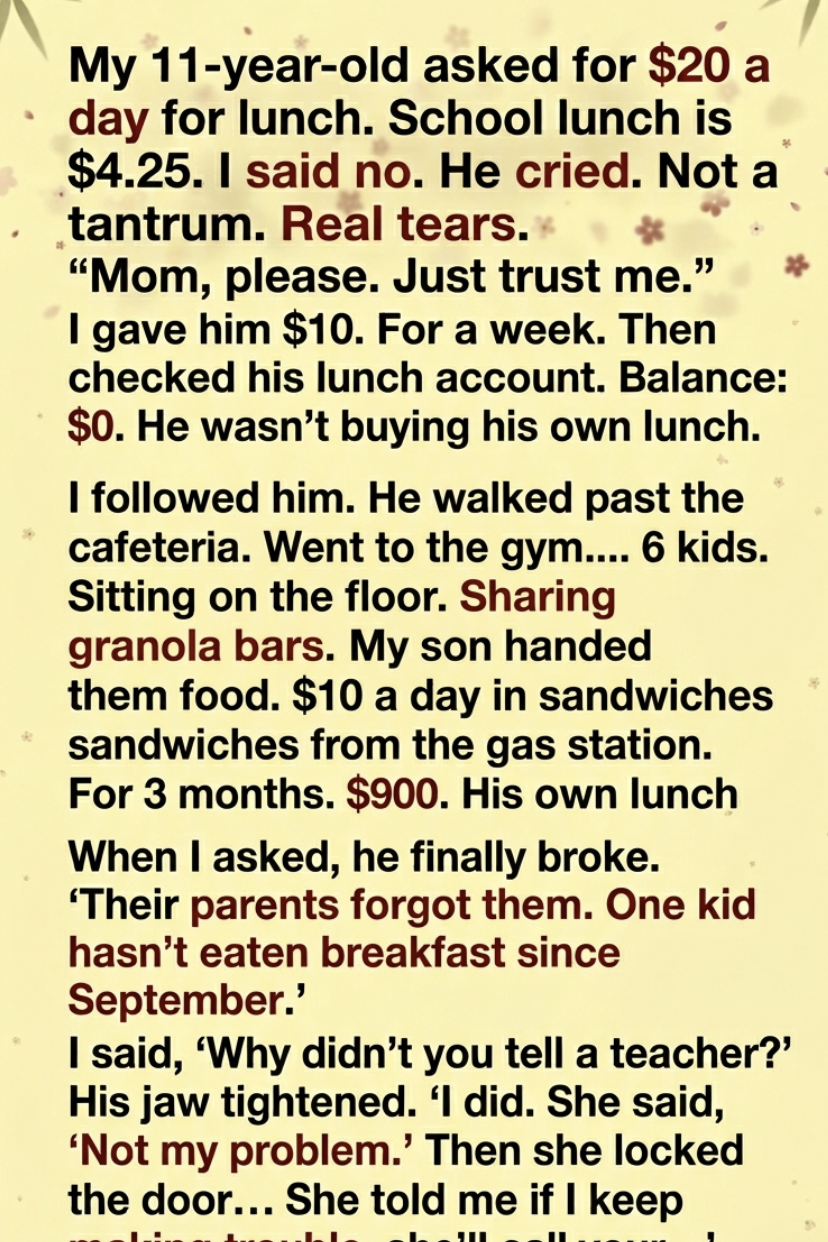
My 11-year-old asked me for $20 a day for lunch.
School lunch cost $4.25.
Naturally, I said no.
He looked devastated.
Not angry.
Not spoiled.
Devastated.
Real tears filled his eyes.
“Mom, please.”
His voice cracked.
“Just trust me.”
Something about the way he said it made me hesitate.
I still didn’t give him twenty.
But I agreed to ten dollars a day.
For one week.
Then I planned to figure out what was going on.
A few days later, I checked his lunch account online.
Balance: $0.
No purchases.
No lunches.
Nothing.
I frowned.
If he wasn’t buying lunch, where was the money going?
The following Tuesday, I took a long lunch break from work.
Parked near the school.
And watched.
The bell rang.
Kids flooded toward the cafeteria.
My son didn’t.
Instead, he walked down a side hallway toward the gym.
Curious, I followed from a distance.
Then I looked through the small window in the gym door.
And my heart shattered.
Six children sat on the floor.
Sharing food.
My son pulled sandwiches from a plastic bag.
Chips.
Granola bars.
Fruit.
One little girl practically inhaled her sandwich.
Another boy carefully wrapped half of his food in a napkin to save for later.
I sat frozen.
Watching.
For nearly ten minutes.
That night, I asked him directly.
“Who are those kids?”
His eyes immediately filled with tears.
Then everything came out.
For three months, he’d been using his lunch money to buy food from a nearby gas station every morning.
Ten dollars a day.
About nine hundred dollars total.
Every penny went to those six kids.
“Why?”
His answer nearly broke me.
“Their parents forgot them.”
Then he quietly added:
“One kid hasn’t eaten breakfast since September.”
I sat beside him.
Trying not to cry.
“Why didn’t you tell a teacher?”
His expression changed instantly.
His jaw tightened.
“I did.”
The room went silent.
“What happened?”
He stared at the floor.
Then whispered:
“She said it wasn’t her problem.”
I felt sick.
But he wasn’t finished.
“Then she locked the gym door.”
I blinked.
“What?”
He nodded.
“She said if I kept making trouble, she’d call your employer and tell them you’re raising a disruptive child.”
For several seconds I couldn’t speak.
Then I asked the question every parent asks when they desperately hope there’s been a misunderstanding.
“Are you sure?”
He stood up.
Walked to his backpack.
And pulled out his phone.
The school allowed students to carry them but keep them off during class.
Apparently the day he’d spoken to the teacher, he’d recorded the conversation.
Not intentionally.
He’d been recording a science project presentation.
The recording continued afterward.
I listened.
Every word.
Every terrible word.
The teacher’s voice was unmistakable.
“It isn’t my responsibility.”
Then:
“Stop causing problems.”
Then:
“If you keep this up, I’ll make one phone call and your mother will hear about it.”
My hands shook with anger.
The next morning, I went to the school.
Not alone.
I brought copies of the recording.
The principal listened.
His expression grew darker with every second.
By the end, he looked physically ill.
Then came the surprise.
The principal already knew something was wrong.
Several parents had complained about the same teacher.
Children returning home hungry.
Requests for assistance ignored.
But nobody had proof.
Until now.
An internal investigation started immediately.
Within two weeks, the teacher was placed on administrative leave.
Three weeks later, she resigned.
But that wasn’t the end of the story.
Because the investigation uncovered something even bigger.
Those six children weren’t isolated cases.
There were nineteen students at the school experiencing food insecurity.
Nineteen.
And most staff members had no idea.
The district responded quickly.
A community food program was created.
Local businesses donated supplies.
Teachers volunteered.
Parents stepped forward.
Within two months, every child in need had access to breakfast and lunch.
No questions asked.
No paperwork delays.
No shame.
One afternoon, the principal called me.
He asked if my son could attend the next school board meeting.
I assumed he was in trouble.
Instead, when we arrived, everyone stood up.
And applauded.
My son looked horrified.
Eleven-year-old boys generally hate public attention.
Then the superintendent spoke.
She called him courageous.
Compassionate.
A leader.
My son just stared at his shoes.
Afterward, one of the little boys from the gym approached him.
Quietly handed him a folded note.
Inside were seven words.
“Thank you for feeding me, Jacob.”
My son still keeps that note in his desk drawer.
Years later, people ask me how I knew I was raising a good kid.
The truth is, I didn’t.
Parents never really know.
You hope.
You try.
You do your best.
But that day, standing outside the gym window, watching my son hand out sandwiches while thinking nobody was looking…
I got my answer.
Because character isn’t revealed when people are being watched.
It’s revealed when nobody notices.
And at eleven years old, my son saw hungry children and decided their problem was his problem.
That’s a lesson far too many adults never learn.