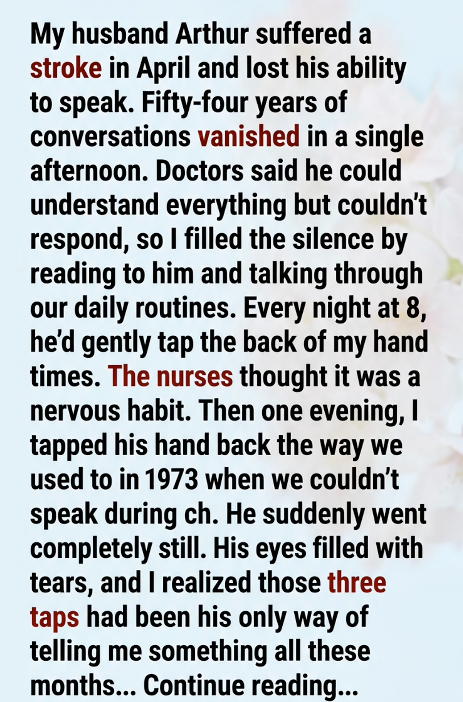
My husband Arthur suffered a stroke in April.
One moment, we were talking about dinner.
The next, he couldn’t speak.
The doctors explained that he could understand everything around him, but his ability to produce speech had been severely affected.
Fifty-four years of conversations vanished in a single afternoon.
For the first few weeks, I cried constantly.
Arthur couldn’t say my name.
Couldn’t tell me when he was uncomfortable.
Couldn’t tell me what he wanted.
So I filled the silence.
I read to him.
I talked about the weather.
I told him what our grandchildren were doing.
I narrated every little thing I did.
And every night at exactly **8 p.m.**, something strange happened.
Arthur would reach for my hand.
Then gently tap the back of it **three times**.
Tap.
Tap.
Tap.
Every night.
The nurses noticed it too.
They assumed it was a nervous habit.
I did too.
Until one evening, I suddenly remembered something.
Something from **1973**.
—
We had only been married for a few years then.
Every Sunday, we’d sit in the same pew at church.
Arthur was mischievous even back then.
Sometimes we’d sit beside each other without speaking because we were supposed to be listening.
So we’d communicate secretly.
Three little taps on the back of my hand meant:
**”I love you.”**
It was our private language.
We hadn’t used it in decades.
I’d completely forgotten.
Until that night.
Arthur tapped my hand three times.
I stared at his fingers.
Then, almost without thinking, I tapped back.
Three times.
Tap.
Tap.
Tap.
Arthur suddenly went completely still.
His eyes widened.
Then filled with tears.
I froze.
“Arthur?”
He looked directly at me.
And for the first time since his stroke, I understood:
Those taps hadn’t been a nervous habit.
He had been trying to talk to me.
—
I squeezed his hand.
“Are you telling me you remember?”
Three taps.
I started crying.
“You remember our church?”
Three taps.
“You remember 1973?”
Three taps.
He began crying too.
I realized he’d been using the only language he could still control.
Ours.
I pulled out a notebook.
I wrote:
**”Three taps = yes.”**
He tapped three times.
I wrote:
**”One tap = no?”**
He tapped once.
I stared at him.
Then suddenly the entire world felt different.
For months, everyone had been speaking for him.
Now he could finally answer.
—
We spent the next hour building a simple system.
One tap meant no.
Three taps meant yes.
Two taps meant “I don’t know.”
Then I asked:
“Have you been trying to tell me something important?”
He stared at me.
Then tapped three times.
My heart started pounding.
“What?”
He couldn’t speak.
So I started asking questions.
“Are you in pain?”
One tap.
“Are you afraid?”
One tap.
“Are you unhappy here?”
One tap.
“Then what are you trying to tell me?”
Three taps.
I thought for a moment.
Then asked:
“Is it about our family?”
Three taps.
—
I began naming people.
“David?”
One tap.
“Sarah?”
One tap.
“Emily?”
One tap.
“Arthur?”
Three taps.
I looked at him.
“Is it about you?”
Three taps.
I wrote:
**”Is there something you need me to know?”**
Three taps.
My hands began shaking.
“What?”
He looked toward the bedside drawer.
Then tapped twice.
I opened it.
Inside was his old wallet.
I handed it to him.
He pointed toward a small photograph.
It was a faded picture from 1973.
Our wedding reception.
But there was something written on the back.
I turned it over.
A name.
**”Eleanor.”**
I had never seen it before.
—
I looked at Arthur.
“Who is Eleanor?”
He tapped three times.
I felt my stomach tighten.
“Someone you knew before me?”
Three taps.
“Someone from church?”
Three taps.
“Someone important?”
Three taps.
I looked at the photograph again.
There was a woman standing in the background.
I hadn’t noticed her before.
She was holding a baby.
I stared at Arthur.
“Is that her?”
Three taps.
“And is the baby…”
I couldn’t finish the question.
Three taps.
—
I suddenly remembered a story Arthur had told me early in our marriage.
His younger sister had supposedly died as an infant.
The family never talked about it.
There had never been a grave we visited.
No photographs.
No explanations.
I had always assumed it was simply a painful family memory.
I looked at the photograph again.
The woman holding the baby looked like Arthur’s mother.
The baby was tiny.
And on the back of the photograph, beneath Eleanor’s name, someone had written a date.
**June 1973.**
Three months before our wedding.
—
I asked:
“Is Eleanor your sister?”
Three taps.
I couldn’t breathe.
“She’s alive?”
Three taps.
“Where?”
Arthur tapped once.
Then pointed toward the hospital window.
I didn’t understand.
He pointed again.
Then toward the nurses’ station.
I suddenly realized.
His sister had been admitted to the same hospital years ago.
But why?
I asked the nurse whether the name Eleanor appeared in any old records.
The nurse looked confused.
Then checked the hospital’s archived patient database.
Her expression changed.
There was a woman named Eleanor who had been treated there decades earlier.
And she was still alive.
—
She was living only a few miles away.
Arthur had apparently known for years.
His sister had suffered a serious illness as a young woman.
The family had believed she had died.
But she had survived.
Circumstances separated them.
Arthur found her again decades later.
They reconnected secretly.
He had promised her he would tell the family eventually.
But he never did.
I looked at him.
“Why didn’t you tell me?”
He gave three taps.
I waited.
Then he tapped once.
No.
He didn’t know how.
—
I asked:
“Did Eleanor know you had a wife?”
Three taps.
“Did she know about our children?”
Three taps.
“Did she want to meet us?”
Three taps.
Then he looked at me with tears in his eyes.
I understood.
She wanted to reconnect.
Arthur had been trying to tell me for months.
But he couldn’t speak.
The three taps had been his only way of saying:
**”I remember.”**
**”She’s real.”**
**”Please help me.”**
—
I found Eleanor.
She cried when I told her Arthur had suffered a stroke.
She came to the hospital the next morning.
The moment Arthur saw her, his entire face changed.
She walked to his bed.
“Arthur?”
He couldn’t speak.
But he tapped her hand three times.
She immediately began crying.
“I remember,” she whispered.
He tapped three times again.
I stood beside them.
Fifty-four years of marriage had taught me hundreds of things about my husband.
But in that moment, I learned something I had somehow missed:
When he lost his voice, he hadn’t lost his way of loving us.
—
Eleanor told me why she’d remained hidden for so many years.
She hadn’t wanted to disrupt Arthur’s life.
She believed the family had moved on without her.
Arthur had found her decades later.
But he was afraid that bringing her into the family would reopen old wounds.
So they stayed in contact quietly.
He visited her.
Called her.
Sent photographs.
And every year, on the anniversary of their mother’s death, they exchanged letters.
Arthur had never told me because he thought he was protecting everyone.
—
I was hurt.
But not angry.
I understood why he’d been afraid.
And I understood something else.
The three taps hadn’t started after his stroke.
They had existed long before I remembered them.
They were a language born in a church pew in 1973.
And fifty years later, that same language had returned to rescue him when words failed.
—
Arthur is still recovering.
He still can’t speak normally.
But every night at 8 p.m., I take his hand.
I tap three times.
He taps three times back.
Sometimes that’s our entire conversation.
Sometimes we use the notebook.
Sometimes we simply sit together.
But now I listen differently.
I don’t assume silence means there’s nothing to say.
Because the night I tapped his hand the way we did in 1973, Arthur’s eyes filled with tears.
And I finally understood what he’d been telling me all those months.
The three taps weren’t a nervous habit.
They weren’t random.
They were his voice.
His way of saying:
**”I’m still here.”**
**”I remember you.”**
And most importantly:
**”Please don’t stop listening.”**