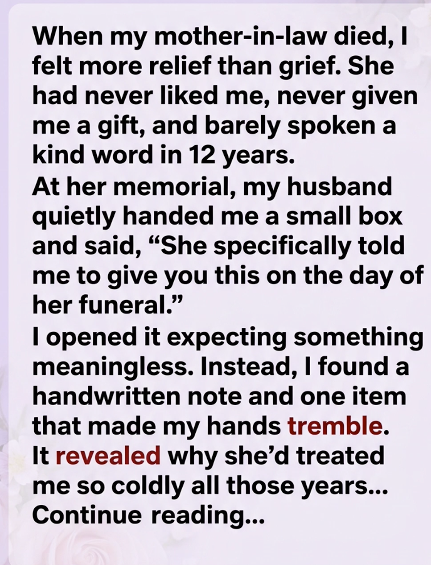
When my mother-in-law died, I felt something I was ashamed to admit.
Relief.
Not grief.
Relief.
For **12 years**, she’d barely spoken a kind word to me.
She never liked me.
Never gave me a birthday gift.
Never invited me to family outings.
Even at Christmas, she’d hand presents to everyone except me.
My husband always told me:
“That’s just how she is.”
I tried to believe him.
But after years of being treated like an outsider, I’d stopped trying to win her approval.
So when she died, I attended the funeral because she was my husband’s mother.
I didn’t expect to feel much.
Then, after the memorial service, my husband quietly approached me.
He was holding a small wooden box.
“Mom specifically told me to give you this.”
I stared at it.
“When?”
“She wrote the instructions months ago.”
I frowned.
“Why?”
He shook his head.
“I don’t know.”
The box was heavier than it looked.
I opened it.
Inside was a handwritten note.
And one small object.
The moment I saw it, my hands began to tremble.
It was a **silver locket**.
I recognized it immediately.
I’d seen it in an old family photograph.
It had belonged to my husband’s father.
The man who had died before I ever met the family.
I looked at my husband.
“Why would she give me this?”
He didn’t know.
I opened the note.
The first sentence made my stomach tighten:
**”I owe you an explanation for the way I’ve treated you.”**
—
I sat down.
The letter continued.
*”For 12 years, you probably believed I hated you.”*
*”The truth is, I was afraid of you.”*
I stared at those words.
Afraid?
Of me?
Then she explained.
Before my husband and I married, his father had left behind a secret.
A second family.
Not another wife.
Another child.
A daughter.
My mother-in-law had spent years trying to find her.
She believed the daughter had been taken away when she was a baby.
But she had never been able to locate her.
Then, shortly before my husband and I met, she found an old photograph.
The woman in the photograph looked exactly like me.
—
I stopped reading.
“That’s impossible.”
My husband looked confused.
“What?”
I handed him the letter.
He read it.
Then looked at me.
“Mom never told me any of this.”
I kept reading.
The letter said:
*”When my son brought you home, I recognized your eyes.”*
*”I thought you were her daughter.”*
*”I didn’t know whether you were related to my family.”*
*”So I kept my distance.”*
I stared at the locket.
Inside was a tiny photograph.
A young woman.
The same eyes.
The same smile.
My face.
But the woman wasn’t me.
—
The letter continued:
*”I treated you coldly because I was afraid to ask the question I most needed answered.”*
*”What if you were connected to her?”*
*”What if my family secret had followed me into my son’s marriage?”*
I couldn’t breathe.
Then came the part that changed everything.
She had secretly hired a genealogist.
The results showed that I was biologically connected to the missing woman.
Not as her daughter.
As her **niece**.
I stared at my husband.
“Your father was my mother’s brother?”
He looked stunned.
“No.”
He read the next paragraph.
Then whispered:
“Your mother was his sister.”
I froze.
—
Suddenly, everything made sense.
My mother had always been vague about her side of the family.
She rarely talked about her older brother.
I’d been told he had died young.
But apparently, he’d been estranged from the family for decades.
My mother-in-law had believed that after his death, his daughter disappeared.
She had spent years searching for her.
She finally discovered that the girl had grown up under a different surname.
And that girl had eventually become my mother.
I was the granddaughter of the family member my mother-in-law had been desperately trying to find.
—
I looked at my husband.
“She knew this?”
He nodded slowly.
“Apparently.”
“And that’s why she hated me?”
“No.”
The letter answered him.
She hadn’t hated me.
She’d been terrified.
She wrote:
*”You reminded me of the daughter I never found.”*
*”Every time I looked at you, I wondered whether I was staring at a piece of the family I had lost.”*
*”And I was angry because I thought fate was mocking me.”*
*”So I pushed you away.”*
My eyes filled with tears.
—
Then I found the final page.
It explained the locket.
My mother-in-law had discovered the locket among her husband’s belongings.
Inside was a photograph of the missing daughter as a child.
On the back was a date.
And a name.
That name belonged to my mother.
My mother-in-law had finally realized the truth:
Her husband’s missing niece had grown up.
She had married.
Had a daughter.
And that daughter was me.
—
But there was another surprise.
The letter said:
*”I spent years trying to find the girl I thought I’d lost forever.”*
*”Then you walked into my house.”*
*”I couldn’t bring myself to tell you because I was ashamed of how I had treated you.”*
*”I wondered whether you would believe me.”*
Then came the sentence that broke my heart:
**”You were never the woman I wanted to keep away from my son.”**
**”You were the family I had spent my life trying to find.”**
—
I started crying.
My husband sat beside me.
“I had no idea.”
I shook my head.
“Neither did I.”
Then he looked at the locket.
“Why didn’t Mom tell us while she was alive?”
I read the final lines.
She had been planning to tell us.
She had prepared the box.
The letter.
The genealogy report.
The photograph.
But she had become ill before she found the courage.
So she gave my husband one instruction:
**”Give this to her at my funeral.”**
—
The next morning, I called my mother.
I asked her about her uncle.
She became silent.
Then started crying.
“How did you find out?”
I told her everything.
She finally admitted the truth.
Her father had been separated from his family after a bitter dispute.
His younger brother had tried to reconnect several times.
But pride kept them apart.
By the time my mother learned the full story, it was too late.
The family had already scattered.
—
I looked at the silver locket again.
For 12 years, I’d believed my mother-in-law had treated me coldly because she thought I wasn’t good enough for her son.
The truth was more complicated.
She had spent years staring at someone who reminded her of a family member she’d lost.
She didn’t know how to handle the grief.
So she turned it into distance.
It wasn’t fair.
It still hurt.
But at least, finally, I understood.
—
A few months later, my husband and I visited my mother-in-law’s grave.
I brought the locket.
I placed my hand over it.
Then whispered:
“You should have told me.”
The wind moved through the trees.
“I might have understood.”
I paused.
“But I’m glad you finally tried.”
—
I still wear the locket.
Not because it excuses how my mother-in-law treated me.
It doesn’t.
Twelve years of coldness leave scars.
But it reminds me that people sometimes hide the deepest things behind the behavior we find hardest to understand.
At her funeral, my husband handed me a small box.
Inside was a note and the silver locket that had belonged to his father.
I expected something meaningless.
Instead, I discovered that my mother-in-law hadn’t spent 12 years hating me.
She had spent 12 years wondering whether I was the missing piece of the family she had been searching for.
And her final confession changed the way I remembered every cold glance, every ignored birthday, and every silent Christmas.
The last line of her letter said:
**”I’m sorry I made you feel unwanted when, all along, I was terrified that I had finally found the family I thought I had lost.”**